

Use Free Databricks-Certified-Data-Analyst-Associate Exam Questions that Stimulates Actual EXAM
Get 100% Real Databricks-Certified-Data-Analyst-Associate Free Online Practice Test
Databricks Databricks-Certified-Data-Analyst-Associate Exam Syllabus Topics:
| Topic | Details |
|---|---|
| Topic 1 |
|
| Topic 2 |
|
| Topic 3 |
|
| Topic 4 |
|
| Topic 5 |
|
| Topic 6 |
|
| Topic 7 |
|
NEW QUESTION # 10
In which of the following situations should a data analyst use higher-order functions?
- A. When built-in functions need to run through the Catalyst Optimizer
- B. When custom logic needs to be converted to Python-native code
- C. When custom logic needs to be applied to simple, unnested data
- D. When custom logic needs to be applied at scale to array data objects
- E. When built-in functions are taking too long to perform tasks
Answer: D
Explanation:
Higher-order functions are a simple extension to SQL to manipulate nested data such as arrays. A higher-order function takes an array, implements how the array is processed, and what the result of the computation will be. It delegates to a lambda function how to process each item in the array. This allows you to define functions that manipulate arrays in SQL, without having to unpack and repack them, use UDFs, or rely on limited built-in functions. Higher-order functions provide a performance benefit over user defined functions. Reference: Higher-order functions | Databricks on AWS, Working with Nested Data Using Higher Order Functions in SQL on Databricks | Databricks Blog, Higher-order functions - Azure Databricks | Microsoft Learn, Optimization recommendations on Databricks | Databricks on AWS
NEW QUESTION # 11
Which of the following statements describes descriptive statistics?
- A. A branch of statistics that uses a variety of data analysis techniques to infer properties of an underlying distribution of probability.
- B. A branch of statistics that uses quantitative variables that must take on an uncountable set of values.
- C. A branch of statistics that uses summary statistics to quantitatively describe and summarize data.
- D. A branch of statistics that uses summary statistics to categorically describe and summarize data.
- E. A branch of statistics that uses quantitative variables that must take on a finite or countably infinite set of values.
Answer: C
Explanation:
Descriptive statistics is a branch of statistics that uses summary statistics, such as mean, median, mode, standard deviation, range, frequency, or correlation, to quantitatively describe and summarize data. Descriptive statistics can help data analysts understand the main features of a data set, such as its central tendency, variability, or distribution. Descriptive statistics can also help data analysts visualize data using charts, graphs, or tables. Descriptive statistics do not make any inferences or predictions about the data, unlike inferential statistics, which use data analysis techniques to infer properties of an underlying population or probability distribution from a sample of data. Reference: Databricks - Descriptive Statistics, Databricks - Data Analysis with Databricks SQL
NEW QUESTION # 12
A data analyst has been asked to count the number of customers in each region and has written the following query:
If there is a mistake in the query, which of the following describes the mistake?
- A. The query is using ORDER BY. which is not allowed in an aggregation.
- B. The query is selecting region but region should only occur in the ORDER BY clause.
- C. The query is missing a GROUP BY region clause.
- D. There are no mistakes in the query.
- E. The query is using count('). which will count all the customers in the customers table, no matter the region.
Answer: C
Explanation:
In the provided SQL query, the data analyst is trying to count the number of customers in each region. However, they made a mistake by not including the "GROUP BY" clause to group the results by region. Without this clause, the query will not return counts for each distinct region but rather an error or incorrect result. Reference: The need for a GROUP BY clause in such queries can be understood from Databricks SQL documentation: Databricks SQL.
I also noticed that you uploaded an image with your question. The image shows a snippet of an SQL query written in plain text on a white background. The query is attempting to select regions and count customers from a "customers" table and order the results by region. There's no visible syntax highlighting or any other color - it's monochromatic. The query is the same as the one in your question. I'm not sure why you included the image, but maybe you wanted to show me the exact format of your query. If so, you can also use code blocks to display formatted content such as SQL queries. For example, you can write:
SELECT region, count(*) AS number_of_customers
FROM customers
ORDER BY region;
This way, you can avoid uploading images and make your questions more clear and concise. I hope this helps.
NEW QUESTION # 13
Which of the following statements about a refresh schedule is incorrect?
- A. Refresh schedules can be configured in the Query Editor.
- B. A query being refreshed on a schedule does not use a SQL Warehouse (formerly known as SQL Endpoint).
- C. A query can be refreshed anywhere from 1 minute lo 2 weeks
- D. A refresh schedule is not the same as an alert.
- E. You must have workspace administrator privileges to configure a refresh schedule
Answer: B
Explanation:
Refresh schedules are used to rerun queries at specified intervals, and these queries typically require computational resources to execute. In the context of a cloud data service like Databricks, this would typically involve the use of a SQL Warehouse (or a SQL Endpoint, as they were formerly known) to provide the necessary computational resources. Therefore, the statement is incorrect because scheduled query refreshes would indeed use a SQL Warehouse/Endpoint to execute the query.
NEW QUESTION # 14
Which of the following approaches can be used to ingest data directly from cloud-based object storage?
- A. It is not possible to directly ingest data from cloud-based object storage
- B. Create an external table while specifying the DBFS storage path to FROM
- C. Create an external table while specifying the object storage path to FROM
- D. Create an external table while specifying the object storage path to LOCATION
- E. Create an external table while specifying the DBFS storage path to PATH
Answer: D
Explanation:
External tables are tables that are defined in the Databricks metastore using the information stored in a cloud object storage location. External tables do not manage the data, but provide a schema and a table name to query the data. To create an external table, you can use the CREATE EXTERNAL TABLE statement and specify the object storage path to the LOCATION clause. For example, to create an external table named ext_table on a Parquet file stored in S3, you can use the following statement:
SQL
CREATE EXTERNAL TABLE ext_table (
col1 INT,
col2 STRING
)
STORED AS PARQUET
LOCATION 's3://bucket/path/file.parquet'
AI-generated code. Review and use carefully. More info on FAQ.
NEW QUESTION # 15
A data analyst has recently joined a new team that uses Databricks SQL, but the analyst has never used Databricks before. The analyst wants to know where in Databricks SQL they can write and execute SQL queries.
On which of the following pages can the analyst write and execute SQL queries?
- A. Data page
- B. Dashboards page
- C. Queries page
- D. SQL Editor page
- E. Alerts page
Answer: D
Explanation:
The SQL Editor page is where the analyst can write and execute SQL queries in Databricks SQL. The SQL Editor page has a query pane where the analyst can type or paste SQL statements, and a results pane where the analyst can view the query results in a table or a chart. The analyst can also browse data objects, edit multiple queries, execute a single query or multiple queries, terminate a query, save a query, download a query result, and more from the SQL Editor page. Reference: Create a query in SQL editor
NEW QUESTION # 16
Which of the following is an advantage of using a Delta Lake-based data lakehouse over common data lake solutions?
- A. Flexible schemas
- B. Open-source formats
- C. Data deletion
- D. Scalable storage
- E. ACID transactions
Answer: E
Explanation:
A Delta Lake-based data lakehouse is a data platform architecture that combines the scalability and flexibility of a data lake with the reliability and performance of a data warehouse. One of the key advantages of using a Delta Lake-based data lakehouse over common data lake solutions is that it supports ACID transactions, which ensure data integrity and consistency. ACID transactions enable concurrent reads and writes, schema enforcement and evolution, data versioning and rollback, and data quality checks. These features are not available in traditional data lakes, which rely on file-based storage systems that do not support transactions. Reference:
Delta Lake: Lakehouse, warehouse, advantages | Definition
Synapse - Data Lake vs. Delta Lake vs. Data Lakehouse
Data Lake vs. Delta Lake - A Detailed Comparison
Building a Data Lakehouse with Delta Lake Architecture: A Comprehensive Guide
NEW QUESTION # 17
An analyst writes a query that contains a query parameter. They then add an area chart visualization to the query. While adding the area chart visualization to a dashboard, the analyst chooses "Dashboard Parameter" for the query parameter associated with the area chart.
Which of the following statements is true?
- A. The area chart will use whatever is selected in the Dashboard Parameter while all or the other visualizations will remain changed regardless of their parameter use.
- B. The area chart will convert to a Dashboard Parameter.
- C. The area chart will use whatever is selected in the Dashboard Parameter along with all of the other visualizations in the dashboard that use the same parameter.
- D. The area chart will use whatever value is input by the analyst when the visualization is added to the dashboard. The parameter cannot be changed by the user afterwards.
- E. The area chart will use whatever value is chosen on the dashboard at the time the area chart is added to the dashboard.
Answer: C
Explanation:
A Dashboard Parameter is a parameter that is configured for one or more visualizations within a dashboard and appears at the top of the dashboard. The parameter values specified for a Dashboard Parameter apply to all visualizations reusing that particular Dashboard Parameter1. Therefore, if the analyst chooses "Dashboard Parameter" for the query parameter associated with the area chart, the area chart will use whatever is selected in the Dashboard Parameter along with all of the other visualizations in the dashboard that use the same parameter. This allows the user to filter the data across multiple visualizations using a single parameter widget2. Reference: Databricks SQL dashboards, Query parameters
NEW QUESTION # 18
A data analyst has been asked to produce a visualization that shows the flow of users through a website.
Which of the following is used for visualizing this type of flow?
- A. Sankey
- B. IChoropleth
- C. Word Cloud
- D. Heatmap
- E. Pivot Table
Answer: A
Explanation:
A Sankey diagram is a type of visualization that shows the flow of data between different nodes or categories. It is often used to represent the movement of users through a website, as it can show the paths they take, the sources they come from, the pages they visit, and the outcomes they achieve. A Sankey diagram consists of links and nodes, where the links represent the volume or weight of the flow, and the nodes represent the stages or steps of the flow. The width of the links is proportional to the amount of flow, and the color of the links can indicate different attributes or segments of the flow. A Sankey diagram can help identify the most common or popular user journeys, the bottlenecks or drop-offs in the flow, and the opportunities for improvement or optimization. Reference: The answer can be verified from Databricks documentation which provides examples and instructions on how to create Sankey diagrams using Databricks SQL Analytics and Databricks Visualizations. Reference links: Databricks SQL Analytics - Sankey Diagram, Databricks Visualizations - Sankey Diagram
NEW QUESTION # 19
In which of the following situations will the mean value and median value of variable be meaningfully different?
- A. When the variable contains no missing values
- B. When the variable is of the boolean type
- C. When the variable contains a lot of extreme outliers
- D. When the variable contains no outliers
- E. When the variable is of the categorical type
Answer: C
Explanation:
The mean value of a variable is the average of all the values in a data set, calculated by dividing the sum of the values by the number of values. The median value of a variable is the middle value of the ordered data set, or the average of the middle two values if the data set has an even number of values. The mean value is sensitive to outliers, which are values that are very different from the rest of the data. Outliers can skew the mean value and make it less representative of the central tendency of the data. The median value is more robust to outliers, as it only depends on the middle values of the data. Therefore, when the variable contains a lot of extreme outliers, the mean value and the median value will be meaningfully different, as the mean value will be pulled towards the outliers, while the median value will remain close to the majority of the data1. Reference: Difference Between Mean and Median in Statistics (With Example) - BYJU'S
NEW QUESTION # 20
Which of the following is a benefit of Databricks SQL using ANSI SQL as its standard SQL dialect?
- A. It is more performant than other SQL dialects
- B. It has increased customization capabilities
- C. It is easy to migrate existing SQL queries to Databricks SQL
- D. It allows for the use of Photon's computation optimizations
- E. It is more compatible with Spark's interpreters
Answer: C
Explanation:
Databricks SQL uses ANSI SQL as its standard SQL dialect, which means it follows the SQL specifications defined by the American National Standards Institute (ANSI). This makes it easier to migrate existing SQL queries from other data warehouses or platforms that also use ANSI SQL or a similar dialect, such as PostgreSQL, Oracle, or Teradata. By using ANSI SQL, Databricks SQL avoids surprises in behavior or unfamiliar syntax that may arise from using a non-standard SQL dialect, such as Spark SQL or Hive SQL12. Moreover, Databricks SQL also adds compatibility features to support common SQL constructs that are widely used in other data warehouses, such as QUALIFY, FILTER, and user-defined functions2. Reference: ANSI compliance in Databricks Runtime, Evolution of the SQL language at Databricks: ANSI standard by default and easier migrations from data warehouses
NEW QUESTION # 21
A data analyst has created a Query in Databricks SQL, and now they want to create two data visualizations from that Query and add both of those data visualizations to the same Databricks SQL Dashboard.
Which of the following steps will they need to take when creating and adding both data visualizations to the Databricks SQL Dashboard?
- A. They will need to alter the Query to return two separate sets of results.
- B. They will need to add two separate visualizations to the dashboard based on the same Query.
- C. They will need to copy the Query and create one data visualization per query.
- D. They will need to create two separate dashboards.
- E. They will need to decide on a single data visualization to add to the dashboard.
Answer: B
Explanation:
A data analyst can create multiple visualizations from the same query in Databricks SQL by clicking the + button next to the Results tab and selecting Visualization. Each visualization can have a different type, name, and configuration. To add a visualization to a dashboard, the data analyst can click the vertical ellipsis button beneath the visualization, select + Add to Dashboard, and choose an existing or new dashboard. The data analyst can repeat this process for each visualization they want to add to the same dashboard. Reference: Visualization in Databricks SQL, Visualize queries and create a dashboard in Databricks SQL
NEW QUESTION # 22
A business analyst has been asked to create a data entity/object called sales_by_employee. It should always stay up-to-date when new data are added to the sales table. The new entity should have the columns sales_person, which will be the name of the employee from the employees table, and sales, which will be all sales for that particular sales person. Both the sales table and the employees table have an employee_id column that is used to identify the sales person.
Which of the following code blocks will accomplish this task?
- A.

- B.

- C.
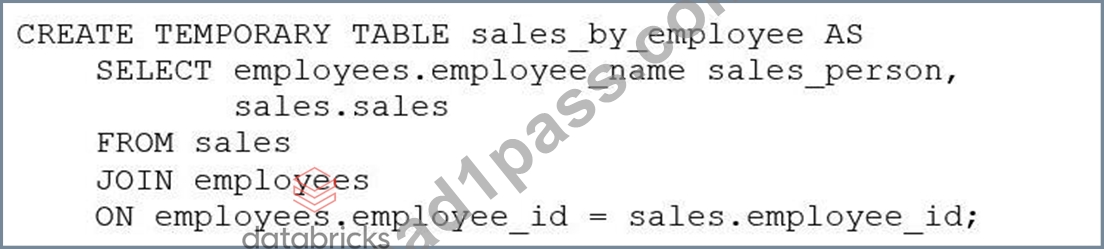
- D.

Answer: A
Explanation:
The SQL code provided in Option D is the correct way to create a view named sales_by_employee that will always stay up-to-date with the sales and employees tables. The code uses the CREATE OR REPLACE VIEW statement to define a new view that joins the sales and employees tables on the employee_id column. It selects the employee_name as sales_person and all sales for each employee, ensuring that the data entity/object is always up-to-date when new data are added to these tables.
NEW QUESTION # 23
A data analyst wants to create a dashboard with three main sections: Development, Testing, and Production. They want all three sections on the same dashboard, but they want to clearly designate the sections using text on the dashboard.
Which of the following tools can the data analyst use to designate the Development, Testing, and Production sections using text?
- A. Separate color palettes for each section
- B. Direct text written into the dashboard in editing mode
- C. Separate queries for each section
- D. Separate endpoints for each section
- E. Markdown-based text boxes
Answer: E
Explanation:
Markdown-based text boxes are useful as labels on a dashboard. They allow the data analyst to add text to a dashboard using the %md magic command in a notebook cell and then select the dashboard icon in the cell actions menu. The text can be formatted using markdown syntax and can include headings, lists, links, images, and more. The text boxes can be resized and moved around on the dashboard using the float layout option. Reference: Dashboards in notebooks, How to add text to a dashboard in Databricks
NEW QUESTION # 24
Delta Lake stores table data as a series of data files, but it also stores a lot of other information.
Which of the following is stored alongside data files when using Delta Lake?
- A. Table metadata
- B. Owner account information
- C. None of these
- D. Table metadata, data summary visualizations, and owner account information
- E. Data summary visualizations
Answer: A
Explanation:
Delta Lake stores table data as a series of data files in a specified location, but it also stores table metadata in a transaction log. The table metadata includes the schema, partitioning information, table properties, and other configuration details. The table metadata is stored alongside the data files and is updated atomically with every write operation. The table metadata can be accessed using the DESCRIBE DETAIL command or the DeltaTable class in Scala, Python, or Java. The table metadata can also be enriched with custom tags or user-defined commit messages using the TBLPROPERTIES or userMetadata options. Reference:
Enrich Delta Lake tables with custom metadata
Delta Lake Table metadata - Stack Overflow
Metadata - The Internals of Delta Lake
NEW QUESTION # 25
A data analyst has a managed table table_name in database database_name. They would now like to remove the table from the database and all of the data files associated with the table. The rest of the tables in the database must continue to exist.
Which of the following commands can the analyst use to complete the task without producing an error?
- A. DROP DATABASE database_name;
- B. DELETE TABLE table_name FROM database_name;
- C. DROP TABLE database_name.table_name;
- D. DELETE TABLE database_name.table_name;
- E. DROP TABLE table_name FROM database_name;
Answer: C
Explanation:
The DROP TABLE command removes a table from the metastore and deletes the associated data files. The syntax for this command is DROP TABLE [IF EXISTS] [database_name.]table_name;. The optional IF EXISTS clause prevents an error if the table does not exist. The optional database_name. prefix specifies the database where the table resides. If not specified, the current database is used. Therefore, the correct command to remove the table table_name from the database database_name and all of the data files associated with it is DROP TABLE database_name.table_name;. The other commands are either invalid syntax or would produce undesired results. Reference: Databricks - DROP TABLE
NEW QUESTION # 26
A data analyst creates a Databricks SQL Query where the result set has the following schema:
region STRING
number_of_customer INT
When the analyst clicks on the "Add visualization" button on the SQL Editor page, which of the following types of visualizations will be selected by default?
- A. IBar Chart
- B. Histogram
- C. There is no default. The user must choose a visualization type.
- D. Line Chart
- E. Violin Chart
Answer: A
Explanation:
According to the Databricks SQL documentation, when a data analyst clicks on the "Add visualization" button on the SQL Editor page, the default visualization type is Bar Chart. This is because the result set has two columns: one of type STRING and one of type INT. The Bar Chart visualization automatically assigns the STRING column to the X-axis and the INT column to the Y-axis. The Bar Chart visualization is suitable for showing the distribution of a numeric variable across different categories. Reference: Visualization in Databricks SQL, Visualization types
NEW QUESTION # 27
After running DESCRIBE EXTENDED accounts.customers;, the following was returned:
Now, a data analyst runs the following command:
DROP accounts.customers;
Which of the following describes the result of running this command?
- A. The accounts.customers table is removed from the metastore, and the underlying data files are deleted.
- B. The accounts.customers table is removed from the metastore, but the underlying data files are untouched.
- C. All files with the .customers extension are deleted.
- D. Running SELECT * FROM accounts.customers will return all rows in the table.
- E. Running SELECT * FROM delta. `dbfs:/stakeholders/customers` results in an error.
Answer: B
Explanation:
the accounts.customers table is an EXTERNAL table, which means that it is stored outside the default warehouse directory and is not managed by Databricks. Therefore, when you run the DROP command on this table, it only removes the metadata information from the metastore, but does not delete the actual data files from the file system. This means that you can still access the data using the location path (dbfs:/stakeholders/customers) or create another table pointing to the same location. However, if you try to query the table using its name (accounts.customers), you will get an error because the table no longer exists in the metastore. Reference: DROP TABLE | Databricks on AWS, Best practices for dropping a managed Delta Lake table - Databricks
NEW QUESTION # 28
A data analyst is attempting to drop a table my_table. The analyst wants to delete all table metadata and data.
They run the following command:
DROP TABLE IF EXISTS my_table;
While the object no longer appears when they run SHOW TABLES, the data files still exist.
Which of the following describes why the data files still exist and the metadata files were deleted?
- A. The table was external
- B. The table was managed
- C. The table's data was larger than 10 GB
- D. The table's data was smaller than 10 GB
- E. The table did not have a location
Answer: A
Explanation:
An external table is a table that is defined in the metastore, but its data is stored outside of the Databricks environment, such as in S3, ADLS, or GCS. When an external table is dropped, only the metadata is deleted from the metastore, but the data files are not affected. This is different from a managed table, which is a table whose data is stored in the Databricks environment, and whose data files are deleted when the table is dropped. To delete the data files of an external table, the analyst needs to specify the PURGE option in the DROP TABLE command, or manually delete the files from the storage system. Reference: DROP TABLE, Drop Delta table features, Best practices for dropping a managed Delta Lake table
NEW QUESTION # 29
......
BEST Verified Databricks Databricks-Certified-Data-Analyst-Associate Exam Questions (2024) : https://simplilearn.lead1pass.com/Databricks/Databricks-Certified-Data-Analyst-Associate-practice-exam-dumps.html