

Download HPE7-A01 Exam Dumps Questions to get 100% Success in HP
100% Accurate Answers! HPE7-A01 Actual Real Exam Questions
HP HPE7-A01 exam is a certification exam for individuals who are interested in becoming Aruba Certified Campus Access Professionals. Aruba Certified Campus Access Professional Exam certification is designed to validate the skills and knowledge required to configure and manage networks in a campus environment using Aruba products and technologies. HPE7-A01 exam focuses on topics such as network access control, mobility, and security.
NEW QUESTION # 45
You need to create a keepalive network between two Aruba CX 8325 switches for VSX configuration How should you establish the keepalive connection?
- A. loopback 0 and OSPF area 0 in default VRF
- B. SVI, VLAN trunk allowed all on ISL in default VRF
- C. SVI, VLAN trunk allowed all on ISL in custom VRF
- D. routed port in custom VRF
Answer: D
Explanation:
To establish a keepalive connection between two Aruba CX 8325 switches for VSX configuration, you need to use a routed port in custom VRF. A routed port is a physical port that acts as a layer 3 interface and does not belong to any VLAN. A custom VRF is a virtual routing and forwarding instance that provides logical separation of routing tables. By using a routed port in custom VRF, you can isolate the keepalive traffic from other traffic and prevent routing loops or conflicts. The other options are incorrect because they either do not use a routed port or do not use a custom VRF. References:
https://www.arubanetworks.com/techdocs/AOS-CX/10.04/HTML/5200-6728/bk01-ch07.htmlhttps://www.aruba
NEW QUESTION # 46
With the CX 6000 48G switch with uplinks of 1/1/47 and 1/1/48, what does the switch do when a client port detects a loop and tx-disable parameter is used?
- A. The port that transmitted the loop is disabled.
- B. The port that received the loop is disabled.
- C. The ports that confirmed the loop are disabled.
- D. The ports that transmitted and received the loop are disabled.
Answer: B
NEW QUESTION # 47
Your manufacturing client is having installers deploy seventy headless scanners and fifty IP cameras in their warehouse These new devices do not support 802 1X authentication.
How can HPE Aruba reduce the IT administration overhead associated with this deployment while maintaining a secure environment using MPSK?
- A. Use MPSK Local to automatically provide unique pre-shared keys for devices.
- B. MPSK Local will allow the cameras to share a key and the scanners to share a different key
- C. Have the MPSK gateway derive the unique pre-shared keys based on the MAC OUI.
- D. Have the installers generate keys with ClearPass Self Service Registration.
Answer: B
Explanation:
A). Have the installers generate keys with ClearPass Self Service Registration. - While this could theoretically work, it would require each installer to manually register each device. This can be cumbersome and time-consuming, especially given the number of devices in this scenario.
B). Have the MPSK gateway derive the unique pre-shared keys based on the MAC OUI. - This is not a typical feature of MPSK. MPSK can assign unique keys based on full MAC addresses, not just the MAC OUI (which only identifies the manufacturer and not individual devices).
C). Use MPSK Local to automatically provide unique pre-shared keys for devices. - MPSK Local can be set up to assign unique pre-shared keys based on MAC addresses, which would reduce administrative overhead. However, the "automatic" provision is somewhat misleading, as the keys and MAC addresses would still need to be predefined in the MPSK Local configuration.
D). MPSK Local will allow the cameras to share a key and the scanners to share a different key. - This is a valid use of MPSK. It would be less secure than giving each device its unique key (since all cameras would share one key and all scanners another), but it would reduce the administrative overhead considerably. This approach balances security and simplicity.
Given the primary goal of reducing IT administration overhead while still maintaining a relatively secure environment, the best answer would be:
D). MPSK Local will allow the cameras to share a key and the scanners to share a different key.
NEW QUESTION # 48
With the Aruba CX 6200 24G switch with uplinks or 1/1/25 and 1/1/26, how do you protect client ports from forming layer-2 loops?
- A. int 1/1/1-1/1/28. loop-guard
- B. int 1/1/1-1/1/24, loop-protect
- C. int 1/1/1-1/1/24. loop-guard
- D. int 1/1/1-1/1/28. loop-protect
Answer: B
Explanation:
The command loop-protect enables loop protection on each layer 2 interface (port, LAG, or VLAN) for which loop protection is needed. Loop protection can find loops in untagged layer 2 links, as well as on tagged VLANs.
NEW QUESTION # 49
What are the requirements to ensure that WMM is working effectively? (Select two)
- A. All APs need to be from the AP-5xx series and AP-6xx series which are Wi-Fi CERTIFIED 6.
- B. The Aruba AOS10 APs installed have to be converted to controlled mode
- C. The AP needs to be connected via a tagged VLAN to the wired port
- D. The Client must be Wi-Fi CERTIFIED for WMM and configured for WMM marking.
- E. The APs and the controller are Wi-Fi CERTIFIED for WMM which is enabled
Answer: D,E
Explanation:
These are the correct requirements to ensure that WMM (Wi-Fi Multimedia) is working effectively.
WMM is a standard that provides quality of service (QoS) for wireless networks by prioritizing traffic into four categories: voice, video, best effort, and background. To use WMM, both the APs and the controller must be Wi-Fi CERTIFIED for WMM, which means they have passed interoperability tests and comply with the standard. WMM must also be enabled on the APs and the controller, which is usually the default setting. The client device must also be Wi-Fi CERTIFIED for WMM and configured for WMM marking, which means it can tag its traffic with the appropriate priority level based on the application type. The other options are incorrect because they are either not related to WMM or not required for WMM to work.
NEW QUESTION # 50
Using Aruba best practices what should be enabled for visitor networks where encryption is needed but authentication is not required?
- A. Opportunistic Wireless Encryption
- B. Wi-Fi Protected Access 3 Enterprise
- C. Open Network Access
- D. Wired Equivalent Privacy
Answer: A
Explanation:
Opportunistic Wireless Encryption (OWE) is a feature that provides encryption for open wireless networks without requiring authentication. OWE uses an enhanced version of the 4-way handshake to establish a pairwise key between the client and the AP, which is then used to encrypt the wireless traffic using WPA2 or WPA3 protocols. OWE can be used for visitor networks where encryption is needed but authentication is not required.References:https://www.arubanetworks.com/assets/tg/TG_OWE.pdf
NEW QUESTION # 51
Match each PoE power class to Its corresponding 802.3 standard. (Options may he used more than once or not at all)
Answer:
Explanation:
* Class 3 (15.4W): 802.3af
* Class 4 (30W): 802.3at
* Class 6 (60W): 802.3bt
* Class 8 (90W): 802.3bt
NEW QUESTION # 52
When configuring UBT on a switch what will happen when a gateway role is not specified?
- A. The switch will put the client on the access VLAN
- B. The gateway will assign a default role to the client
- C. The switch will assign the default deny role to the client.
- D. The gateway will send back the deny role to the client.
Answer: A
Explanation:
According to the Aruba Documentation Portal1, user-based tunneling (UBT) is a feature that uses GRE to tunnel ingress traffic on a switch interface to a gateway for further processing. UBT enables a switch to provide a centralized security policy, using per-user authentication and access control to ensure consistent access and permissions.
Option A: The switch will put the client on the access VLAN
This is because option A shows how UBT works on an Aruba switch. When a device connects to the network, it is authenticated using either MAC Authentication or 802.1X and triggers an enforcement policy from ClearPass, which contains an enforcement profile with a user role configuration. The user role can be assigned locally on the switch or on ClearPass as part of an enforcement profile. The user role determines the VLAN that the device belongs to and the access policies that apply to it23.
Therefore, option A is correct.
1: https://www.arubanetworks.com/techdocs/central/latest/content/nms/aos-cx/cfg/conf-cx-ubt.htm
2: https://www.arubanetworks.com/techdocs/AOS-CX/10.06/HTML/5200-7696/GUID-581D2976-694B-46C7-8497-F6B788AA05B2.html
3: https://community.arubanetworks.com/viewdocument/?DocumentKey=c740df4e-3e26-4cc5-9126-355a18709c44&CommunityKey=2fd943a6-8898-4dbe-915f-4f09e4d3c317&tab=librarydocuments
NEW QUESTION # 53
Match each PoE power class to Its corresponding 802.3 standard. (Options may he used more than once or not at all)
Answer:
Explanation:
* Class 3 (15.4W): 802.3af
* Class 4 (30W): 802.3at
* Class 6 (60W): 802.3bt
* Class 8 (90W): 802.3bt
NEW QUESTION # 54
Match the terms below to their characteristics (Options may be used more than once or not at all.)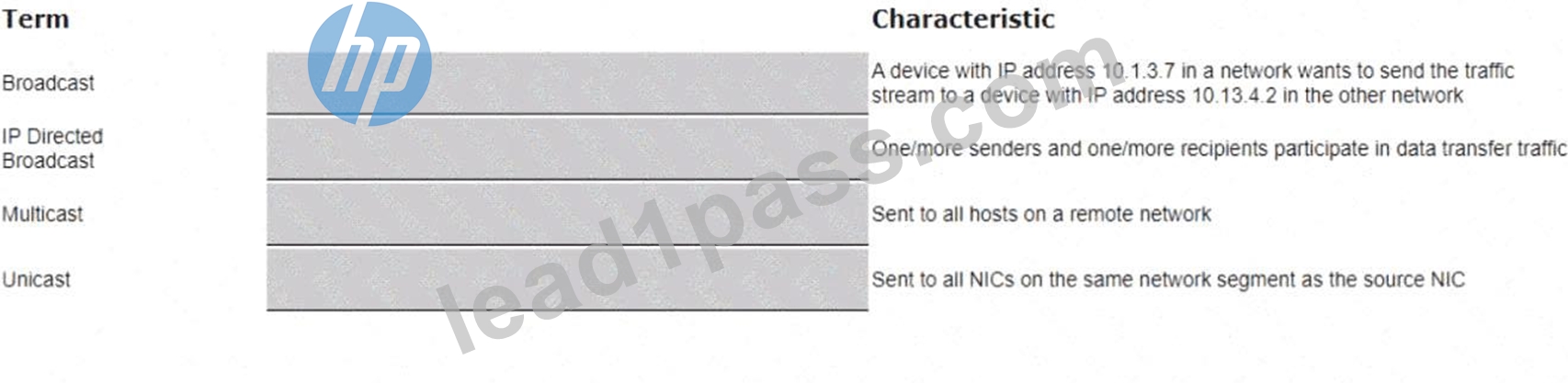
Answer:
Explanation: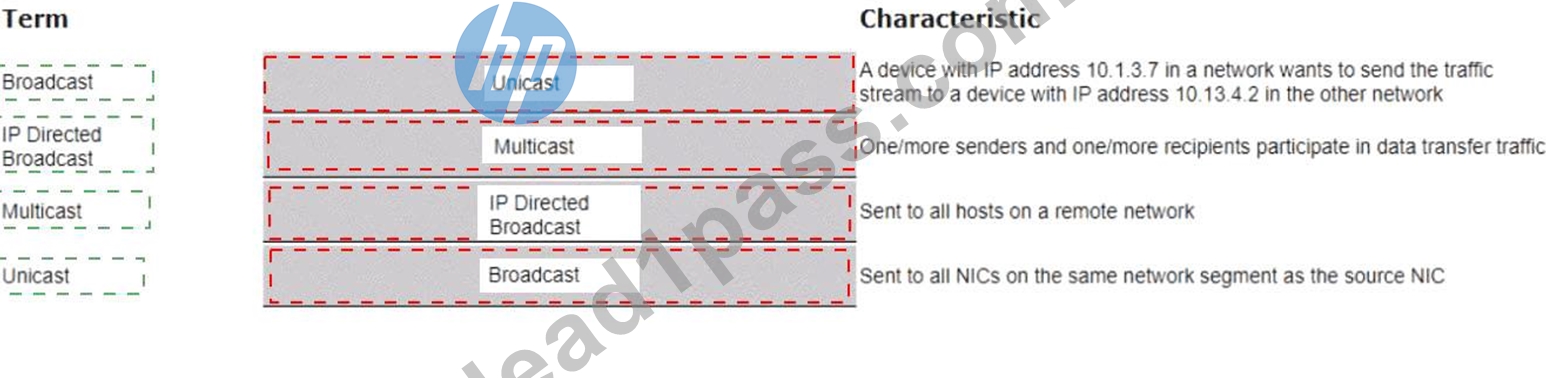
Explanation:
a) A device with IP address 10.1.3.7 in a network wants to send the traffic stream to a device with IP address
10.13.4.2 in the other network -> Unicast
b) One/more senders and one/more recipients participate in data transfer traffic -> Multicast c) Sent to all hosts on a remote network -> IP Directed Broadcast d) Sent to all NICs on the same network segment as the source NIC -> Broadcast References: 1 https://www.thestudygenius.com/unicast-broadcast-multicast/ The terms broadcast, IP directed broadcast, multicast, and unicast are different types of communication or data transmission over a network. They differ in how many devices are involved in the communication and how they address the messages. The following table summarizes the characteristics of each term1:
A screenshot of a computer Description automatically generated with medium confidence
NEW QUESTION # 55
You are deploying Aruba CX 6300's with the customers requirement to only allow one (1) VoIP phone and one (1) device.
The following local role gets assigned to the phone
port-access rote VoIP device-traffic-class voice
What set of commands best fits this requirement?
- A. interface 1/1/1
aaa authentication port-access client-limit 2
aaa authentication port-access auth-mode client-mode - B. interface 1/1/1
aaa authentication port-access client-limit 1
aaa authentication port-access auth-mode device-mode - C. interface 1/1/1
aaa authentication port-access client-limit multi-domain 2 aaa authentication port-access auth-mode multi-domain - D. interface 1/1/1
aaa authentication port-access auth-mode multi-domain
Answer: C
Explanation:
Aruba CX 6300 switches support various features to control the port access for different types of devices, such as client mode, device mode, and multidomain mode. These features can help limit the number of clients that can connect to a port and prevent unauthorized devices from accessing the network.
This is because option C shows how to configure the client limit and the auth-mode for a specific port using the interface command and the aaa authentication port-access command. The client limit specifies the maximum number of clients that can connect to a port. The auth-mode specifies the authentication mode for the port. In this case, option C sets both parameters to multi-domain mode, which allows only one voice device and one data device to be authenticated on a port
1. https://www.arubanetworks.com/techdocs/AOS-CX/10.10/HTML/monitoring_6300-6400/Content/Chp_LEDs/fro-pan-led-630.htm
2: https://www.arubanetworks.com/products/switches/6300-series/
3: https://www.arubanetworks.com/techdocs/AOS-CX/10.11/HTML/security_6200-6300-6400/Content/Chp_Port_acc/Port_acc_gen_cmds/aaa-aut-por-acc-aut-mod-fl-109.htm
NEW QUESTION # 56
A network administrator is troubleshooting some issues guest users are having when connecting and authenticating to the network The access switches are AOS-CX switches.
What command should the administrator use to examine information on which role the guest user has been assigned?
- A. show port-access role
- B. diag-dump captiveportal client verbose
- C. show port-access captiveportal profile
- D. show aaa authentication port-access interface all client-status
Answer: D
Explanation:
The show aaa authentication port-access interface all client-status command displays the status of all clients authenticated by port-based access control on all interfaces. The output includes the MAC address, user role, VLAN ID, and session timeout for each client. This command can be used to examine information on which role the guest user has been assigned by the AOS-CX switch. Reference: https://techhub.hpe.com/eginfolib/Aruba/OS-CX_10.04/5200-6692/GUID-9B8F6E8F-9C7A-4F0D-AE7B-9D8E6C5B6A7F.html
NEW QUESTION # 57
Match the appropriate QoS concept with its definition. (Options may be used more than once or not at all.)
Answer:
Explanation:
NEW QUESTION # 58
A company recently deployed new Aruba Access Points at different branch offices Wireless 802.1X authentication will be against a RADIUS server in the cloud. The security team is concerned that the traffic between the AP and the RADIUS server will be exposed.
What is the appropriate solution for this scenario?
- A. Enable EAP-TTLS on all wireless devices.
- B. Enable EAP-TLS on all wireless devices
- C. Configure RadSec on the AP and Aruba Central.
- D. Configure RadSec on the AP and the RADIUS server
Answer: D
Explanation:
This is the appropriate solution for this scenario where wireless 802.1X authentication will be against a RADIUS server in the cloud and the security team is concerned that the traffic between the AP and the RADIUS server will be exposed. RadSec, also known as RADIUS over TLS, is a protocol that provides encryption and authentication for RADIUS traffic over TCP and TLS. RadSec can be configured on both the AP and the RADIUS server to establish a secure tunnel for exchanging RADIUS packets. The other options are incorrect because they either do not provide encryption or authentication for RADIUS traffic or do not involve RadSec. Reference: https://www.securew2.com/blog/what-is-radsec/ https://www.cloudradius.com/radsec-vs-radius/
NEW QUESTION # 59
Which statements are true regarding a VXLAN implementation on Aruba Switches? (Select two.)
- A. VTEPs encapsulate and decapsulate VXLAN traffic
- B. VNIs encapsulate and decapsulate VXLAN traffic
- C. They are only available for datacenter switches (CX 8k, 9k,10k)
- D. MTU size must be increased beyond the default
- E. All Aruba CX switches support VXLAN.
Answer: A,D
Explanation:
Option A: MTU size must be increased beyond the default
This is because option A shows how to configure the MTU size for VXLAN tunnels on Aruba switches using the interface command and the vxlan command. The MTU size must be increased beyond the default value of 1500 bytes to accommodate the VXLAN header and payload2.
Therefore, option A is true regarding a VXLAN implementation on Aruba switches. Option B: VNIs encapsulate and decapsulate VXLAN traffic This is also true regarding a VXLAN implementation on Aruba switches. VNIs are used to encapsulate and decapsulate VXLAN traffic between two devices, such as a switch and a server. VNIs are also used to map VXLAN tunnels to overlay networks3.
Therefore, option B is also true regarding a VXLAN implementation on Aruba switches.
VXLAN is a Layer 2 encapsulation technology that substitutes the usage of VLAN numbers to label Ethernet broadcast domains with VXLAN numbers. VXLAN supports 224 Ethernet broadcast domains or VXLAN numbers. A VXLAN number ID is referred to as VNI. There is a one-to-one relationship between an Ethernet broadcast domain and a VNI. A single Ethernet broadcast domain can't have more than one VNI.
NEW QUESTION # 60
What is a primary benefit of BSS coloring?
- A. BSS color tags improve performance by allowing APS on the same channel to be farther apart
- B. BSS color tags are applied to WI-Fi channels and can reduce the threshold tor interference
- C. BSS color tags are applied on the wireless controllers and can reduce the threshold for interference_
- D. BSS color tags improve security by identifying rogue APS and tagging them as threats.
Answer: B
Explanation:
Explanation
The primary benefit of BSS coloring is D. BSS color tags are applied to Wi-Fi channels and can reduce the threshold for interference.
BSS coloring is a mechanism that allows Wi-Fi 6 devices to mark each frame with a color code that identifies the BSS (Basic Service Set) it belongs to. This helps differentiate between frames from different BSSs that share the same channel and avoid unnecessary collisions and backoffs. BSS coloring also introduces an adaptive threshold for interference, which means that Wi-Fi 6 devices can adjust the signal strength value that determines whether a channel is busy or not based on the current network environment. This allows for more efficient use of spectrum and higher throughput in dense scenarios12.
NEW QUESTION # 61
What is the best practice for handling voice traffic with dynamic segmentation on AOS-CX switches?
- A. Central authentication and port-based tunneling of the voice traffic.
- B. Controller authentication and port-based tunneling of all traffic
- C. Switch authentication and user-based tunneling of the voice traffic.
- D. Switch authentication and local forwarding of the voice traffic
Answer: D
Explanation:
This is the best practice for handling voice traffic with dynamic segmentation on AOS-CX switches. Dynamic segmentation is a feature that allows AOS-CX switches to tunnel user traffic to a controller or another switch based on user roles and policies. For voice traffic, it is recommended to use switch authentication and local forwarding, which means the voice devices are authenticated by the switch and their traffic is forwarded locally without tunneling. This reduces latency and jitter for voice traffic and improves voice quality. The other options are incorrect because they either use central authentication or tunneling, which are not optimal for voice traffic. References: https://www.arubanetworks.com/techdocs/AOS-CX/10.04/HTML/5200-6728
/bk01-ch05.html https://www.arubanetworks.com/assets/ds/DS_AOS-CX.pdf
NEW QUESTION # 62
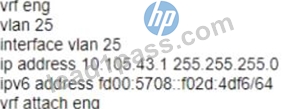
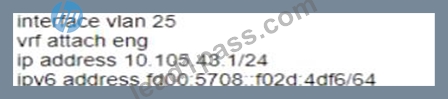
You are configuring an SVI on an Aruba CX switch that needs to have the following characteristics:
* VLANID = 25
. IPv4 address 10 105 43 1 with mask 255 255 255.0
* IPv6 address fd00:5708::f02d:4df6 with a 64 bit prefix length
* member of VRF eng
* VRF eng and VLAN 25 have not yet been created
Which command lists will satisfy the requirements with the least number of commands?
- A.
- B.
- C.
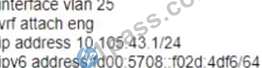
- D.
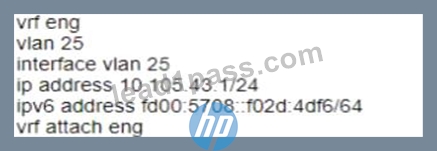
Answer: B
Explanation:
Explanation
This is the correct command list that will satisfy the requirements with the least number of commands. Option C contains four commands that will create VLAN 25, assign it to VRF eng, create an SVI for VLAN 25 with IPv4 and IPv6 addresses, and enable the SVI. The other options are incorrect because they either contain more commands than necessary or do not meet all the requirements. References:
https://www.arubanetworks.com/techdocs/AOS-CX/10.05/HTML/5200-7294/GUID-7D9E9F6E-5C2A-4F7E-BE
https://www.arubanetworks.com/techdocs/AOS-CX/10.05/HTML/5200-7294/GUID-99A8B276-0DA3-4458-AF
NEW QUESTION # 63
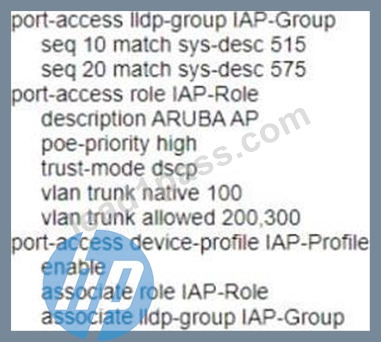
A system engineer needs to preconfigure several Aruba CX 6300 switches that will be sent to a remote office An untrained local field technician will do the rollout of the switches and the mounting of several AP-515s and AP-575S. Cables running to theAPs are not labeled.
The VLANs are already preconfigured to VLAN 100 (mgmt), VLAN 200 (clients), and VLAN 300 (guests).
What is the correct configuration to ensure that APs will work properly?
- A.
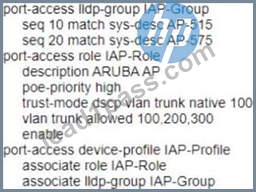
- B.
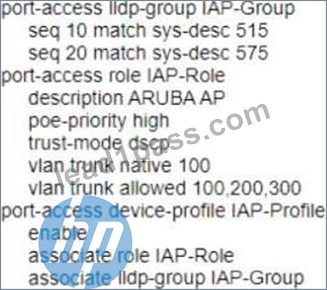
- C.
Answer: B
Explanation:
Option C is the correct configuration to ensure that APs will work properly. It uses the ap command to configure a port profile for APs with VLAN 100 as the native VLAN and VLAN 200 and 300 as tagged VLANs. It also enables LLDP on the ports to discover the APs and assign them to the port profile automatically. The other options are incorrect because they either do not use the ap command, do not enable LLDP, or do not configure the VLANs correctly.
References:
https://www.arubanetworks.com/techdocs/AOS-CX_10_08/UG/bk01-ch02.html
https://www.arubanetworks.com/techdocs/AOS-CX_10_08/UG/bk01-ch03.html
NEW QUESTION # 64
You need to have different routing-table requirements with Aruba CX 6300 VSF configuration Assuming the correct layer-2 VLAN already exists how would you create a new OSPF configuration for a separate routing table?
- A. Attach a new OSFP process ID with a custom routing table
- B. Create a new OSPF area, and attach VRF name.
- C. Attach OSPF process ID in the VRF configuration.
- D. Create a new OSPF process ID with vrf name.
Answer: D
Explanation:
To create a new OSPF configuration for a separate routing table, you need to create a new OSPF process ID with vrf name. This will create a new OSPF instance that is associated with the specified VRF and its routing table. The other options are incorrect because they either do not create a new OSPF instance or do not associate it with a VRF. References: https://www.arubanetworks.com/techdocs/AOS-CX/10.04/HTML/5200-
6728/bk01-ch02.html https://www.arubanetworks.com/techdocs/AOS-CX/10.04/HTML/5200-6728/bk01- ch03.html
NEW QUESTION # 65
A network administrator is attempting to troubleshoot a connectivity issue between a group of users and a particular server. The administrator needs to examine the packets over a period of time from their desktop; however, the administrator is not directly connected to the AOS-CX switch involved with the traffic flow.
What statements are correct regarding the ERSPAN session that needs to be established on an AOS-CX switch? (Select two)
- A. On the source AOS-CX switch, the destination specified is the administrators desktop
- B. The encapsulation protocol used is VXLAN.
- C. On the source AOS-CX switch, the destination specified is the switch to which the administrator's desktop is connected
- D. The encapsulation protocol used is GRE.
- E. The encapsulation protocol is UDP.
Answer: A,D
Explanation:
These are the correct statements regarding the ERSPAN session that needs to be established on an AOS-CX switch for a network administrator to examine the packets over a period of time from their desktop. ERSPAN (Encapsulated Remote Switched Port Analyzer) is a feature that allows an AOS-CX switch to mirror traffic from one or more source ports or VLANs to a remote destination IP address over a GRE (Generic Routing Encapsulation) tunnel. The destination IP address must be the IP address of the administrator's desktop, which must have a packet capture tool installed to receive and analyze the mirrored traffic. The encapsulation protocol used for ERSPAN is GRE, which adds a header to the mirrored packets with information such as source and destination IP addresses, session ID, etc. The other statements are incorrect because they either do not specify the correct destination IP address or do not use ERSPAN or GRE.
NEW QUESTION # 66
Match each PoE power class to Its corresponding 802.3 standard. (Options may he used more than once or not at all)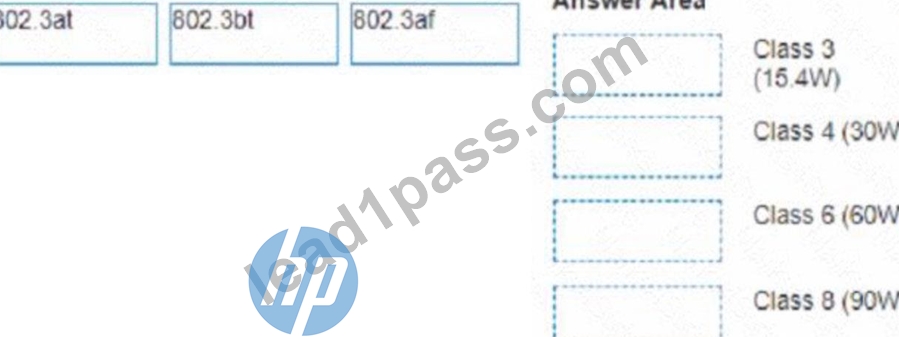
Answer:
Explanation: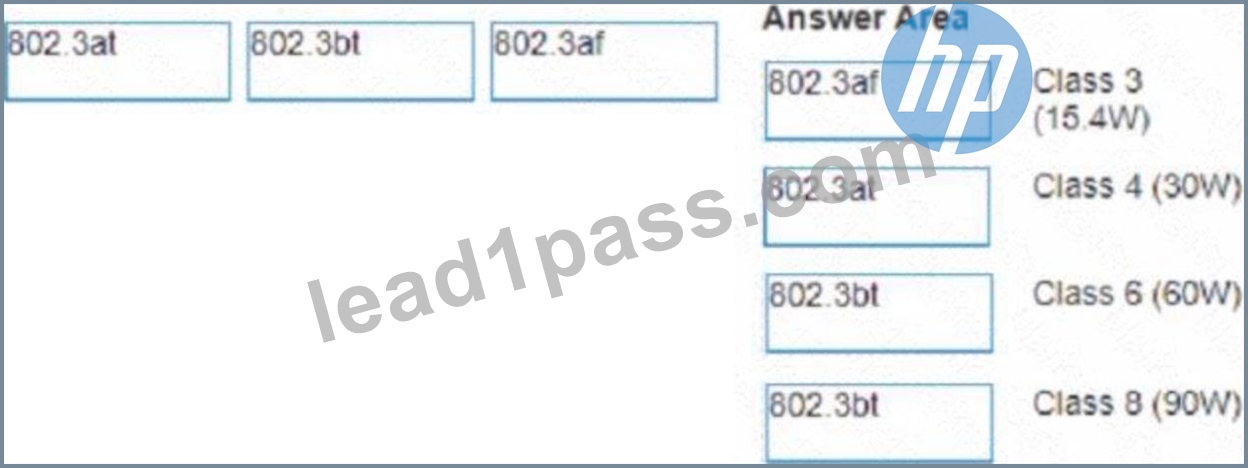
Explanation:
* Class 3 (15.4W): 802.3af
* Class 4 (30W): 802.3at
* Class 6 (60W): 802.3bt
* Class 8 (90W): 802.3bt
NEW QUESTION # 67
A customer is using a legacy application that communicates at layer-2. The customer would like to keep this application working across the campus which is connected via layer-3. The legacy devices are connected to Aruba CX 6300 switches throughout the campus.
Which technology minimizes flooding so the legacy application can work efficiently?
- A. EVPN-VXLAN
- B. Generic Routing Encapsulation (GRE)
- C. Ethernet over IP (EolP)
- D. Static VXLAN
Answer: A
Explanation:
Explanation
EVPN-VXLAN is a technology that allows layer-2 communication across layer-3 networks by using Ethernet VPN (EVPN) as a control plane and Virtual Extensible LAN (VXLAN) as a data plane3. EVPN-VXLAN can be used to support legacy applications that communicate at layer-2 across different campuses or data centers that are connected via layer-3. EVPN-VXLAN minimizes flooding by using BGP to distribute MAC addresses and IP addresses of hosts across different VXLAN segments3. EVPN-VXLAN also provides benefits such as loop prevention, load balancing, mobility, and scalability3. References: 3
https://www.arubanetworks.com/assets/tg/TG_EVPN_VXLAN.pdf
NEW QUESTION # 68
......
HP HPE7-A01 exam is a great way for IT professionals to showcase their skills and knowledge in Aruba wireless and wired networks. By passing HPE7-A01 exam, candidates can demonstrate to employers and clients that they have the expertise needed to design, deploy, and maintain Aruba networks in campus environments. Aruba Certified Campus Access Professional Exam certification can also lead to career advancement opportunities and higher salaries.
Best Value Available! Realistic Verified Free HPE7-A01 Exam Questions: https://simplilearn.lead1pass.com/HP/HPE7-A01-practice-exam-dumps.html