

2023 1z0-1084-22 exam torrent 1z0-1084-22 Study Guide
Easily pass 1z0-1084-22 Exam with our Dumps & PDF Test Engine
NEW QUESTION # 43
You encounter an unexpected error when invoking the Oracle Function named "myfunction" in application "myapp". Which can you use to get more information on the error?
- A. fn --verbose invoke myapp myfunction
- B. DEBOG=1 fn invoke myapp myfunction
- C. fn --debug invoke myapp myfunction
- D. Call Oracle support with your error message
Answer: B
Explanation:
Troubleshooting Oracle Functions
If you encounter an unexpected error when using an Fn Project CLI command, you can find out more about the problem by starting the command with the string DEBUG=1 and running the command again. For example:
$ DEBUG=1 fn invoke helloworld-app helloworld-func
Note that DEBUG=1 must appear before the command, and that DEBUG must be in upper case.
NEW QUESTION # 44
You want to push a new image in the Oracle Cloud Infrastructure (OCI) Registry. Which two actions do you need to perform?
- A. Generate an auth token to complete the authentication via Docker CLI.
- B. Assign a tag via Docker CLI to the image.
- C. Generate an OCI tag namespace in your repository.
- D. Generate an API signing key to complete the authentication via Docker CLI.
- E. Assign an OCI defined tag via OCI CLI to the image.
Answer: A,B
Explanation:
Pushing Images Using the Docker CLI:
You use the Docker CLI to push images to Oracle Cloud Infrastructure Registry.
To push an image, you first use the docker tag command to create a copy of the local source image as a new image (the new image is actually just a reference to the existing source image). As a name for the new image, you specify the fully qualified path to the target location in Oracle Cloud Registry where you want to push the image, optionally including the name of a repository.
For example, assume you have a local image named acme-web-app:latest. Let's say you want to push this image to Oracle Cloud Infrastructure Registry with a name of acme-web-app:version2.0.test into a repository called project01 in the Ashburn region of the acme-dev tenancy. When you use the docker tag command, you'd name the new image with the fully qualified path to its destination, in the format <region-key>.ocir.io/<tenancy-namespace>/<repo-name>/<image-name>:<tag>. So in this case, you'd name the new image iad.ocir.io/ansh81vru1zp/project01/acme-web-app:version2.0.test. Subsequently, when you use the docker push command, the image's name ensures it is pushed to the correct destination.
To push images to Oracle Cloud Infrastructure Registry using the Docker CLI:
If you already have an auth token, go to the next step. Otherwise:
On the Auth Tokens page, click Generate Token.
Enter a friendly description for the auth token. Avoid entering confidential information.
Click Generate Token. The new auth token is displayed.
Copy the auth token immediately to a secure location from where you can retrieve it later, because you won't see the auth token again in the Console.
Close the Generate Token dialog.
References:
https://docs.cloud.oracle.com/en-us/iaas/Content/Registry/Tasks/registrypushingimagesusingthedockercli.htm
NEW QUESTION # 45
You have written a Node.js function and deployed it to Oracle Functions. Next, you need to call this function from a microservice written in Java deployed on Oracle Cloud Infrastructure (OCI) Container Engine for Kubernetes (OKE).
Which can help you to achieve this?
- A. Use the OCI Java SDK to invoke the function from the microservice.
- B. Oracle Functions does not allow a microservice deployed on OKE to invoke a function.
- C. OKE does not allow a microservice to invoke a function from Oracle Functions.
- D. Use the OCI CLI with kubect1 to invoke the function from the microservice.
Answer: A
Explanation:
Invoking Functions
You can invoke a function that you've deployed to Oracle Functions in different ways:
1. Using the Fn Project CLI.
2. Using the Oracle Cloud Infrastructure CLI.
3. Using the Oracle Cloud Infrastructure SDKs.
4. Making a signed HTTP request to the function's invoke endpoint. Every function has an invoke endpoint.
Using the Fn Project CLI to Invoke Functions
To invoke a function deployed to Oracle Functions using the Fn Project CLI:
Log in to your development environment as a functions developer.
In a terminal window, enter:
$ fn invoke <app-name> <function-name>
Using SDKs to Invoke Functions:
If you're writing a program to invoke a function in a language for which an Oracle Cloud Infrastructure SDK exists, Oracle recommends you use that SDK to send API requests to invoke the function. Among other things, the SDK will facilitate Oracle Cloud Infrastructure authentication.
References:
https://docs.cloud.oracle.com/en-us/iaas/Content/Functions/Tasks/functionsinvokingfunctions.htm
NEW QUESTION # 46
Which is NOT a supported SDk Oracle Cloud Infrastructure (OCI)?
- A. Ruby SDK
- B. Java SDK
- C. NET SDK
- D. Python SDK
- E. Go SDK
Answer: C
Explanation:
https://docs.cloud.oracle.com/en-us/iaas/Content/API/Concepts/sdks.htm
Software Development Kits (SDKs) Build and deploy apps that integrate with Oracle Cloud Infrastructure services. Each SDK provides the tools you need to develop an app, including code samples and documentation to create, test, and troubleshoot. In addition, if you want to contribute to the development of the SDKs, they are all open source and available on GitHub.
SDK for Java
Python SDK
Ruby SDK
Go SDK
https://docs.cloud.oracle.com/en-us/iaas/Content/API/Concepts/sdkconfig.htm
NEW QUESTION # 47
You are developing a distributed application and you need a call to a path to always return a specific JSON content deploy an Oracle Cloud Infrastructure API Gateway with the below API deployment specification.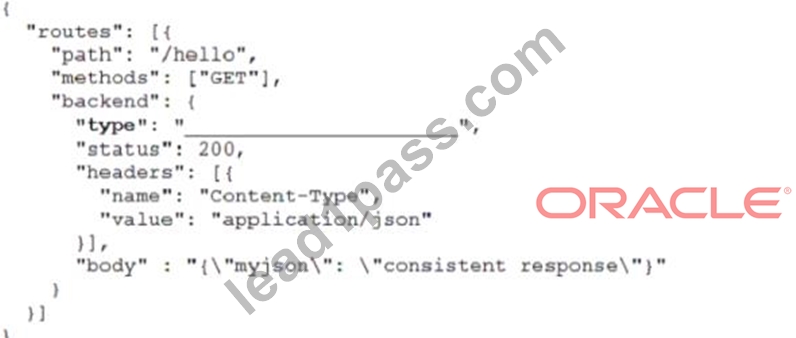
What is the correct value for type?
- A. HTTP_BACKEND
- B. JSON_BACKEND
- C. STOCK_RESPONSE_BACKEND
- D. CONSTANT_BACKEND
Answer: C
Explanation:
Adding Stock Responses as an API Gateway Back End:
You'll often want to verify that an API has been successfully deployed on an API gateway without having to set up an actual back-end service. One approach is to define a route in the API deployment specification that has a path to a 'dummy' back end. On receiving a request to that path, the API gateway itself acts as the back end and returns a stock response you've specified.
Equally, there are some situations in a production deployment where you'll want a particular path for a route to consistently return the same stock response without sending a request to a back end. For example, when you want a call to a path to always return a specific HTTP status code in the response.
Using the API Gateway service, you can define a path to a stock response back end that always returns the same:
HTTP status code
HTTP header fields (name-value pairs)
content in the body of the response
"type": "STOCK_RESPONSE_BACKEND" indicates that the API gateway itself will act as the back end and return the stock response you define (the status code, the header fields and the body content).
References:
https://docs.cloud.oracle.com/en-us/iaas/Content/APIGateway/Tasks/apigatewayaddingstockresponses.htm
NEW QUESTION # 48
You are developing a serverless application with Oracle Functions and Oracle Cloud Infrastructure Object Storage- Your function needs to read a JSON file object from an Object Storage bucket named "input-bucket" in compartment "qa-compartment". Your corporate security standards mandate the use of Resource Principals for this use case.
Which two statements are needed to implement this use case?
- A. Set up a policy to grant all functions read access to the bucket:
allow all functions in compartment qa-compartment to read objects in target.bucket.name='input-bucket' - B. Set up the following dynamic group for your function's OCID: Name: read-file-dg Rule: resource . id = ' ocid1. f nf unc. ocl -phx. aaaaaaaakeaobctakezj z5i4uj j 7g25q7sx5mvr55pms6f 4da !
- C. Set up a policy to grant your user account read access to the bucket:
allow user XYZ to read objects in compartment qa-compartment where target .bucket, name-'input-bucket' - D. Set up a policy with the following statement to grant read access to the bucket:
allow dynamic-group read-file-dg to read objects in compartment qa-compartment where target .bucket .name=' input-bucket * - E. No policies are needed. By default, every function has read access to Object Storage buckets in the tenancy
Answer: B,D
Explanation:
When a function you've deployed to Oracle Functions is running, it can access other Oracle Cloud Infrastructure resources. For example:
- You might want a function to get a list of VCNs from the Networking service.
- You might want a function to read data from an Object Storage bucket, perform some operation on the data, and then write the modified data back to the Object Storage bucket.
To enable a function to access another Oracle Cloud Infrastructure resource, you have to include the function in a dynamic group, and then create a policy to grant the dynamic group access to that resource.
https://docs.cloud.oracle.com/en-us/iaas/Content/Functions/Tasks/functionsaccessingociresources.htm
NEW QUESTION # 49
You are building a container image and pushing it to the Oracle Cloud Infrastructure Registry (OCIR). You need to make sure that these get deleted from the repository.
Which action should you take?
- A. Set global policy of image retention to "Retain All Images".
- B. In your compartment, write a policy to limit access to the specific repository.
- C. Edit the tenancy global retention policy.
- D. Create a group and assign a policy to perform lifecycle operations on images.
Answer: C
Explanation:
Deleting an Image
When you no longer need an old image or you simply want to clean up the list of image tags in a repository, you can delete images from Oracle Cloud Infrastructure Registry.
Your permissions control the images in Oracle Cloud Infrastructure Registry that you can delete. You can delete images from repositories you've created, and from repositories that the groups to which you belong have been granted access by identity policies. If you belong to the Administrators group, you can delete images from any repository in the tenancy.
Note that as well deleting individual images , you can set up image retention policies to delete images automatically based on selection criteria you specify (see Retaining and Deleting Images Using Retention Policies).
Note:
In each region in a tenancy, there's a global image retention policy. The global image retention policy's default selection criteria retain all images so that no images are automatically deleted. However, you can change the global image retention policy so that images are deleted if they meet the criteria you specify. A region's global image retention policy applies to all repositories in the region, unless it is explicitly overridden by one or more custom image retention policies.
You can set up custom image retention policies to override the global image retention policy with different criteria for specific repositories in a region. Having created a custom image retention policy, you apply the custom retention policy to a repository by adding the repository to the policy. The global image retention policy no longer applies to repositories that you add to a custom retention policy.
https://docs.cloud.oracle.com/en-us/iaas/Content/Registry/Tasks/registrymanagingimageretention.htm#:~:text=In%20each%20region%20in%20a,meet%20the%20criteria%20you%20specify.
NEW QUESTION # 50
Given a service deployed on Oracle Cloud infrastructure Container Engine for Kubernetes (OKE), which annotation should you add in the sample manifest file to specify a 400 Mbps load balancer?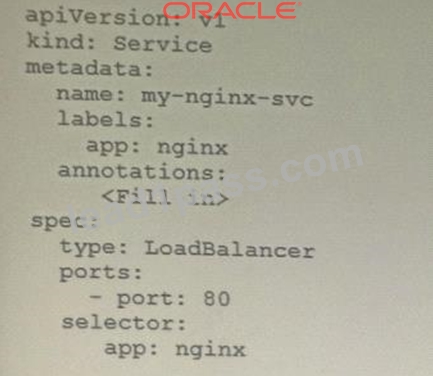
- A. service . beta. kubernetes . lo/oci-load-balancer-shape: 400Mbps
- B. service . beta . kubernetes . lo/oci-load-balancer-size: 400Mbps
- C. service, beta, kubernetes. lo/oci-load-balancer-value: 4 00Mbps
- D. service.beta, kubernetes. lo/oci-load-balancer-kind: 400Mbps
Answer: A
Explanation:
The shape of an Oracle Cloud Infrastructure load balancer specifies its maximum total bandwidth (that is, ingress plus egress). By default, load balancers are created with a shape of 100Mbps. Other shapes are available, including 400Mbps and 8000Mbps.
To specify an alternative shape for a load balancer, add the following annotation in the metadata section of the manifest file:
service.beta.kubernetes.io/oci-load-balancer-shape: <value>
where value is the bandwidth of the shape (for example, 100Mbps, 400Mbps, 8000Mbps).
For example:
apiVersion: v1
kind: Service
metadata:
name: my-nginx-svc
labels:
app: nginx
annotations:
service.beta.kubernetes.io/oci-load-balancer-shape: 400Mbps
spec:
type: LoadBalancer
ports:
- port: 80
selector:
app: nginx
https://github.com/oracle/oci-cloud-controller-manager/blob/master/docs/load-balancer-annotations.md
NEW QUESTION # 51
Which two handle Oracle Functions authentication automatically?
- A. Oracle Cloud Infrastructure CLl
- B. Fn Project CLI
- C. Oracle Cloud Infrastructure SDK
- D. Signed HTTP Request
- E. cURL
Answer: A,B
Explanation:
If you use the Fn Project CLI or the Oracle Cloud Infrastructure CLI to invoke a function, authentication is handled for you. See Using the Fn Project CLI to Invoke Functions and Using the Oracle Cloud Infrastructure CLI to Invoke Functions.
If you use an Oracle Cloud Infrastructure SDK to invoke a function, you can use the SDK to handle authentication. See Using SDKs to Invoke Functions.
If you make a signed HTTP request to a function's invoke endpoint, you'll have to handle authentication yourself by including a signature and the OCID of the compartment to which the function belongs in the request header Fn Project CLI you can create an Fn Project CLI Context to Connect to Oracle Cloud Infrastructure and specify --provider oracle This option enables Oracle Functions to perform authentication and authorization using Oracle Cloud Infrastructure request signing, private keys, user groups, and policies that grant permissions to those user groups.
References:
https://blogs.oracle.com/developers/oracle-functions-invoking-functions-automatically-with-cloud-events
https://docs.cloud.oracle.com/en-us/iaas/Content/Functions/Tasks/functionsinvokingfunctions.htm
NEW QUESTION # 52
What is the difference between blue/green and canary deployment strategies?
- A. In blue/green, application Is deployed In minor increments to a select group of people. In canary, both old and new applications are simultaneously in production.
- B. In blue/green, both old and new applications are in production at the same time. In canary, application is deployed Incrementally to a select group of people.
- C. In blue/green, current applications are slowly replaced with new ones. In canary, both old and new applications are In production at the same time.
- D. In blue/green, current applications are slowly replaced with new ones. In < MW y, Application ll deployed incrementally to a select group of people.
Answer: B
Explanation:
Blue-green deployment is a technique that reduces downtime and risk by running two identical production environments called Blue and Green. At any time, only one of the environments is live, with the live environment serving all production traffic. For this example, Blue is currently live and Green is idle.
https://docs.cloudfoundry.org/devguide/deploy-apps/blue-green.html
Canary deployments are a pattern for rolling out releases to a subset of users or servers. The idea is to first deploy the change to a small subset of servers, test it, and then roll the change out to the rest of the servers. ... Canaries were once regularly used in coal mining as an early warning system.
https://octopus.com/docs/deployment-patterns/canary-deployments
NEW QUESTION # 53
Which two are characteristics of microservices?
- A. Microservices can be independently deployed.
- B. Microservices are hard to test in isolation.
- C. All microservices share a data store.
- D. Microservices can be implemented in limited number of programming languages.
- E. Microservices communicate over lightweight APIs.
Answer: A,E
Explanation:
Learn About the Microservices Architecture
If you want to design an application that is multilanguage, easily scalable, easy to maintain and deploy, highly available, and that minimizes failures, then use the microservices architecture to design and deploy a cloud application.
In a microservices architecture, each microservice owns a simple task, and communicates with the clients or with other microservices by using lightweight communication mechanisms such as REST API requests.
The following diagram shows the architecture of an application that consists of multiple microservices.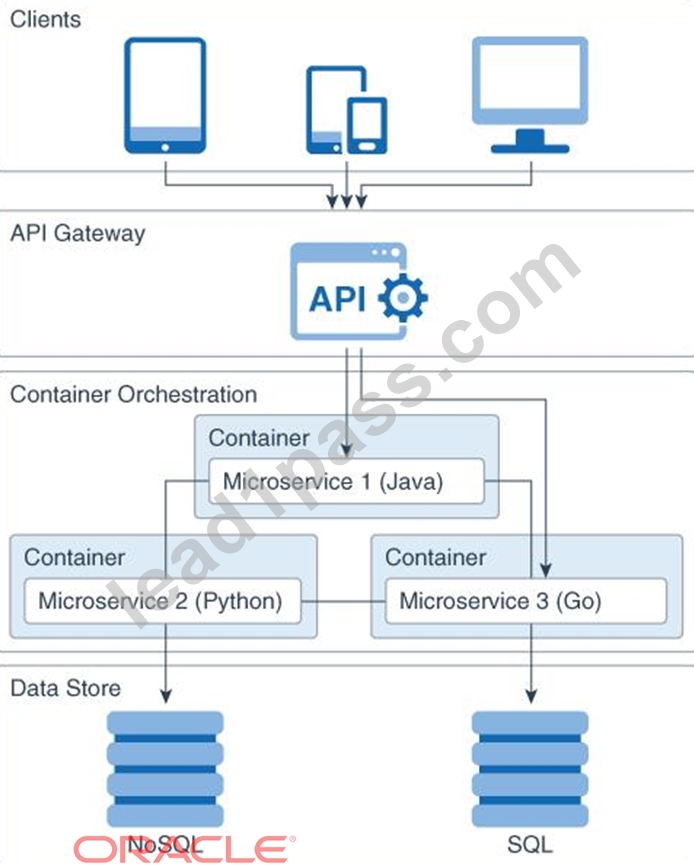
Microservices enable you to design your application as a collection of loosely coupled services. Microservices follow the share-nothing model, and run as stateless processes. This approach makes it easier to scale and maintain the application.
The API layer is the entry point for all the client requests to a microservice. The API layer also enables the microservices to communicate with each other over HTTP, gRPC, and TCP/UDP.
The logic layer focuses on a single business task, minimizing the dependencies on the other microservices. This layer can be written in a different language for each microservice.
The data store layer provides a persistence mechanism, such as a database storage engine, log files, and so on. Consider using a separate persistent data store for each microservice.
Typically, each microservice runs in a container that provides a lightweight runtime environment.
Loosely coupled with other services - enables a team to work independently the majority of time on their service(s) without being impacted by changes to other services and without affecting other services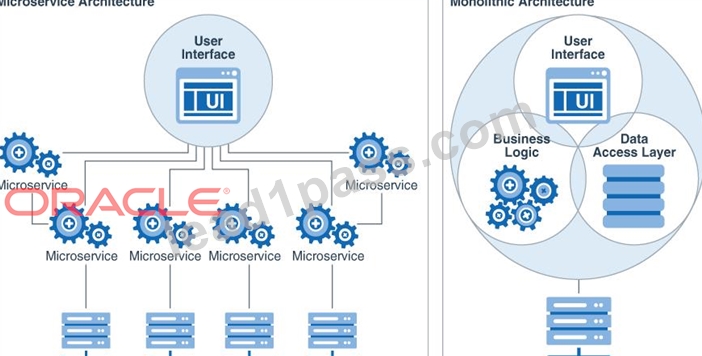
References:
https://docs.oracle.com/en/solutions/learn-architect-microservice/index.html
https://microservices.io/patterns/microservices.html
https://www.techjini.com/blog/microservices/
NEW QUESTION # 54
Which two are benefits of distributed systems?
- A. Scalability
- B. Privacy
- C. Ease of testing
- D. Resiliency
- E. Security
Answer: A,D
Explanation:
distributed systems of native-cloud like functions that have a lot of benefit like Resiliency and availability Resiliency and availability refers to the ability of a system to continue operating, despite the failure or sub-optimal performance of some of its components.
In the case of Oracle Functions:
The control plane is a set of components that manages function definitions.
The data plane is a set of components that executes functions in response to invocation requests.
For resiliency and high availability, both the control plane and data plane components are distributed across different availability domains and fault domains in a region. If one of the domains ceases to be available, the components in the remaining domains take over to ensure that function definition management and execution are not disrupted.
When functions are invoked, they run in the subnets specified for the application to which the functions belong. For resiliency and high availability, best practice is to specify a regional subnet for an application (or alternatively, multiple AD-specific subnets in different availability domains). If an availability domain specified for an application ceases to be available, Oracle Functions runs functions in an alternative availability domain.
Concurrency and Scalability
Concurrency refers to the ability of a system to run multiple operations in parallel using shared resources. Scalability refers to the ability of the system to scale capacity (both up and down) to meet demand.
In the case of Functions, when a function is invoked for the first time, the function's image is run as a container on an instance in a subnet associated with the application to which the function belongs. When the function is executing inside the container, the function can read from and write to other shared resources and services running in the same subnet (for example, Database as a Service). The function can also read from and write to other shared resources (for example, Object Storage), and other Oracle Cloud Services.
If Oracle Functions receives multiple calls to a function that is currently executing inside a running container, Oracle Functions automatically and seamlessly scales horizontally to serve all the incoming requests. Oracle Functions starts multiple Docker containers, up to the limit specified for your tenancy. The default limit is 30 GB of RAM reserved for function execution per availability domain, although you can request an increase to this limit. Provided the limit is not exceeded, there is no difference in response time (latency) between functions executing on the different containers.
NEW QUESTION # 55
What is the open source engine for Oracle Functions?
- A. OpenFaaS
- B. Fn Project
- C. Knative
- D. Apache OpenWhisk
Answer: B
Explanation:
https://www.oracle.com/webfolder/technetwork/tutorials/FAQs/oci/Functions-FAQ.pdf Oracle Functions is a fully managed, multi-tenant, highly scalable, on-demand, Functions-as-a-Service platform. It is built on enterprise-grade Oracle Cloud Infrastructure and powered by the Fn Project open source engine. Use Oracle Functions (sometimes abbreviated to just Functions) when you want to focus on writing code to meet business needs.
NEW QUESTION # 56
A service you are deploying to Oracle infrastructure (OCI) Container En9ine for Kubernetes (OKE) uses a docker image from a private repository Which configuration is necessary to provide access to this repository from OKE?
- A. Add a generic secret on the cluster containing your identity credentials. Then specify a registrycredentials property in the deployment manifest.
- B. Create a docker-registry secret for OCIR with API key credentials on the cluster, and specify the imagepullsecret property in the application deployment manifest.
- C. Create a dynamic group for nodes in the cluster, and a policy that allows the dynamic group to read repositories in the same compartment.
- D. Create a docker-registry secret for OCIR with identity Auth Token on the cluster, and specify the image pull secret property in the application deployment manifest.
Answer: D
Explanation:
Pulling Images from Registry during Deployment
During the deployment of an application to a Kubernetes cluster, you'll typically want one or more images to be pulled from a Docker registry. In the application's manifest file you specify the images to pull, the registry to pull them from, and the credentials to use when pulling the images. The manifest file is commonly also referred to as a pod spec, or as a deployment.yaml file (although other filenames are allowed).
If you want the application to pull images that reside in Oracle Cloud Infrastructure Registry, you have to perform two steps:
- You have to use kubectl to create a Docker registry secret. The secret contains the Oracle Cloud Infrastructure credentials to use when pulling the image. When creating secrets, Oracle strongly recommends you use the latest version of kubectl To create a Docker registry secret:
1- If you haven't already done so, follow the steps to set up the cluster's kubeconfig configuration file and (if necessary) set the KUBECONFIG environment variable to point to the file. Note that you must set up your own kubeconfig file. You cannot access a cluster using a kubeconfig file that a different user set up.
2- In a terminal window, enter:
$ kubectl create secret docker-registry <secret-name> --docker-server=<region-key>.ocir.io --docker-username='<tenancy-namespace>/<oci-username>' --docker-password='<oci-auth-token>' --docker-email='<email-address>' where:
<secret-name> is a name of your choice, that you will use in the manifest file to refer to the secret . For example, ocirsecret
<region-key> is the key for the Oracle Cloud Infrastructure Registry region you're using. For example, iad. See Availability by Region.
ocir.io is the Oracle Cloud Infrastructure Registry name.
<tenancy-namespace> is the auto-generated Object Storage namespace string of the tenancy containing the repository from which the application is to pull the image (as shown on the Tenancy Information page). For example, the namespace of the acme-dev tenancy might be ansh81vru1zp. Note that for some older tenancies, the namespace string might be the same as the tenancy name in all lower-case letters (for example, acme-dev).
<oci-username> is the username to use when pulling the image. The username must have access to the tenancy specified by <tenancy-name>. For example, [email protected] . If your tenancy is federated with Oracle Identity Cloud Service, use the format oracleidentitycloudservice/<username>
<oci-auth-token> is the auth token of the user specified by <oci-username>. For example, k]j64r{1sJSSF-;)K8
<email-address> is an email address. An email address is required, but it doesn't matter what you specify. For example, [email protected]
- You have to specify the image to pull from Oracle Cloud Infrastructure Registry, including the repository location and the Docker registry secret to use, in the application's manifest file.
References:
https://docs.cloud.oracle.com/en-us/iaas/Content/Registry/Tasks/registrypullingimagesfromocir.htm
NEW QUESTION # 57
What is the minimum of storage that a persistent volume claim can obtain in Oracle Cloud Infrastructure Container Engine for Kubernetes (OKE)?
- A. 10 GB
- B. 50 GB
- C. 1 GB
- D. 1 TB
Answer: B
Explanation:
The minimum amount of persistent storage that a PVC can request is 50 gigabytes. If the request is for less than 50 gigabytes, the request is rounded up to 50 gigabytes.
https://docs.cloud.oracle.com/en-us/iaas/Content/ContEng/Tasks/contengcreatingpersistentvolumeclaim.htm
NEW QUESTION # 58
Which two statements accurately describe Oracle SQL Developer Web on Oracle Cloud Infrastructure (OCI) Autonomous Database?
- A. It provides a development environment and a data modeler interface for OCI Autonomous Databases.
- B. It is available for databases with both dedicated and shared Exadata infrastructure.
- C. It is available for databases with dedicated Exadata infrastructure only.
- D. After provisioning into an OCI compute Instance, it can automatically connect to the OCI Autonomous Databases instances.
- E. It must be enabled via OCI Identity and Access Management policy to get access to the Autonomous Databases instances.
Answer: A,C
Explanation:
Oracle SQL Developer Web
Oracle SQL Developer Web in Autonomous Data Warehouse provides a development environment and a data modeler interface for Autonomous Databases. SQL Developer Web is available for databases with both dedicated Exadata infrastructure and shared Exadata infrastructure.
https://docs.cloud.oracle.com/en-us/iaas/Content/Database/Tasks/adbtools.htm
NEW QUESTION # 59
You are working on a cloud native e-commerce application on Oracle Cloud Infrastructure (OCI). Your application architecture has multiple OCI services, including Oracle Functions. You need to trigger these functions directly from other OCI services, without having to run custom code.
Which OCI service cannot trigger your functions directly?
- A. OCI Events Service
- B. OCI Registry
- C. Oracle Integration
- D. OCI API Gateway
Answer: B
Explanation:
Overview of Functions:
Oracle Functions is a fully managed, multi-tenant, highly scalable, on-demand, Functions-as-a-Service platform. It is built on enterprise-grade Oracle Cloud Infrastructure and powered by the Fn Project open source engine. Use Oracle Functions (sometimes abbreviated to just Functions) when you want to focus on writing code to meet business needs.
The serverless and elastic architecture of Oracle Functions means there's no infrastructure administration or software administration for you to perform. You don't provision or maintain compute instances, and operating system software patches and upgrades are applied automatically. Oracle Functions simply ensures your app is highly-available, scalable, secure, and monitored. With Oracle Functions, you can write code in Java, Python, Node, Go, and Ruby (and for advanced use cases, bring your own Dockerfile, and Graal VM).
You can invoke a function that you've deployed to Oracle Functions from:
- The Fn Project CLI.
- The Oracle Cloud Infrastructure SDKs.
- Signed HTTP requests to the function's invoke endpoint. Every function has an invoke endpoint.
- Other Oracle Cloud services (for example, triggered by an event in the Events service) or from external services.
so You can then deploy your code, call it directly or trigger it in response to events, and get billed only for the resources consumed during the execution.
Invoking Oracle Functions from Other Oracle Cloud Infrastructure Services:
You can invoke functions in Oracle Functions from other Oracle Cloud Infrastructure services. Typically, you'll want an event in another service to trigger a request to invoke a function defined in Oracle Functions.
This functionality is currently available in:
1. The Events service. For more information, see Overview of Events.
2.The Notifications service. For more information, see Notifications Overview. For a scenario, see Scenario A: Automatically Resize VMs.
3.The API Gateway service. For more information, see Adding a Function in Oracle Functions as an API Gateway Back End.
4.The Oracle Integration service, using the OCI Signature Version 1 security policy. For more information, see Configure Oracle Integration to Call Oracle Cloud Infrastructure Functions with the REST Adapter in Using the REST Adapter with Oracle Integration.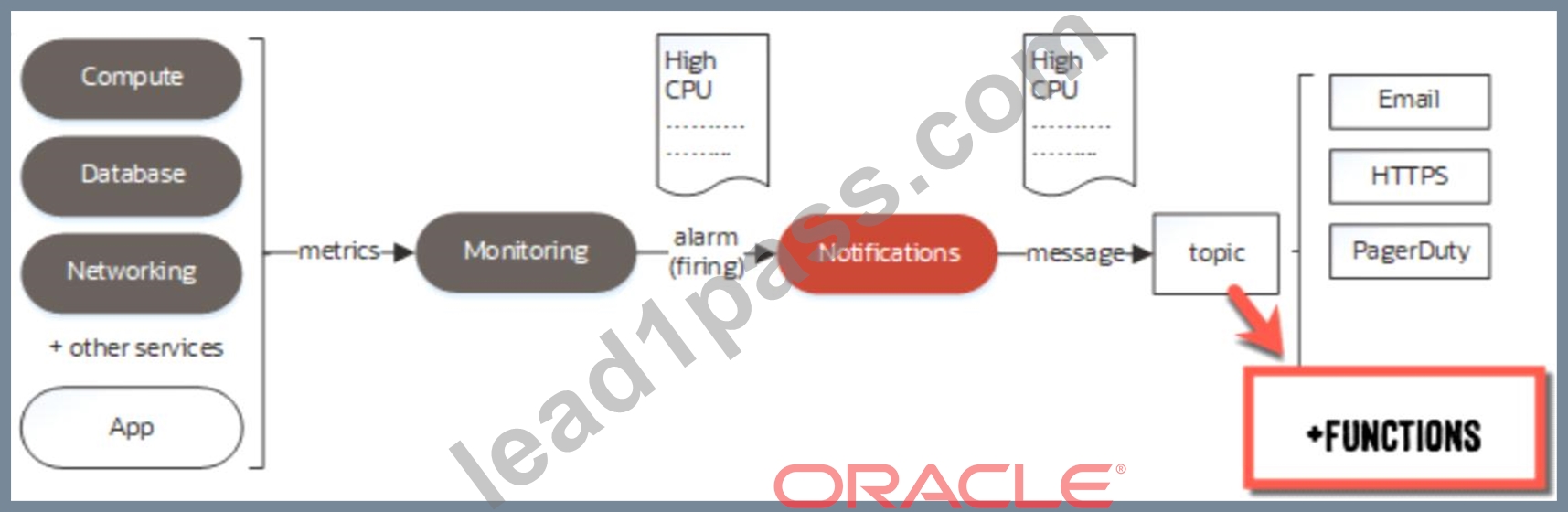
so OCI Registry services cannot trigger your functions directly
References:
https://docs.cloud.oracle.com/en-us/iaas/Content/Functions/Tasks/functionsintegratingwithother.htm
https://docs.cloud.oracle.com/en-us/iaas/Content/Functions/Concepts/functionsoverview.htm
https://blogs.oracle.com/cloud-infrastructure/announcing-notifications-triggers-for-serverless-functions
NEW QUESTION # 60
Which two "Action Type" options are NOT available in an Oracle Cloud Infrastructure (OCI) Events rule definition?
- A. Email
- B. Functions
- C. Notifications
- D. Slack
- E. Streaming
Answer: A,D
Explanation:
Overview of Events
Oracle Cloud Infrastructure Events enables you to create automation based on the state changes of resources throughout your tenancy. Use Events to allow your development teams to automatically respond when a resource changes its state.
Event Rules must also specify an action to trigger when the filter finds a matching event. Actions are responses you define for event matches. You set up select Oracle Cloud Infrastructure services that the Events service has established as actions. The resources for these services act as destinations for matching events. When the filter in the rule finds a match, the Events service delivers the matching event to one or more of the destinations you identified in the rule. The destination service that receives the event then processes the event in whatever manner you defined. This delivery provides the automation in your environment.
You can only deliver events to certain Oracle Cloud Infrastructure services with a rule. Use the following services to create actions:
Notifications
Streaming
Functions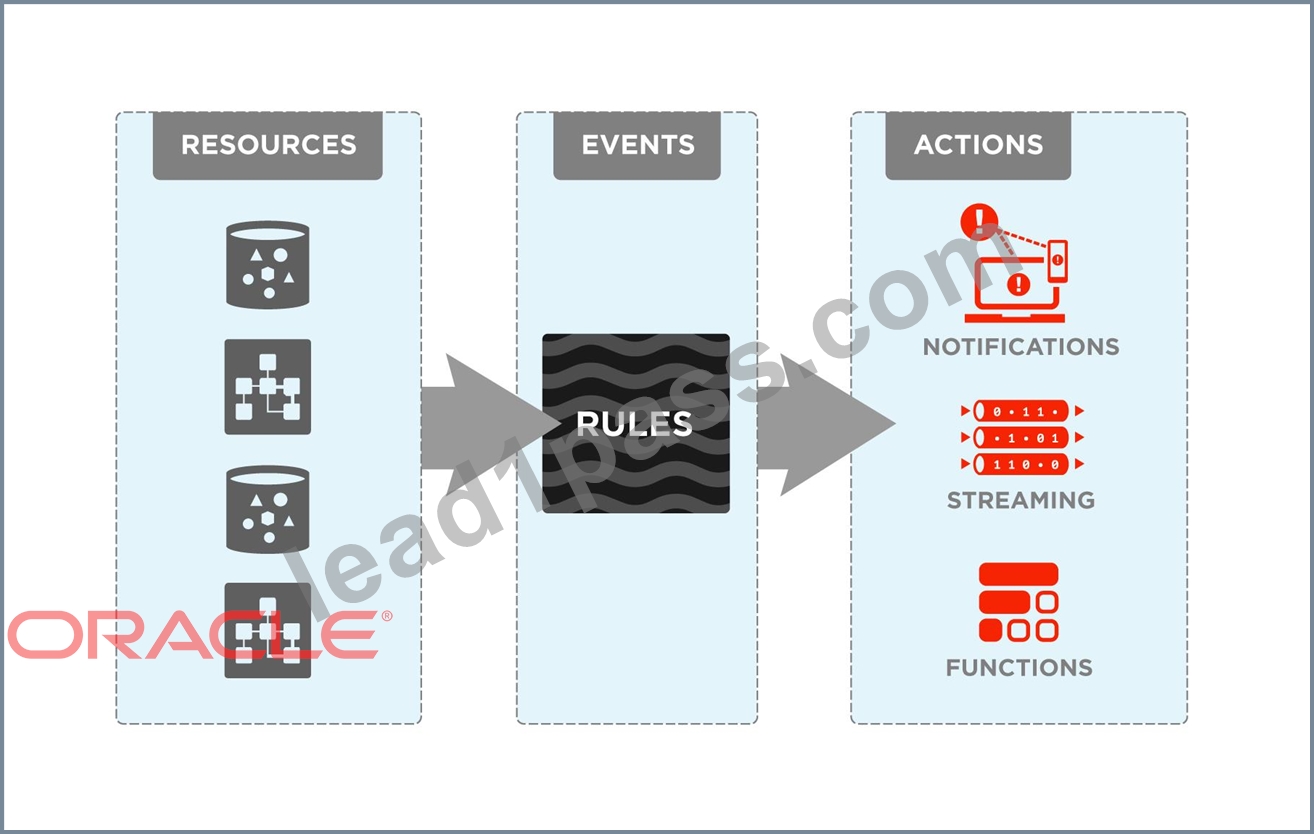
References:
https://docs.cloud.oracle.com/en-us/iaas/Content/Events/Concepts/eventsoverview.htm
NEW QUESTION # 61
You are working on a serverless DevSecOps application using Oracle Functions. You have deployed a Python function that uses the Oracle Cloud Infrastructure (OCI) Python SDK to stop any OC1 Compute instance that does not comply with your corporate security standards There are 3 non compliant OCI Compute instances.
However, when you invoke this function none of the instances were stopped. How should you troubleshoot this?
- A. Enable function logging in the OCI console, include some print statements in your function code and use logs to troubleshoot this.
- B. Enable function tracing in the OCI console, and go to OCI Monitoring console to see the function stack trace.
- C. There is no way to troubleshoot a function running on Oracle Functions.
- D. Enable function remote debugging in the OCI console, and use your favorite IDE to inspect the function running on Oracle Functions.
Answer: A
Explanation:
Storing and Viewing Function Logs:
When a function you've deployed to Oracle Functions is invoked, you'll typically want to store the function's logs so that you can review them later. You specify where Oracle Functions stores a function's logs by setting a logging policy for the application containing the function.
You can specify that Oracle Functions:
Stores logs in Oracle Cloud Infrastructure. Until an Oracle Cloud Infrastructure logging service is released, Oracle Functions stores logs as files in a storage bucket in Oracle Cloud Infrastructure Object Storage.
Note that to view function logs in a storage bucket, the group to which you belong must have been granted access with the following identity policy statements:
Allow group <group-name> to manage object-family in compartment <compartment-name> Allow group <group-name> to read objectstorage-namespaces in compartment <compartment-name> (Usually created when configuring your tenancy for function development. See Create a Policy to Give Oracle Functions Users Access to Oracle Cloud Infrastructure Registry Repositories.) Stores logs by exporting them to an external logging destination like Papertrail. Note that to use an external logging destination, you must have set up a VCN with public subnets and an internet gateway (see Create the VCN and Subnets to Use with Oracle Functions, if they don't exist already).
You set application logging policies in the Console.
References:
https://docs.cloud.oracle.com/en-us/iaas/Content/Functions/Tasks/functionsexportingfunctionlogfiles.htm
NEW QUESTION # 62
......
1z0-1084-22 PDF Pass Leader, 1z0-1084-22 Latest Real Test: https://simplilearn.lead1pass.com/Oracle/1z0-1084-22-practice-exam-dumps.html