
UPDATED [2025] Pass Snowflake ADA-C01 Exam in First Attempt Guaranteed
Pass ADA-C01 Exam Latest Practice Questions
Snowflake ADA-C01 Exam Syllabus Topics:
| Topic | Details |
|---|---|
| Topic 1 |
|
| Topic 2 |
|
| Topic 3 |
|
| Topic 4 |
|
| Topic 5 |
|
| Topic 6 |
|
NEW QUESTION # 42
What roles can be used to create network policies within Snowflake accounts? (Select THREE).
- A. ORGADMIN
- B. Any role that owns the database where the network policy is created
- C. SECURITYADMIN
- D. ACCOUNTADMIN
- E. Any role with the global permission of CREATE NETWORK POLICY
- F. SYSADMIN
Answer: C,D,E
Explanation:
Network policies are used to restrict access to the Snowflake service and internal stages based on user IP address1. To create network policies, a role must have the global permission of CREATE NETWORK POLICY2. By default, the system-defined roles of SECURITYADMIN and ACCOUNTADMIN have this permission3. However, any other role can be granted this permission by an administrator4. Therefore, the answer is B, C, and E. The other options are incorrect because SYSADMIN and ORGADMIN do not have the CREATE NETWORK POLICY permission by default3, and network policies are not tied to specific databases5.
NEW QUESTION # 43
For Snowflake network policies, what will occur when the account_level and user_level network policies are both defined?
- A. The user_level network policies will not be supported.
- B. The account_level policy will override the user_level policy.
- C. The user_level policy will override the account_level policy.
- D. A network policy error will be generated with no definitions provided.
Answer: C
Explanation:
According to the Network Policies documentation, a network policy can be applied to an account, a security integration, or a user. If there are network policies applied to more than one of these, the most specific network policy overrides more general network policies. The following summarizes the order of precedence:
* Account: Network policies applied to an account are the most general network policies. They are overridden by network policies applied to a security integration or user.
* Security Integration: Network policies applied to a security integration override network policies applied to the account, but are overridden by a network policy applied to a user.
* User: Network policies applied to a user are the most specific network policies. They override both accounts and security integrations.
Therefore, if both the account_level and user_level network policies are defined, the user_level policy will take effect and the account_level policy will be ignored. The other options are incorrect because:
* The account_level policy will not override the user_level policy, as explained above.
* The user_level network policies will be supported, as they are part of the network policy feature.
* A network policy error will not be generated, as there is no conflict between the account_level and user_level network policies.
NEW QUESTION # 44
Review the output of the SHOW statement below which displays the current grants on the table DB1. S1. T1: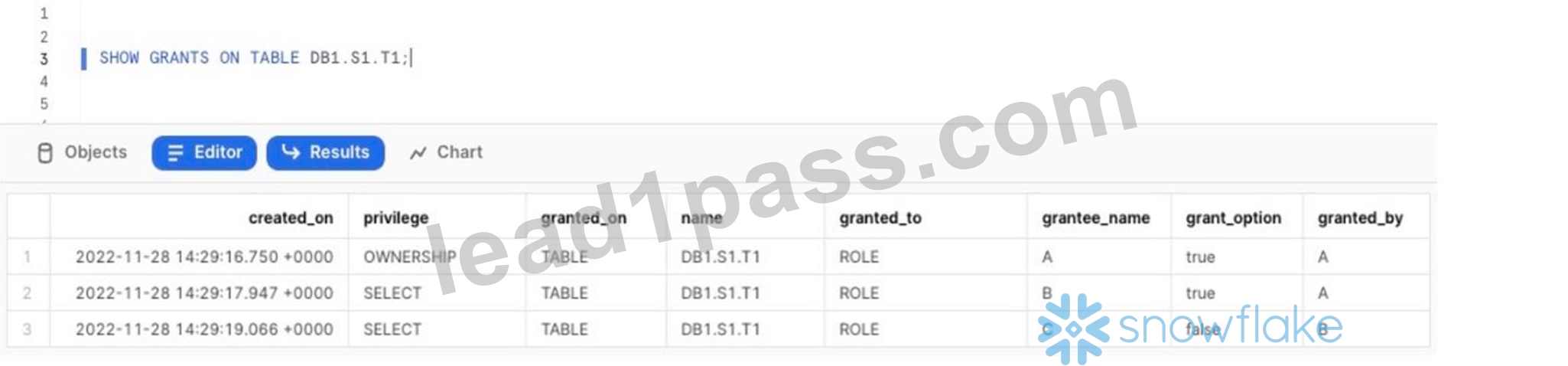
This statement is executed:
USE ROLE ACCOUNTADMIN;
DROP ROLE A;
What will occur?
- A. The SELECT privilege on table DB1. S1. T1 to role B will be shown as GRANTED_BY the role ACCOUNTADMIN.
- B. The SELECT privileges for roles B and C will remain.
- C. The OWNERSHIP privilege on table DB1. S1. T1 will be transferred to the ACCOUNTADMIN role.
- D. The table object DB1. S1. T1 will be dropped.
Answer: B
Explanation:
Dropping role A does not affect the SELECT privileges granted to roles B and C on the table DB1.S1.T1. According to the Snowflake documentation, dropping a role revokes all privileges granted to the role, but does not revoke any privileges granted by the role. Therefore, the OWNERSHIP privilege on the table DB1.S1.T1 will be revoked from role A, but the SELECT privileges granted by role A to role B and by role B to role C will remain. The GRANTED_BY column will still show the original grantor of the privilege, not the ACCOUNTADMIN role.
NEW QUESTION # 45
A data provider wants to share data from multiple databases with a data consumer account.
How can this be accomplished?
- A. The data provider needs to create a secure view and must grant the REFERENCE_USAGE privilege on the database where the secure view is created.
- B. The data provider needs to create a secure view and grant the USAGE privilege on each database referenced by the secure view.
- C. The data provider needs to create a secure view and grant the REFERENCE_USAGE privilege on each database referenced by the secure view.
- D. The data provider needs to create a secure view and grant the REFERENCE_USAGE privilege to a database role to include objects from multiple databases in a share
Answer: C
Explanation:
Explanation
Option B is the correct answer because it follows the steps described in the Snowflake documentation for sharing data from multiple databases using secure views. The data provider needs to grant the REFERENCE_USAGE privilege on each database that contains objects referenced by the secure view, and the USAGE privilege only on the database where the secure view is created. Option A is incorrect because it grants the USAGE privilege instead of the REFERENCE_USAGE privilege. Option C is incorrect because it grants the REFERENCE_USAGE privilege to a database role, which is not supported. Option D is incorrect because it grants the REFERENCE_USAGE privilege on the wrong database.
NEW QUESTION # 46
A team is provisioning new lower environments from the production database using cloning. All production objects and references reside in the database, and do not have external references.
What set of object references needs to be re-pointed before granting access for usage?
- A. Sequences, storage integrations, views, secure views, and materialized views
- B. Sequences, views, and secure views
- C. Sequences, views, secure views, and materialized views
- D. There are no object references that need to be re-pointed
Answer: A
Explanation:
According to the Snowflake documentation1, when an object in a schema is cloned, any future grants defined for this object type in the schema are applied to the cloned object unless the COPY GRANTS option is specified in the CREATE statement for the clone operation. However, some objects may still reference the source object or external objects after cloning, which may cause issues with access or functionality. These objects include:
* Sequences: If a table column references a sequence that generates default values, the cloned table may reference the source or cloned sequence, depending on where the sequence is defined. To avoid conflicts, the sequence reference should be re-pointed to the desired sequence using the ALTER TABLE command2.
* Storage integrations: If a stage or a table references a storage integration, the cloned object may still reference the source storage integration, which may not be accessible or valid in the new environment. To avoid errors, the storage integration reference should be re-pointed to the desired storage integration using the ALTER STAGE or ALTER TABLE command34.
* Views, secure views, and materialized views: If a view references another view or table, the cloned view may still reference the source object, which may not be accessible or valid in the new environment. To avoid errors, the view reference should be re-pointed to the desired object using the CREATE OR REPLACE VIEW command5.
1: Cloning Considerations | Snowflake Documentation 2: [ALTER TABLE | Snowflake Documentation] 3: [ALTER STAGE | Snowflake Documentation] 4: [ALTER TABLE | Snowflake Documentation] 5: [CREATE VIEW | Snowflake Documentation]
NEW QUESTION # 47
Which statement allows this user to access this Snowflake account from a specific IP address (192.168.1.100) while blocking their access from anywhere else?
- A. CREATE NETWORK POLICY ADMIN_POLICY
ALLOWED_IP_LIST = ('192.168.1.100');
ALTER USER ABC SET NETWORK_POLICY = 'ADMIN_POLICY';
User ABC is the only user with an ACCOUNTADMIN role. - B. CREATE OR REPLACE NETWORK POLICY ADMIN_POLICY
ALLOWED_IP_LIST = ('192.168. 1. 100/0') ;
ALTER USER ABC SET NETWORK_POLICY = 'ADMIN_POLICY'; - C. CREATE NETWORK POLICY ADMIN_POLICY
ALLOWED IP LIST = ('192.168.1.100')
BLOCKED_IP_LIST = ('0.0.0.0/0');
ALTER USER ABC SET NETWORK_POLICY = 'ADMIN_POLICY'; - D. CREATE NETWORK POLICY ADMIN POLICY
ALLOWED_IP_LIST = ('192.168.1.100');
ALTER ROLE ACCOUNTADMIN SET NETWORK_POLICY = 'ADMIN_POLICY';
Answer: C
Explanation:
Option C creates a network policy that allows only the IP address 192.168.1.100 and blocks all other IP addresses using the CIDR notation 0.0.0.0/01. It then applies the network policy to the user ABC, who has the ACCOUNTADMIN role. This ensures that only this user can access the Snowflake account from the specified IP address, while blocking their access from anywhere else. Option A does not block any other IP addresses, option B applies the network policy to the role instead of the user, and option D uses an invalid CIDR notation.
NEW QUESTION # 48
A requirement has been identified to allow members of a corporate Data Product team to bring in data sets from the Snowflake Marketplace. The members of this team use the role DP_TEAM.
What grant statements must the ACCOUNTADMIN execute in order for the DP TEAM role to import and work with data from the Marketplace?
- A. grant import share on account to role dp_team;
grant create database on account to role dp_team; - B. grant marketplace in account to role dp_team;
grant create database from share to role dp_team; - C. grant imported privileges on account to role dp_team;
grant create database on account to role dp_team; - D. grant usage on snowflake_marketplace to role dp_team;
grant create database on account to role dp_team;
Answer: A
Explanation:
Explanation
Option D is the correct answer because it follows the steps described in the Snowflake documentation for importing data from the Snowflake Marketplace. The ACCOUNTADMIN role needs to grant the IMPORT SHARE privilege on the account to the DP_TEAM role, which allows the role to import data from any provider in the marketplace. The ACCOUNTADMIN role also needs to grant the CREATE DATABASE privilege on the account to the DP_TEAM role, which allows the role to create a database from a share. Option A is incorrect because there is no MARKETPLACE privilege in Snowflake. Option B is incorrect because the USAGE privilege on SNOWFLAKE_MARKETPLACE is not sufficient to import data from the marketplace.
Option C is incorrect because there is no IMPORTED PRIVILEGES privilege in Snowflake.
NEW QUESTION # 49
A large international company with many operating regions requires data to be shared bi-directionally among all offices (head office to regional offices and regional offices among themselves). This company is a Snowflake account holder with European operations deployed in Microsoft Azure (single region) while North American regional offices are using AWS (single region) as their deployment cloud. This setup is required to comply with Personal Identifiable Information (PII) regulations in some of the European countries. The corporate head office is in Europe.
How can this data be shared bi-directionally, while MINIMIZING costs?
- A. Move all the Snowflake accounts to a single region, and implement data sharing.
- B. Use data replication everywhere to reduce costs associated with same-region sharing.
- C. Use the PUT command to move files to an Amazon S3 bucket and Azure Blobs, and use an external file management application to move files within the corporate VPC.
- D. Use bi-directional data sharing among offices in the same region and replication among offices across the continents.
Answer: D
Explanation:
According to the Snowflake documentation1, data sharing is a feature that allows sharing selected objects in a database in one account with other accounts in the same organization, without copying or transferring any data. Data sharing is supported across regions and across cloud platforms, but it requires enabling account database replication for both the source and target accounts2. Data replication is a feature that allows replicating objects from a source account to one or more target accounts in the same organization, providing read-only access for the replicated objects. Data replication is also supported across regions and across cloud platforms, but it incurs additional storage costs for the replicated data2. Therefore, the best way to share data bi-directionally among all offices, while minimizing costs, is to use data sharing among offices in the same region, which does not require replication or additional storage, and use replication among offices across the continents, which provides near real-time access to the shared data. Option A is incorrect because using data replication everywhere would increase the costs associated with additional storage and compute resources for the replicated data. Option B is incorrect because using the PUT command to move files to an Amazon S3 bucket and Azure Blobs, and using an external file management application to move files within the corporate VPC, would not leverage the benefits of Snowflake's data sharing and replication features, and would also incur additional costs and complexity for data transfer and synchronization. Option C is incorrect because moving all the Snowflake accounts to a single region would violate the PII regulations in some of the European countries, and would also incur additional costs and complexity for data migration and consolidation.
NEW QUESTION # 50
What are the requirements when creating a new account within an organization in Snowflake? (Select TWO).
- A. The account name is immutable and cannot be changed.
- B. The account name must be unique within the organization.
- C. The account name must be unique among all Snowflake customers.
- D. The account requires at least one ORGADMIN role within one of the organization's accounts.
- E. The account name must be specified when the account is created.
Answer: B,E
Explanation:
According to the CREATE ACCOUNT documentation, the account name must be specified when the account is created, and it must be unique within an organization, regardless of which Snowflake Region the account is in. The other options are incorrect because:
* The account does not require at least one ORGADMIN role within one of the organization's accounts. The account can be created by an organization administrator (i.e. a user with the ORGADMIN role) through the web interface or using SQL, but the new account does not inherit the ORGADMIN role from the existing account. The new account will have its own set of users, roles, databases, and warehouses.
* The account name is not immutable and can be changed. The account name can be modified by contacting Snowflake Support and requesting a name change. However, changing the account name may affect some features that depend on the account name, such as SSO or SCIM.
* The account name does not need to be unique among all Snowflake customers. The account name only needs to be unique within the organization, as the account URL also includes the region and cloud platform information. For example, two accounts with the same name can exist in different regions or cloud platforms, such as myaccount.us-east-1.snowflakecomputing.com and myaccount.eu-west-1.aws.snowflakecomputing.com.
NEW QUESTION # 51
A company enabled replication between accounts and is ready to replicate data across regions in the same cloud service provider.
The primary database object is : PROD_AWS_EAST. Location : AWS_EAST
The secondary database object is : PROD_AWS_WEST. Location : AWS_WEST
What command and account location is needed to refresh the data?
- A. Location : AWS_WEST
Command : REFRESH DATABASE PROD_AWS WEST REFRESH; - B. Location : AWS EAST
Command: ALTER DATABASE PROD_AWS_WEST REFRESH; - C. Location : AWS_EAST
Command : REFRESH DATABASE PROD_AWS_WEST REFRESH; - D. Location : AWS_WEST
Command : ALTER DATABASE PROD AWS WEST REFRESH;
Answer: A
Explanation:
The REFRESH DATABASE command is used to refresh a secondary database with the latest data and metadata from the primary database1. The command must be executed in the target account where the secondary database resides2. Therefore, the answer is A, as the location is AWS_WEST and the command is REFRESH DATABASE PROD_AWS_WEST REFRESH. The other options are incorrect because they either use the wrong location, the wrong command, or the wrong database name.
NEW QUESTION # 52
When adding secure views to a share in Snowflake, which function is needed to authorize users from another account to access rows in a base table?
- A. CURRENT_CLIENT
- B. CURRENT_USER
- C. CURRENT_ROLE
- D. CURRENT ACCOUNT
Answer: B
Explanation:
Explanation
According to the Working with Secure Views documentation, secure views are designed to limit access to sensitive data that should not be exposed to all users of the underlying table(s). When sharing secure views with another account, the view definition must include a function that returns the identity of the user who is querying the view, such as CURRENT_USER, CURRENT_ROLE, or CURRENT_ACCOUNT. These functions can be used to filter the rows in the base table based on the user's identity. For example, a secure view can use the CURRENT_USER function to compare the user name with a column in the base table that contains the authorized user names. Only the rows that match the user name will be returned by the view. The CURRENT_CLIENT function is not suitable for this purpose, because it returns the IP address of the client that is connected to Snowflake, which is not related to the user's identity.
NEW QUESTION # 53
A Snowflake Administrator needs to persist all virtual warehouse configurations for auditing and backups. Given a table already exists with the following schema:
Table Name : VWH_META
Column 1 : SNAPSHOT_TIME TIMESTAMP_NTZ
Column 2 : CONFIG VARIANT
Which commands should be executed to persist the warehouse data at the time of execution in JSON format in the table VWH META?
- A. 1. SHOW WAREHOUSES;
2. INSERT INTO VWH_META
SELECT CURRENT_TIMESTAMP (),
OBJECT CONSTRUCT (*)
FROM TABLE (RESULT_SCAN (LAST_QUERY_ID ())); - B. 1. SHOW WAREHOUSES;
2. INSERT INTO VWH META
SELECT CURRENT TIMESTAMP (), *
FROM TABLE (RESULT_SCAN (LAST_QUERY_ID ())) ; - C. 1. SHOW WAREHOUSES;
2. INSERT INTO VWH META
SELECT CURRENT TIMESTAMP (),
FROM TABLE (RESULT_SCAN (LAST_QUERY_ID(1) ) ) ; - D. 1. SHOW WAREHOUSES;
2. INSERT INTO VWH META
SELECT CURRENT TIMESTAMP (), *
FROM TABLE (RESULT_SCAN (SELECT
LAST QUERY ID(-1)));
Answer: A
Explanation:
According to the Using Persisted Query Results documentation, the RESULT_SCAN function allows you to query the result set of a previous command as if it were a table. The LAST_QUERY_ID function returns the query ID of the most recent statement executed in the current session. Therefore, the combination of these two functions can be used to access the output of the SHOW WAREHOUSES command, which returns the configurations of all the virtual warehouses in the account. However, to persist the warehouse data in JSON format in the table VWH_META, the OBJECT_CONSTRUCT function is needed to convert the output of the SHOW WAREHOUSES command into a VARIANT column. The OBJECT_CONSTRUCT function takes a list of key-value pairs and returns a single JSON object. Therefore, the correct commands to execute are:
1. SHOW WAREHOUSES;
2. INSERT INTO VWH_META SELECT CURRENT_TIMESTAMP (), OBJECT_CONSTRUCT (*) FROM TABLE (RESULT_SCAN (LAST_QUERY_ID ())); The other options are incorrect because:
* A. This option does not use the OBJECT_CONSTRUCT function, so it will not persist the warehouse data in JSON format. Also, it is missing the * symbol in the SELECT clause, so it will not select any columns from the result set of the SHOW WAREHOUSES command.
* B. This option does not use the OBJECT_CONSTRUCT function, so it will not persist the warehouse data in JSON format. It will also try to insert multiple columns into a single VARIANT column, which will cause a type mismatch error.
* D. This option does not use the OBJECT_CONSTRUCT function, so it will not persist the warehouse data in JSON format. It will also try to use the RESULT_SCAN function on a subquery, which is not supported. The RESULT_SCAN function can only be used on a query ID or a table name.
NEW QUESTION # 54
Which commands can be performed by a user with the ORGADMIN role but not the ACCOUNTADMIN role? (Select TWO).
- A. SELECT SYSTEM$GLOBAL_ACCOUNT_SET_PARAMETER (
'ACCOUNT LOCATOR',
'ENABLE ACCOUNT DATABASE_REPLICATION',
'true'
); - B. SHOW USERS;
- C. SHOW ORGANIZATION ACCOUNTS;
- D. GRANT ROLE ORGADMIN TO USER <username>;
- E. SHOW REGIONS;
Answer: A,C
Explanation:
Explanation
According to the Snowflake documentation1, the ORGADMIN role is a special system role that is responsible for managing operations at the organization level, such as creating and viewing accounts, enabling database replication, and setting global account parameters. The ACCOUNTADMIN role is a system role that is responsible for managing operations at the account level, such as creating and managing users, roles, warehouses, databases, and shares. Therefore, the commands that can be performed by the ORGADMIN role but not the ACCOUNTADMIN role are:
*SHOW ORGANIZATION ACCOUNTS: This command lists all the accounts in the organization and their properties, such as region, edition, and status2. The ACCOUNTADMIN role can only show the current account and its properties using the SHOW ACCOUNTS command3.
*SELECT SYSTEM$GLOBAL_ACCOUNT_SET_PARAMETER: This function sets a global account parameter for an account in the organization, such as enabling account database replication4. The ACCOUNTADMIN role can only set local account parameters using the ALTER ACCOUNT command.
Option A is incorrect because the SHOW REGIONS command can be executed by any role, not just the ORGADMIN role. Option B is incorrect because the SHOW USERS command can be executed by the ACCOUNTADMIN role, as well as any role that has been granted the MONITOR privilege on the account.
Option D is incorrect because the GRANT ROLE ORGADMIN TO USER <username> command can be executed by the ACCOUNTADMIN role, as well as any role that has been granted the ORGADMIN role1.
NEW QUESTION # 55
.
Company A uses Snowflake to manage audio files of call recordings. Company A hired Company B, who also uses Snowflake, to transcribe the audio files for further analysis.
Company A's Administrator created a share.
What object should be added to the share to allow Company B access to the files?
- A. A secure view with a column for METADATA$FILENAME.
- B. A secure view with a column for file URLs.
- C. A secure view with a column for pre-signed URLs.
- D. A secure view with a column for the stage name and a column for the file path.
Answer: C
Explanation:
According to the Snowflake documentation1, pre-signed URLs are required to access external files in a share. A secure view can be used to generate pre-signed URLs for the audio files stored in an external stage and expose them to the consumer account. Option A is incorrect because file URLs alone are not sufficient to access external files in a share. Option C is incorrect because METADATA$FILENAME only returns the file name, not the full path or URL. Option D is incorrect because the stage name and file path are not enough to generate pre-signed URLs.
NEW QUESTION # 56
Which commands can be performed by a user with the ORGADMIN role but not the ACCOUNTADMIN role? (Select TWO).
- A. SHOW USERS;
- B. SELECT SYSTEM$GLOBAL_ACCOUNT_SET_PARAMETER (
- C. SHOW ORGANIZATION ACCOUNTS;
- D. GRANT ROLE ORGADMIN TO USER <username>;
- E. SHOW REGIONS;
Answer: B,C
Explanation:
'ACCOUNT LOCATOR',
'ENABLE ACCOUNT DATABASE_REPLICATION',
'true'
);
Explanation:
According to the Snowflake documentation1, the ORGADMIN role is a special system role that is responsible for managing operations at the organization level, such as creating and viewing accounts, enabling database replication, and setting global account parameters. The ACCOUNTADMIN role is a system role that is responsible for managing operations at the account level, such as creating and managing users, roles, warehouses, databases, and shares. Therefore, the commands that can be performed by the ORGADMIN role but not the ACCOUNTADMIN role are:
* SHOW ORGANIZATION ACCOUNTS: This command lists all the accounts in the organization and their properties, such as region, edition, and status2. The ACCOUNTADMIN role can only show the current account and its properties using the SHOW ACCOUNTS command3.
* SELECT SYSTEM$GLOBAL_ACCOUNT_SET_PARAMETER: This function sets a global account parameter for an account in the organization, such as enabling account database replication4. The ACCOUNTADMIN role can only set local account parameters using the ALTER ACCOUNT command.
Option A is incorrect because the SHOW REGIONS command can be executed by any role, not just the ORGADMIN role. Option B is incorrect because the SHOW USERS command can be executed by the ACCOUNTADMIN role, as well as any role that has been granted the MONITOR privilege on the account. Option D is incorrect because the GRANT ROLE ORGADMIN TO USER <username> command can be executed by the ACCOUNTADMIN role, as well as any role that has been granted the ORGADMIN role1.
NEW QUESTION # 57
A Snowflake organization MYORG consists of two Snowflake accounts:
The ACCOUNT1 has a database PROD_DB and the ORGADMIN role enabled.
Management wants to have the PROD_DB database replicated to ACCOUNT2.
Are there any necessary configuration steps in ACCOUNT1 before the database replication can be configured and initiated in ACCOUNT2?
- A. It is not possible to replicate a database from an Enterprise edition Snowflake account to a Standard edition Snowflake account.
- B. USE ROLE ORGADMIN;
SELECT SYSTEMSGLOBAL_ACCOUNT_SET_PARAMETER ('MYORG. ACCOUNT1',
'ENABLE_ACCOUNT_DATABASE_REPLICATION', 'TRUE');
SELECT SYSTEMSGLOBAL_ACCOUNT_SET_PARAMETER ('MYORG. ACCOUNT2',
'ENABLE_ACCOUNT_DATABASE_REPLICATION', 'TRUE');
USE ROLE ACCOUNTADMIN;
ALTER DATABASE PROD DB ENABLE REPLICATION TO ACCOUNTS MYORG. ACCOUNT2; - C. USE ROLE ORGADMIN;
SELECT SYSTEMSGLOBAL ACCOUNT SET_PARAMETER ( 'MYORG. ACCOUNT1',
'ENABLE_ACCOUNT_DATABASE_REPLICATION', 'TRUE');
USE ROLE ACCOUNTADMIN;
ALTER DATABASE PROD_DB ENABLE REPLICATION TO ACCOUNTS MYORG. ACCOUNT2
IGNORE EDITION CHECK; - D. No configuration steps are necessary in ACCOUNT1. Replicating databases across accounts within the same Snowflake organization is enabled by default.
Answer: C
Explanation:
Explanation
According to the Snowflake documentation1, database replication across accounts within the same organization requires the following steps:
*Link the accounts in the organization using the ORGADMIN role.
*Enable account database replication for both the source and target accounts using the SYSTEM$GLOBAL_ACCOUNT_SET_PARAMETER function.
*Promote a local database to serve as the primary database and enable replication to the target accounts using the ALTER DATABASE ... ENABLE REPLICATION TO ACCOUNTS command.
*Create a secondary database in the target account using the CREATE DATABASE ... FROM SHARE command.
*Refresh the secondary database periodically using the ALTER DATABASE ... REFRESH command.
Option A is incorrect because it does not include the step of creating a secondary database in the target account. Option C is incorrect because replicating databases across accounts within the same organization is not enabled by default, but requires enabling account database replication for both the source and target accounts. Option D is incorrect because it is possible to replicate a database from an Enterprise edition Snowflake account to a Standard edition Snowflake account, as long as the IGNORE EDITION CHECK option is used in the ALTER DATABASE ... ENABLE REPLICATION TO ACCOUNTS command2.
Option B is correct because it includes all the necessary configuration steps in ACCOUNT1, except for creating a secondary database in ACCOUNT2, which can be done after the replication is enabled.
NEW QUESTION # 58
......
Snowflake ADA-C01 Study Guide Archives : https://simplilearn.lead1pass.com/Snowflake/ADA-C01-practice-exam-dumps.html