

PASS 1V0-41.20 exam with VMware Real Exam Questions - 100% Valid!
Actual 1V0-41.20 Exam Recently Updated Questions with Free Demo
VMware 1V0-41.20 certification exam covers a range of topics related to network virtualization, including the installation and configuration of VMware NSX, virtual switching, network security, and network services. 1V0-41.20 exam consists of 50 multiple-choice questions that need to be completed within 90 minutes. 1V0-41.20 exam is available in multiple languages, including English, Japanese, and Chinese.
VMware 1V0-41.20 (Associate VMware Network Virtualization) Certification Exam is a globally recognized certification exam that is designed to validate the knowledge and skills of individuals who are interested in network virtualization technologies. Associate VMware Network Virtualization certification exam is ideal for professionals who are looking to enhance their career prospects in the field of virtualization technologies. 1V0-41.20 exam is designed to test the knowledge and skills of candidates in the areas of VMware NSX-T Data Center, VMware vSphere, and VMware Cloud Foundation.
Understanding functional and technical aspects of Associate VMware Network Virtualization Administrative and Operational Tasks
The following will be discussed in VMWARE 1V0-21.20 exam dumps:
- Port Group Policies
- Differentiate VMware Virtual Switch Technologies
- Distributed Virtual Switch
- Identify Capabilities of Network I/O Control
- Distributed Virtual Switch Policies
- Identify Common Virtual Switch Policies
- Standard Virtual Switch
NEW QUESTION # 28
What are two benefits of virtual networking? (Choose two.)
- A. Limited network infrastructure scalability
- B. Reduced provisioning time
- C. Increased complexity
- D. Limited workload mobility
- E. Increased network visibility
Answer: B,E
NEW QUESTION # 29
A software developer has recently deployed two web servers that need to communicate with each other to exchange information. A junior network administrator has been asked to connect these two virtual machines to an already existing segment in NSX called Web-Segment and verify that communication between these two VMs is possible. The two web servers are running in a vSphere environment managed by vCenter Server.
Which two steps need to be performed to complete this task? (Choose two.)
- A. Connect the VMs to the segment from the NSX UI
- B. Connect the VMs to the segment from inside the Guest OS
- C. Connect the VMs to the segment from the vSphere Client
- D. Use the traced command to check connectivity between VMs
- E. Use the ping command to check connectivity between VMs
Answer: A,E
NEW QUESTION # 30
A customer needs multi-cloud load balancing, web application firewall, and container ingress services across on-premises data centers and any cloud.
Which product meets this customer's needs?
- A. NSX Distributed IDS
- B. VMware HCX
- C. NSX Cloud
- D. NSX Advanced Load Balancer
Answer: D
Explanation:
NSX Advanced Load Balancer (formerly Avi Networks) meets the customer's needs for multi-cloud load balancing, web application firewall, and container ingress services across on-premises data centers and any cloud. This product provides comprehensive load balancing and security services to ensure application availability and protection.
References:
* NSX Advanced Load Balancer
* NSX Advanced Load Balancer Documentation
NEW QUESTION # 31
A team of software developers has recently deployed a 3-tier application consisting of web servers, application servers, and database servers. These servers are currently connected to different segments.
A junior network administrator has been asked to ensure that the servers of the 3-tier application can communicate with each other. Users need access to the 3-tier application from the external network. The administrator has been asked to use a multi-tier deployment.
Which two steps does the administrator need to perform to complete this task? (Choose two.)
- A. Connect the three segments to a Tier-1 Gateway from the NSX UI
- B. Connect the Tier-1 Gateway to the external router from the NSX UI
- C. Connect the three segments to a Tier-0 Gateway from the NSX UI
- D. Connect the Tier-1 Gateway to the Tier-0 Gateway from the NSX UI
- E. Connect the three segments to the external router from the NSX UI
Answer: C,D
NEW QUESTION # 32
A customer needs to create a multi-tier network infrastructure.
What does the customer need to do to create this infrastructure?
- A. Connect segments to a Tier-0 gateway, and connect the Tier-0 gateway to the Tier-1 gateway.
- B. Connect segments to the Tier-1 gateway only.
- C. Connect segments to the Tier-0 gateway only.
- D. Connect segments to a Tier-1 gateway, and connect the Tier-1 gateway to the Tier-0 gateway.
Answer: D
NEW QUESTION # 33
What is the benefit of connecting segments to Tier-1 Gateways?
- A. Enhanced cloud consumption model
- B. Enhanced North/South communication
- C. Enhanced East/West communication
- D. Enhanced micro-segmentation model
Answer: C
Explanation:
Connecting segments to Tier-1 Gateways in NSX-T Data Center enhances East/West communication. Tier-1 Gateways are designed to manage internal traffic between segments and provide routing within the logical network, optimizing the internal data flow between workloads.
References:
* NSX-T Data Center Logical Routing
* Tier-0 and Tier-1 Gateways
NEW QUESTION # 34
Given this exhibit: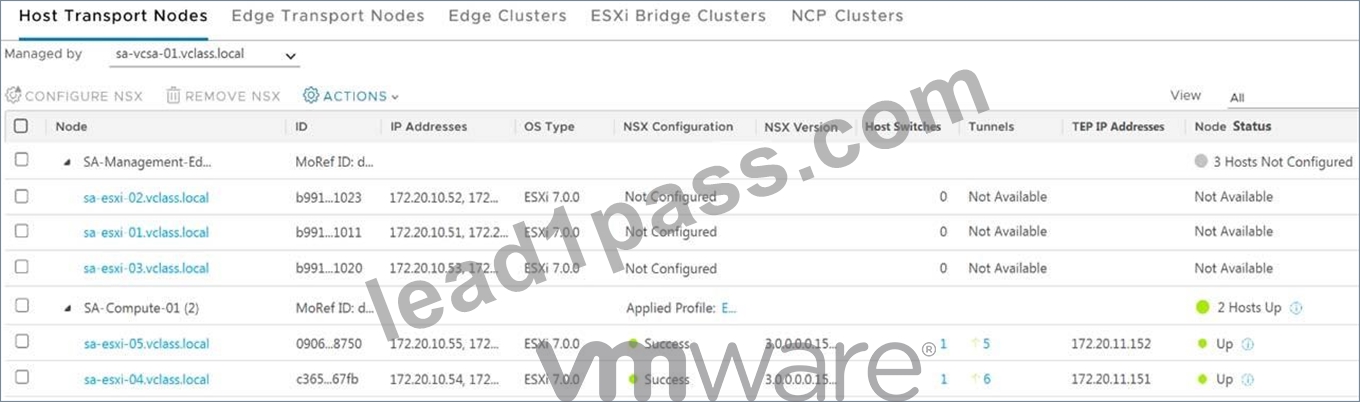
Which statement is true about the host transport nodes?
- A. sa-esxi-05.vclass.local is successfully prepared for NSX with a TEP address of 172.20.10.55.
- B. sa-esxi-04.vclass.local is successfully prepared for NSX with a TEP address of 172.20.11.151.
- C. sa-esxi-02.vclass.local is successfully prepared for NSX with a TEP address of 172.20.10.52.
- D. sa-esxi-03.vclass.local had an error while being prepared for NSX with no TEP address assigned.
Answer: B
NEW QUESTION # 35
A customer needs help detecting lateral threat movement on east-west network traffic across multi-cloud environments.
Which solution should the customer use?
- A. VMware HCX
- B. NSX Intelligence
- C. NSX Distributed IDS
- D. NSX SD-WAN
Answer: C
NEW QUESTION # 36
How can NSX-T Distributed Firewall help customers achieve security for newly migrated containerized applications?
- A. Quality of service
- B. Dynamic routing
- C. Micro-segmentation
- D. Network I/O control
Answer: C
Explanation:
The NSX-T Distributed Firewall helps customers achieve security for newly migrated containerized applications through micro-segmentation. Micro-segmentation allows for granular security policies to be applied at the individual workload level, providing isolation and protection within the virtual network.
References:
* NSX-T Data Center: Distributed Firewall
* Micro-Segmentation with NSX
NEW QUESTION # 37
A customer needs to create a multi-tier network infrastructure.
What does the customer need to do to create this infrastructure?
- A. Connect segments to a Tier-0 gateway, and connect the Tier-0 gateway to the Tier-1 gateway.
- B. Connect segments to the Tier-1 gateway only.
- C. Connect segments to the Tier-0 gateway only.
- D. Connect segments to a Tier-1 gateway, and connect the Tier-1 gateway to the Tier-0 gateway.
Answer: D
Explanation:
To create a multi-tier network infrastructure in NSX-T, the customer needs to connect segments to a Tier-1 gateway and then connect the Tier-1 gateway to the Tier-0 gateway. This setup allows for the separation of internal (Tier-1) and external (Tier-0) routing.
References:
* NSX-T Data Center Logical Routing
* Understanding Tier-0 and Tier-1 Gateways
NEW QUESTION # 38
A customer needs to manage and extend their data center network into VMware Cloud on AWS and Microsoft Azure Cloud.
Which VMware product should the customer use?
- A. vCloud Director Extender
- B. vRealize Network Insight Cloud
- C. NSX Intelligence
- D. NSX Cloud
Answer: D
Explanation:
NSX Cloud is the VMware product designed to manage and extend data center networks into VMware Cloud on AWS and Microsoft Azure Cloud. NSX Cloud provides consistent networking and security for applications running in both private data centers and public clouds, ensuring seamless connectivity and uniform policy enforcement across hybrid environments.
NEW QUESTION # 39
Which two components are part of the Data Plane in the NSX-T Data Center Architecture? (Choose two.)
- A. NSX Container Plugin (NCP)
- B. NSX Manager
- C. NSX Controller
- D. Hypervisor
- E. Edge Node
Answer: D,E
NEW QUESTION # 40
What does NSX-T provide to a telecom provider's network services related to network throughput?
- A. Higher recoverability
- B. Higher availability
- C. Higher performance
- D. Higher security
Answer: B
NEW QUESTION # 41
Given this exhibit:
Which statement is true about the firewall rule?
- A. It is a gateway firewall applied to a Tier-0 gateway that drops traffic on port 22.
- B. It is a distributed firewall applied to App-Servers, DB-Servers and Web-Servers that drops traffic on port 22.
- C. It is a gateway firewall applied to a Tier-1 gateway that rejects traffic on port 22.
- D. It is a distributed firewall applied to App-Servers, DB-Servers and Web-Servers that rejects traffic on port 22.
Answer: A
Explanation:
The firewall rule shown in the exhibit is part of a gateway firewall applied to a Tier-0 gateway (TO-GW-01).
The key indicators are the "Category: LOCAL GATEWAY" and the "Applied to: TO-GW-01". The rule is set to "Drop" SSH traffic (port 22) from any source to the destinations listed (App-Servers, DB-Servers, Web-Servers).
References:
* VMware NSX-T Data Center Documentation
* Understanding Firewall Categories in NSX-T
NEW QUESTION # 42
A customer notices that some virtual machines are not getting the required resources although some of the hosts in the cluster are underutilized.
Which component of vSphere can help solve the customer's problem?
- A. Distributed Resource Scheduler
- B. Admission Control
- C. Distributed Port Groups
- D. Proactive High Availability
Answer: A
Explanation:
The Distributed Resource Scheduler (DRS) can help solve the problem of virtual machines not getting required resources while some hosts in the cluster are underutilized. DRS balances the load across the hosts in a cluster by moving virtual machines to ensure optimal distribution of resources. It continuously monitors the cluster and makes adjustments to achieve better performance and resource utilization.
NEW QUESTION # 43
How can NSX-T Distributed Firewall help customers achieve security for newly migrated containerized applications?
- A. Quality of service
- B. Dynamic routing
- C. Micro-segmentation
- D. Network I/O control
Answer: C
Explanation:
Explanation/Reference: https://blogs.vmware.com/networkvirtualization/2020/04/nsx-t-3-0.html/
NEW QUESTION # 44
When is vCenter Server required to deploy NSX-T Data Center?
- A. To perform NSX license management
- B. To deploy NSX Edge virtual machines
- C. To deploy NSX Controller virtual machines
- D. To perform NSX certificate management
Answer: C
NEW QUESTION # 45
Which three solutions does the software-defined data center (SDDC) help build? (Choose three.)
- A. Public cloud
- B. Native cloud
- C. On premises
- D. Hybrid cloud
- E. Secure cloud
- F. Hyperscale
Answer: A,C,D
NEW QUESTION # 46
A customer has experienced a disaster.
Which statement describes a recovery benefit of a vSphere Environment with NSX Data Center?
- A. Workload mobility is tied to vCenter server.
- B. NSX Datacenter enables replication between sites.
- C. It is a requirement to stretch cluster to have a DR scenario.
- D. It simplifies the DR by not requiring the change of the IP addresses of workloads.
Answer: D
Explanation:
In a vSphere environment with NSX Data Center, a key recovery benefit during a disaster is the ability to simplify the disaster recovery (DR) process by not requiring the change of the IP addresses of workloads. This is due to NSX's ability to abstract the network configuration from the underlying physical infrastructure, allowing virtual machines to maintain their IP addresses regardless of their physical location.
References:
* VMware NSX-T Data Center: Disaster Recovery
* VMware NSX-T Data Center Architecture Overview
NEW QUESTION # 47
A customer needs to secure two virtual machines that are attached to the same segment.
How can the customer achieve network security using NSX Data Center?
- A. Configure a distributed firewall rule
- B. Move one of the virtual machines to a separate segment
- C. Install a personal firewall on each virtual machine
- D. Configure a physical firewall rule
Answer: A
NEW QUESTION # 48
......
1V0-41.20 Free Sample Questions to Practice One Year Update: https://simplilearn.lead1pass.com/VMware/1V0-41.20-practice-exam-dumps.html