

Verified AI-900 dumps Q&As - Pass Guarantee or Full Refund [May-2026]
AI-900 PDF Dumps | May 24, 2026 Recently Updated Questions
To pass the AI-900 exam, candidates need to demonstrate their knowledge of AI fundamentals and their ability to apply AI concepts to real-world scenarios. AI-900 exam consists of 40-60 multiple-choice and multiple-response questions, and candidates have 60 minutes to complete the exam. Microsoft recommends that candidates have some experience with Azure services and a basic understanding of programming concepts before taking the exam.
Microsoft AI-900 exam is intended for individuals who have a basic understanding of cloud computing and are familiar with one or more programming languages. AI-900 exam is also suitable for business professionals who want to understand how AI can impact their organization and how Azure AI services can be leveraged to achieve business goals.
Microsoft AI-900 certification exam, also known as the Microsoft Azure AI Fundamentals exam, is designed to validate a candidate's foundational knowledge of artificial intelligence (AI) and its applications in Microsoft Azure. AI-900 exam is suitable for professionals who are new to the field of AI and want to gain a basic understanding of the concepts and services offered by Microsoft Azure. It is also beneficial for individuals who are interested in pursuing a career in AI or want to enhance their existing skills.
NEW QUESTION # 127
You have an Azure Machine Learning model that predicts product quality. The model has a training dataset that contains 50,000 records. A sample of the data is shown in the following table.
For each of the following Statements, select Yes if the statement is true. Otherwise, select No.
NOTE: Each correct selection is worth one point.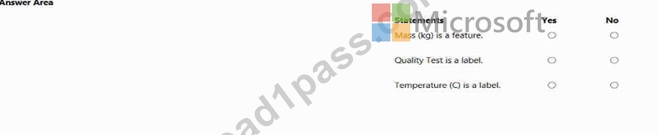
Answer:
Explanation: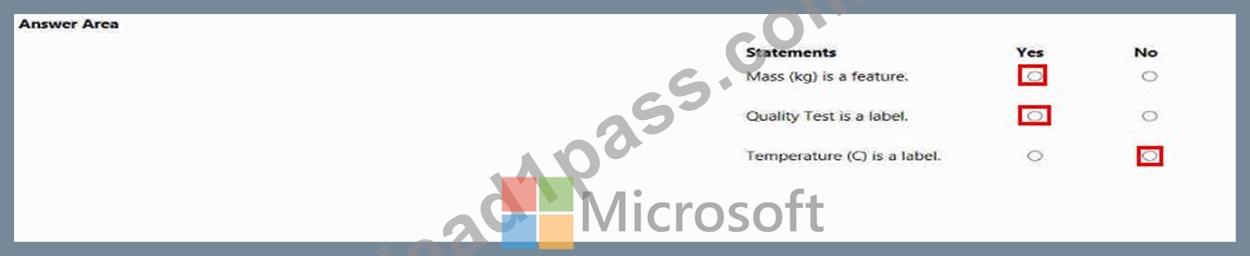
NEW QUESTION # 128
You plan to apply Text Analytics API features to a technical support ticketing system.
Match the Text Analytics API features to the appropriate natural language processing scenarios.
To answer, drag the appropriate feature from the column on the left to its scenario on the right. Each feature may be used once, more than once, or not at all.
NOTE: Each correct selection is worth one point.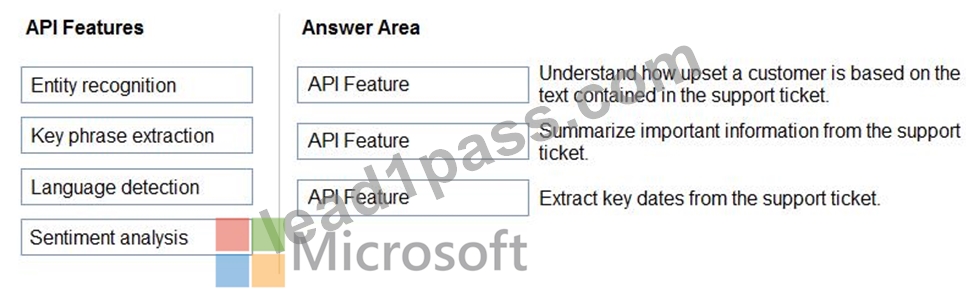
Answer:
Explanation: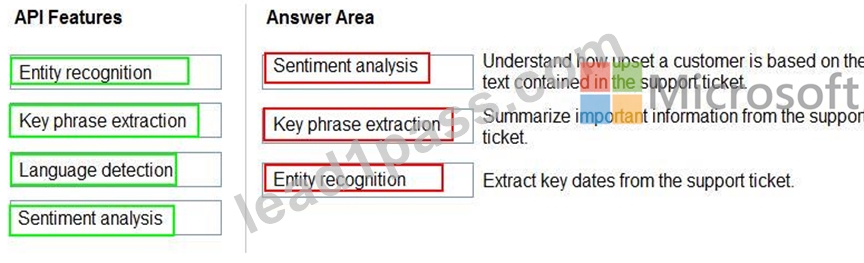
Reference:
https://docs.microsoft.com/en-us/azure/architecture/data-guide/technology-choices/natural-language-processing
https://azure.microsoft.com/en-us/services/cognitive-services/text-analytics
NEW QUESTION # 129
For each of the following statements, select Yes if the statement is true. Otherwise, select No.
NOTE: Each correct selection is worth one point.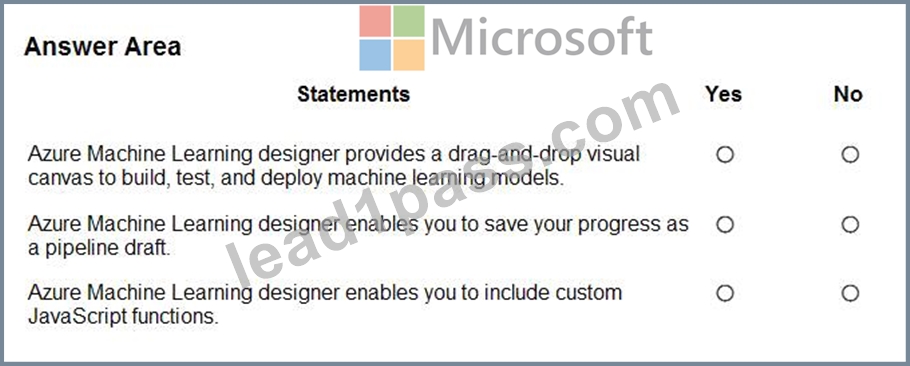
Answer:
Explanation: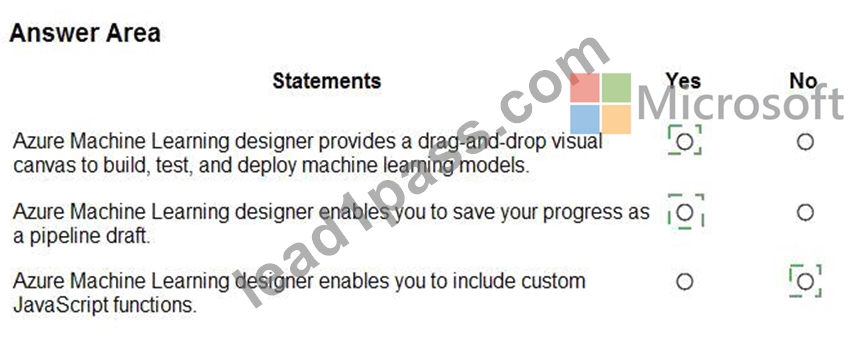
Explanation: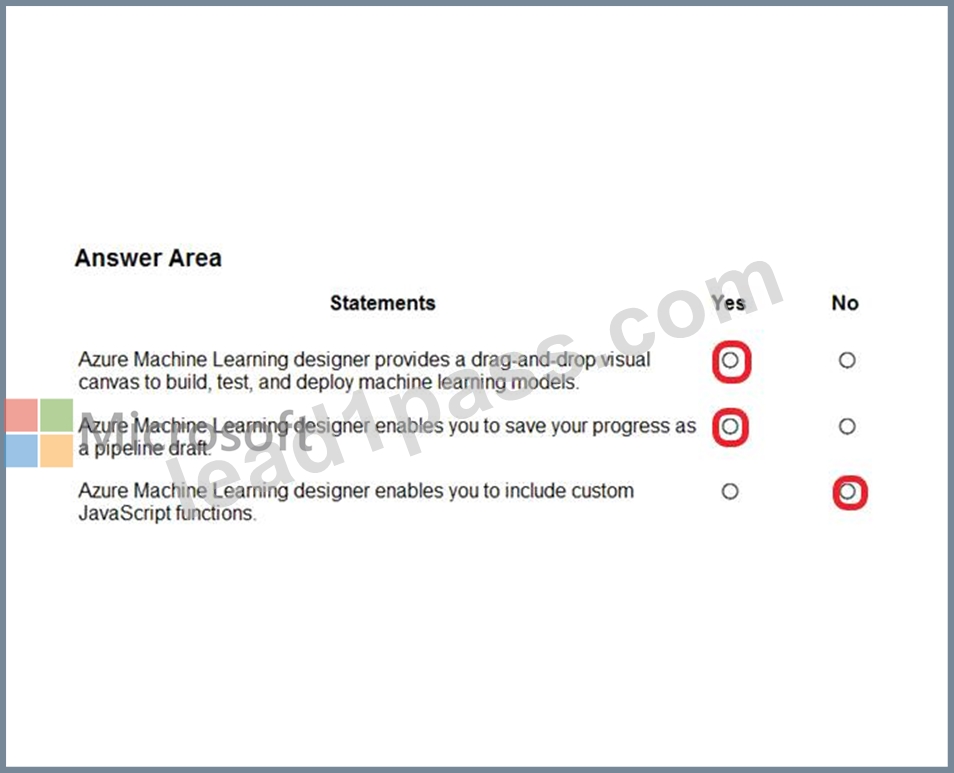
Box 1: Yes
Azure Machine Learning designer lets you visually connect datasets and modules on an interactive canvas to create machine learning models.
Box 2: Yes
With the designer you can connect the modules to create a pipeline draft.
As you edit a pipeline in the designer, your progress is saved as a pipeline draft.
Box 3: No
Reference:
https://docs.microsoft.com/en-us/azure/machine-learning/concept-designer
NEW QUESTION # 130
You plan to deploy an Azure Machine Learning model as a service that will be used by client applications.
Which three processes should you perform in sequence before you deploy the model? To answer, move the appropriate processes from the list of processes to the answer area and arrange them in the correct order.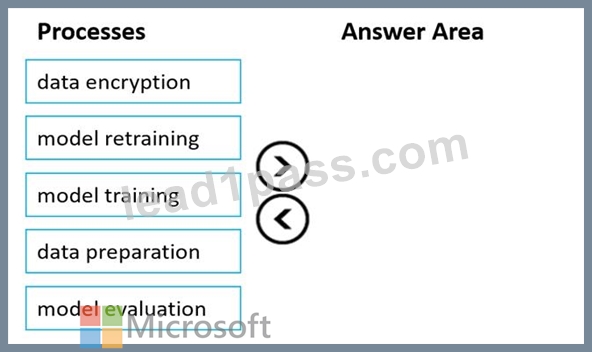
Answer:
Explanation: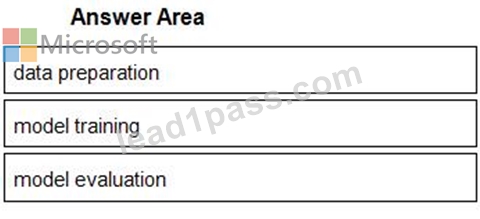
1 - data preparation
2 - model training
3 - model evaluation
Reference:
https://docs.microsoft.com/en-us/azure/machine-learning/concept-ml-pipelines
NEW QUESTION # 131
You have a database that contains a list of employees and their photos.
You are tagging new photos of the employees.
For each of the following statements select Yes if the statement is true. Otherwise, select No.
NOTE: Each correct selection is worth one point.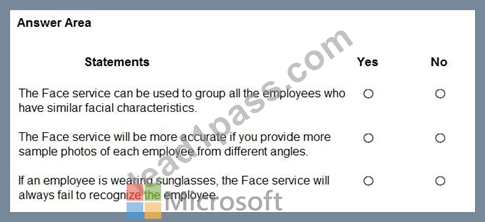
Answer:
Explanation: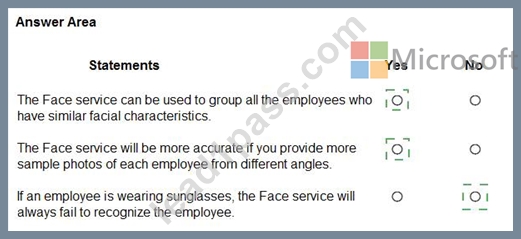
Explanation: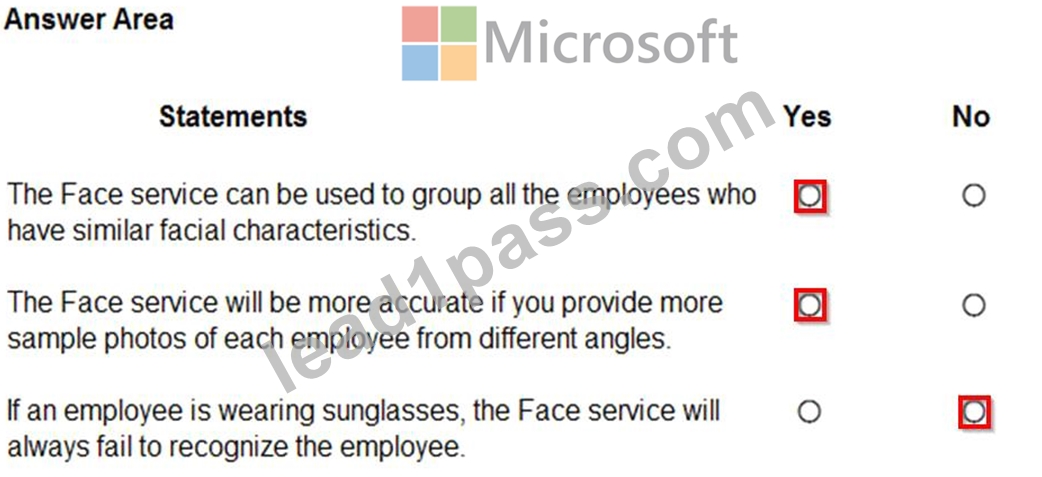
Reference:
https://docs.microsoft.com/en-us/azure/cognitive-services/face/overview
https://docs.microsoft.com/en-us/azure/cognitive-services/face/concepts/face-detection
NEW QUESTION # 132
For each of the following statements, select Yes if the statement is true. Otherwise, select No.
NOTE: Each correct selection is worth one point.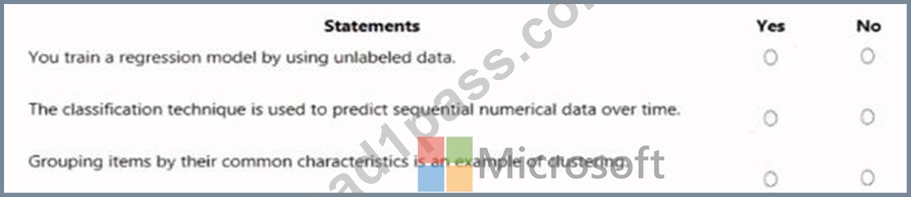
Answer:
Explanation: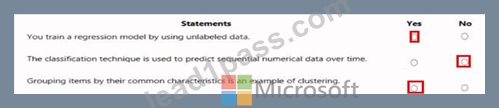
NEW QUESTION # 133
You use Azure Machine Learning designer to publish an inference pipeline.
Which two parameters should you use to consume the pipeline? Each correct answer presents part of the solution.
NOTE: Each correct selection is worth one point.
- A. the REST endpoint
- B. the authentication key
- C. the model name
- D. the training endpoint
Answer: A,B
Explanation:
Explanation
https://docs.microsoft.com/en-in/learn/modules/create-regression-model-azure-machine-learning-designer/deploy
NEW QUESTION # 134
You have a dataset that contains the columns shown in the following table.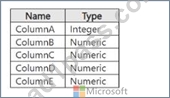
You have a machine learning model that predicts the value of ColumnE based on the other numeric columns.
Which type of model is this?
- A. regression
- B. clustering
- C. analysis
Answer: A
NEW QUESTION # 135
You are building an AI-based app.
You need to ensure that the app uses the principles for responsible AI.
Which two principles should you follow? Each correct answer presents part of the solution.
NOTE: Each correct selection is worth one point.
- A. Implement a process of Al model validation as part of the software review process
- B. Implement an Agile software development methodology
- C. Establish a risk governance committee that includes members of the legal team, members of the risk management team, and a privacy officer
- D. Prevent the disclosure of the use of Al-based algorithms for automated decision making
Answer: A,C
Explanation:
The correct answers are B. Implement a process of AI model validation as part of the software review process and C. Establish a risk governance committee that includes members of the legal team, members of the risk management team, and a privacy officer.
According to the Microsoft Azure AI Fundamentals (AI-900) Official Study Guide and the Microsoft Responsible AI principles, responsible AI emphasizes six key principles: fairness, reliability and safety, privacy and security, inclusiveness, transparency, and accountability. These principles ensure that AI systems are trustworthy, ethical, and safe for users and society.
Option B aligns with the reliability and safety principle. Model validation ensures that AI models behave as expected, perform accurately across different data conditions, and produce consistent results. Microsoft teaches that AI models should be validated, tested, and monitored regularly to avoid unintended outcomes, bias, or failures. Validation processes help ensure that the AI behaves responsibly before deployment and continues to perform reliably over time.
Option C aligns with the accountability and governance principle. Establishing a risk governance committee that includes legal, privacy, and risk management experts ensures that AI development and deployment are overseen responsibly. This committee is responsible for reviewing compliance with data protection laws, ensuring ethical practices, and managing risks associated with AI-driven decisions. Microsoft emphasizes that accountability requires human oversight and governance structures to ensure ethical alignment throughout the AI system's lifecycle.
The incorrect options are:
* A. Implement an Agile software development methodology: Agile is a software project management approach, not a Responsible AI principle.
* D. Prevent the disclosure of the use of AI-based algorithms: This violates the transparency principle, which requires organizations to disclose when and how AI is used.
Therefore, following the official Responsible AI framework taught in AI-900, the correct and verified answers are B and C, as they directly promote reliability, safety, accountability, and governance in AI systems.
NEW QUESTION # 136
To complete the sentence, select the appropriate option in the answer area.
Computer vision capabilities can be Deployed to....................
Answer:
Explanation:
NEW QUESTION # 137
You need to provide content for a business chatbot that will help answer simple user queries.
What are three ways to create question and answer text by using QnA Maker? Each correct answer presents a complete solution.
NOTE: Each correct selection is worth one point.
- A. Manually enter the questions and answers.
- B. Connect the bot to the Cortana channel and ask questions by using Cortana.
- C. Import chit-chat content from a predefined data source.
- D. Use automated machine learning to train a model based on a file that contains the questions.
- E. Generate the questions and answers from an existing webpage.
Answer: A,C,E
Explanation:
Section: Describe features of conversational AI workloads on Azure
Explanation:
Automatic extraction
Extract question-answer pairs from semi-structured content, including FAQ pages, support websites, excel files, SharePoint documents, product manuals and policies.
Reference:
https://docs.microsoft.com/en-us/azure/cognitive-services/qnamaker/concepts/content-types
NEW QUESTION # 138
For each of the following statements, select Yes if the statement is true. Otherwise, select No.
NOTE: Each correct selection is worth one point.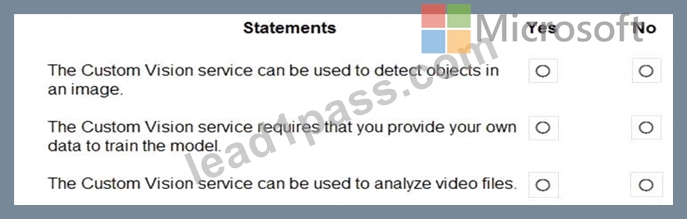
Answer:
Explanation: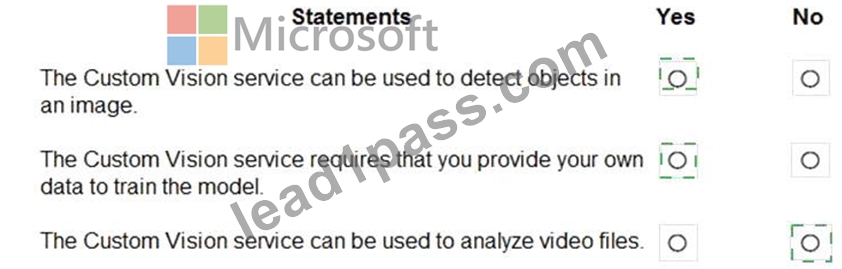
Explanation: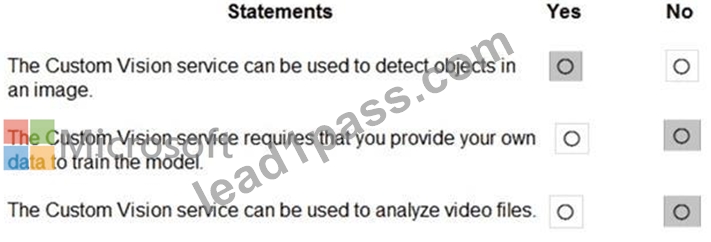
According to the Microsoft Azure AI Fundamentals (AI-900) study guide and Azure Cognitive Services documentation, the Custom Vision service is a specialized computer vision tool that allows users to build, train, and deploy custom image classification and object detection models. It is part of the Azure Cognitive Services suite, designed for scenarios where pre-built Computer Vision models do not meet specific business requirements.
* "The Custom Vision service can be used to detect objects in an image." # YesThis statement is true.
The Custom Vision service supports object detection, enabling the model to identify and locate multiple objects within a single image using bounding boxes. For example, it can locate cars, products, or animals in photos.
* "The Custom Vision service requires that you provide your own data to train the model." # YesThis statement is true. Unlike pre-trained models such as the standard Computer Vision API, the Custom Vision service requires users to upload and label their own images. The system uses this labeled dataset to train a model specific to the user's scenario, improving accuracy for custom use cases.
* "The Custom Vision service can be used to analyze video files." # NoThis statement is false. The Custom Vision service works only with static images, not videos. To analyze video files, Azure provides Video Indexer and Azure Media Services, which are designed for extracting insights from moving visual content.
NEW QUESTION # 139
For each of the following statements, select Yes if the statement is true. Otherwise, select No.
NOTE; Each correct selection is worth one point.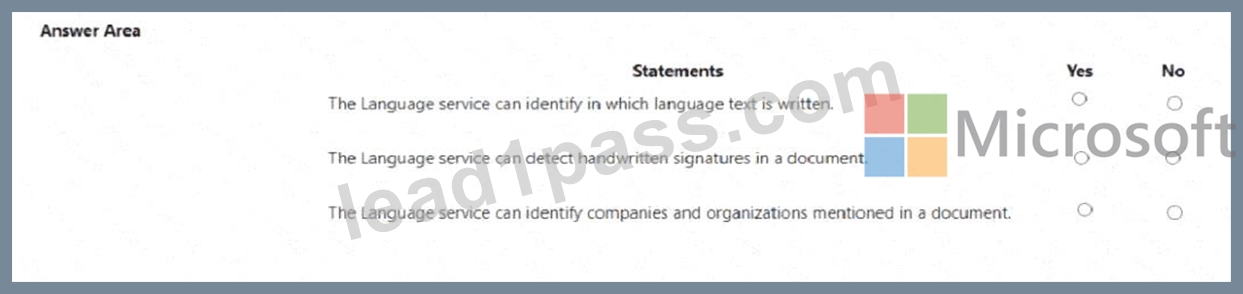
Answer:
Explanation: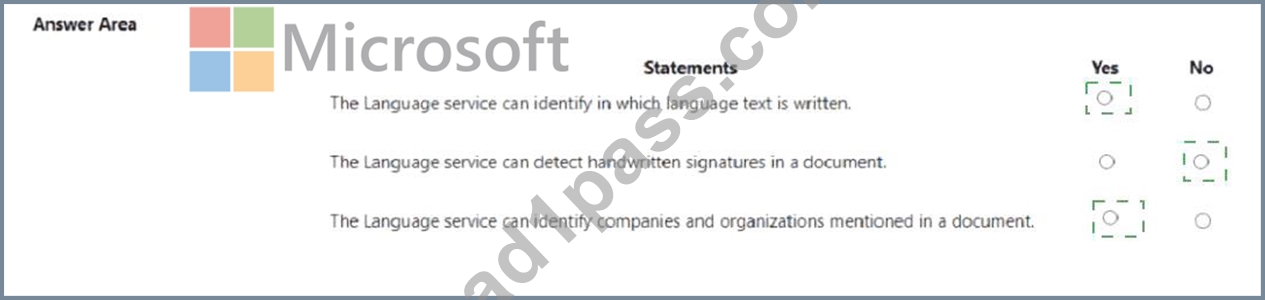
Explanation: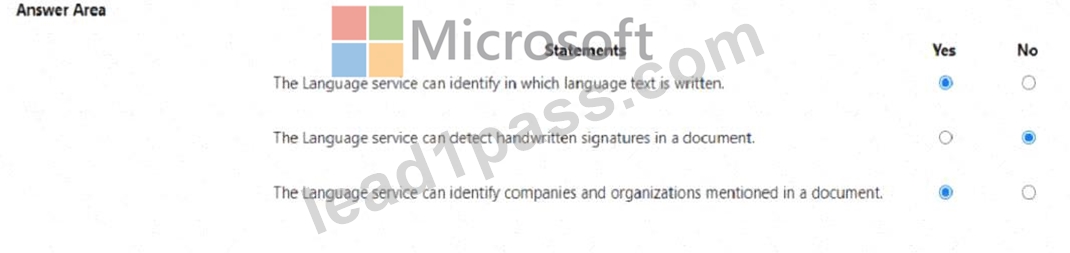
According to the Microsoft Azure AI Fundamentals (AI-900) official study guide and Microsoft Learn modules on machine learning concepts, ensuring that the accuracy of a predictive model can be proven requires data partitioning-specifically splitting the available data into training and testing datasets. This is a foundational concept in supervised machine learning.
When you split the data, typically about 70-80% of the dataset is used for training the model, while the remaining 20-30% is used for testing (or validation). The reason behind this approach is to ensure that the model's performance metrics-such as accuracy, precision, recall, and F1-score-are evaluated on data the model has never seen before. This prevents overfitting and allows you to demonstrate that the model generalizes well to new, unseen data.
In the AI-900 Microsoft Learn content under "Describe the machine learning process", it is explained that after cleaning and transforming the data, the next essential step is data splitting to "evaluate model performance objectively." By keeping training and testing data separate, you can prove the reliability and accuracy of the model's predictions, which is particularly crucial in sensitive domains like clinical or healthcare analytics, where decision transparency and validation are vital.
* Option A (Train the model by using the clinical data) is incorrect because you should not train and evaluate on the same data-it would lead to biased results.
* Option C (Train the model using automated ML) is incorrect because automated ML is a method for training and tuning, but it doesn't inherently prove accuracy.
* Option D (Validate the model by using the clinical data) is also incorrect if you use the same dataset for validation and training-it would not prove true accuracy.
Therefore, per Microsoft's official AI-900 study content, the verified correct answer is B. Split the clinical data into two datasets.
NEW QUESTION # 140
Extracting relationships between data from large volumes of unstructured data is an example of which type of Al workload?
- A. computer vision
- B. natural language processing (NLP)
- C. knowledge mining
- D. anomaly detection
Answer: C
Explanation:
Extracting relationships and insights from large volumes of unstructured data (such as documents, text files, or images) aligns with the Knowledge Mining workload in Microsoft Azure AI. According to the Microsoft AI Fundamentals (AI-900) study guide and Microsoft Learn module "Describe features of common AI workloads," knowledge mining involves using AI to search, extract, and structure information from vast amounts of unstructured or semi-structured content.
In a typical knowledge mining solution, tools like Azure AI Search and Azure AI Document Intelligence work together to index data, apply cognitive skills (such as OCR, key phrase extraction, and entity recognition), and then enable users to discover relationships and patterns through intelligent search. The process transforms raw content into searchable knowledge.
The key characteristics of knowledge mining include:
* Using AI to extract entities and relationships between data points.
* Applying cognitive skills to text, images, and documents.
* Creating searchable knowledge stores from unstructured data.
Hence, B. Knowledge Mining is correct.
The other options-computer vision, NLP, and anomaly detection-deal with image recognition, language understanding, and data irregularities, respectively, not large-scale information extraction.
NEW QUESTION # 141
You plan to deploy an Azure Machine Learning model as a service that will be used by client applications.
Which three processes should you perform in sequence before you deploy the model? To answer, move the appropriate processes from the list of processes to the answer area and arrange them in the correct order.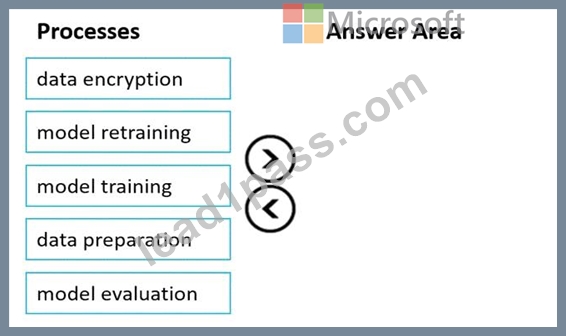
Answer:
Explanation: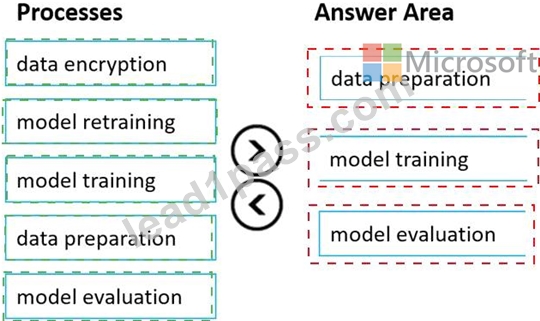
Explanation
Graphical user interface, text, application, chat or text message Description automatically generated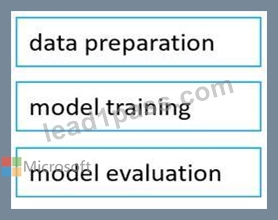
Reference:
https://docs.microsoft.com/en-us/azure/machine-learning/concept-ml-pipelines
NEW QUESTION # 142
You need to determine the location of cars in an image so that you can estimate the distance between the cars.
Which type of computer vision should you use?
- A. face detection
- B. image classification
- C. object detection
- D. optical character recognition (OCR)
Answer: C
Explanation:
Explanation
Object detection is similar to tagging, but the API returns the bounding box coordinates (in pixels) for each object found. For example, if an image contains a dog, cat and person, the Detect operation will list those objects together with their coordinates in the image. You can use this functionality to process the relationships between the objects in an image. It also lets you determine whether there are multiple instances of the same tag in an image.
The Detect API applies tags based on the objects or living things identified in the image. There is currently no formal relationship between the tagging taxonomy and the object detection taxonomy. At a conceptual level, the Detect API only finds objects and living things, while the Tag API can also include contextual terms like
"indoor", which can't be localized with bounding boxes.
Reference:
https://docs.microsoft.com/en-us/azure/cognitive-services/computer-vision/concept-object-detection
NEW QUESTION # 143
To complete the sentence, select the appropriate option in the answer area.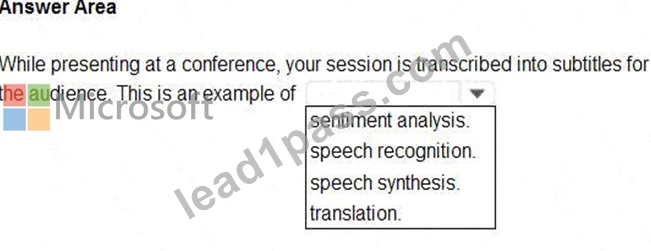
Answer:
Explanation: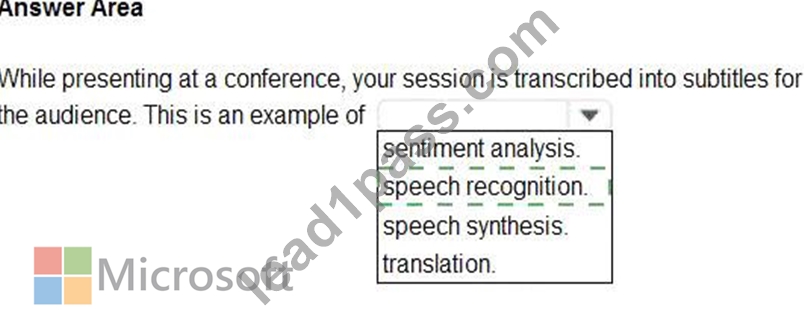
Explanation: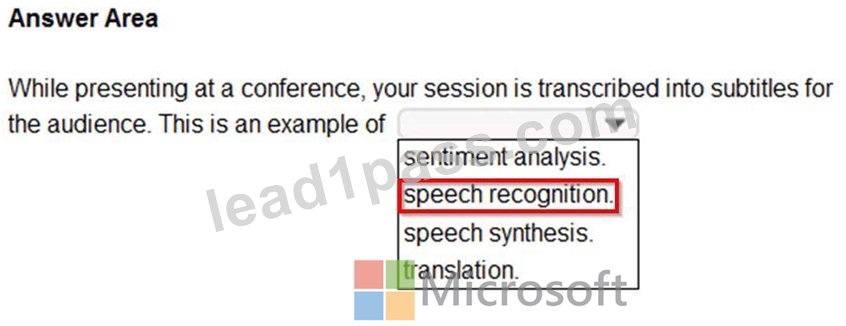
According to the Microsoft Azure AI Fundamentals (AI-900) official study guide and the Microsoft Learn module "Identify features and uses of speech capabilities", speech recognition refers to the process of converting spoken words into written text. When a speaker's voice is transcribed into subtitles during a presentation, the system listens to the audio input, identifies the spoken words, and generates corresponding text in real time. This is precisely what speech recognition technology accomplishes.
Azure provides this functionality through the Azure Speech Service, which supports multiple speech-related features:
* Speech-to-Text (Speech Recognition) - Converts spoken audio into text.
* Text-to-Speech (Speech Synthesis) - Converts written text into spoken audio.
* Speech Translation - Translates spoken words into another language.
In this case, the session is transcribed into subtitles in the same language, not translated or spoken aloud, so the correct feature is Speech Recognition.
Let's review the other options:
* Sentiment Analysis: This belongs to the Text Analytics service under natural language processing (NLP) and is used to determine the emotional tone of text, not to convert speech to text.
* Speech Synthesis: Converts text into audible speech (Text-to-Speech), the reverse of what is happening in this scenario.
* Translation: Converts spoken or written words from one language to another. Here, no translation is mentioned-only transcription.
Therefore, the described process-turning live spoken language into readable subtitles-is an example of Speech Recognition, a speech-to-text AI capability provided by Azure Cognitive Services.
Final answer: Speech recognition
Reference:Microsoft Learn - Identify speech capabilities of Azure AI services (AI-900 Learning Path)
NEW QUESTION # 144
You have 100 instructional videos that do NOT contain any audio. Each instructional video has a script. You need to generate a narration audio file for each video based on the script. Which type of workload should you use?
- A. translation
- B. speech recognition
- C. speech synthesis
- D. language modeling
Answer: C
Explanation:
Speech synthesis, also known as text-to-speech (TTS), is the AI workload that converts written text into spoken words. In this case, the task is to generate narration audio from provided scripts for silent instructional videos.
Speech recognition performs the opposite function - it converts speech into text. Language modeling is for text understanding and prediction (e.g., GPT). Translation converts text between languages, not from text to audio.
Therefore, the most appropriate workload, according to Microsoft's AI-900 study material under the "Speech AI capabilities" section, is speech synthesis, which enables natural voice narration generation.
NEW QUESTION # 145
For each of the following statements, select Yes if the statement is true. Otherwise, select No.
NOTE: Each correct selection is worth one point.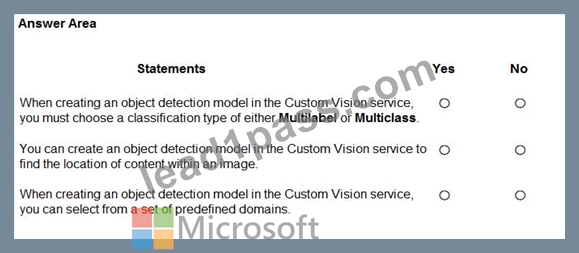
Answer:
Explanation: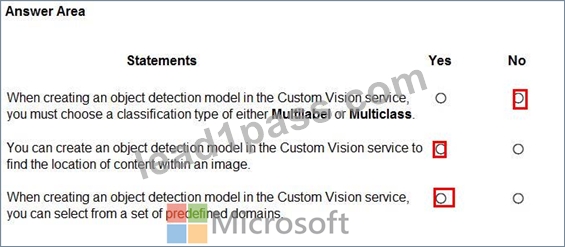
Reference:
https://docs.microsoft.com/en-us/azure/cognitive-services/custom-vision-service/get-started-build-detector
NEW QUESTION # 146
Which two scenarios are examples of a natural language processing workload? Each correct answer presents a complete solution.
NOTE; Each correct selection is worth one point.
- A. assembly line machinery that autonomously inserts headlamps into cars
- B. a website that uses a knowledge base to interactively respond to users' questions
- C. monitoring the temperature of machinery to turn on a fan when the temperature reaches a specific threshold
- D. a smart device in the home that responds to questions such as, "What will the weather be like today?
Answer: B,D
NEW QUESTION # 147
......
AI-900 Exam Questions – Valid AI-900 Dumps Pdf: https://simplilearn.lead1pass.com/Microsoft/AI-900-practice-exam-dumps.html