

Passing HashiCorp HCVA0-003 Exam Using 2025 Practice Tests
HCVA0-003 Study Guide Brilliant HCVA0-003 Exam Dumps PDF
HashiCorp HCVA0-003 Exam Syllabus Topics:
| Topic | Details |
|---|---|
| Topic 1 |
|
| Topic 2 |
|
| Topic 3 |
|
| Topic 4 |
|
| Topic 5 |
|
NEW QUESTION # 152
What command can be used to revoke all leases associated with a database role named prod-mysql?
- A. vault revoke database/role/prod-mysql
- B. vault lease revoke -prefix database/creds/prod-mysql
- C. vault lease revoke database/creds/prod-mysql
- D. vault lease revoke database/role/prod-mysql
Answer: B
Explanation:
Comprehensive and Detailed In-Depth Explanation:
To revoke all leases tied to a specific database role like prod-mysql, the correct command leverages the - prefix flag:
* B. vault lease revoke -prefix database/creds/prod-mysql: This command revokes all leases with the prefix database/creds/prod-mysql, which corresponds to credentials generated by the prod-mysql role in the database secrets engine. "To immediately revoke all leases associated with a specific role, the user can run the command vault lease revoke -prefix database/creds/prod-mysql," ensuring targeted revocation without affecting other roles.
* Incorrect Options:
* A. vault lease revoke database/role/prod-mysql: Incorrect path; roles are at database/roles/, not leases. "Does not specify the correct path for revoking leases."
* C. vault revoke: Missing lease subcommand; incorrect syntax. "Does not follow the correct syntax for revoking leases."
* D. vault lease revoke database/creds/prod-mysql: Targets a single lease, not all, without - prefix. "Does not include the -prefix flag to revoke all leases." The -prefix approach ensures comprehensive lease cleanup for the role.
Reference:https://developer.hashicorp.com/vault/docs/commands/lease/revoke#examples
NEW QUESTION # 153
Jarrad is an AWS engineer and has provisioned a new EC2 instance running MySQL since his application requires a specific MySQL version. He wants to integrate Vault into his workflow but is new to Vault. What secrets engine should Jarrad use to integrate this new database running in AWS?
- A. aws
- B. azure
- C. database
- D. kv
Answer: C
Explanation:
Comprehensive and Detailed In-Depth Explanation:
For integrating a MySQL database on an EC2 instance with Vault, thedatabase secrets engineis the appropriate choice:
* B. database: "The 'database' secrets engine in Vault is specifically designed for integrating with databases like MySQL." It generates dynamic credentials, manages rotations, and supports MySQL plugins, ideal for Jarrad's use case. "To manage the database resource, the database secrets engine should be used, specifically with the MySQL plugin."
* Incorrect Options:
* A. azure: For Azure-specific credential management, not databases. "Used for generating Azure service principal credentials."
* C. kv: Stores static secrets, not dynamic database credentials. "Used for storing arbitrary secrets in a key-value pair format."
* D. aws: Manages AWS credentials, not database integration. "Used for generating AWS access keys." The database engine's MySQL support is agnostic to the hosting platform (EC2 vs. RDS), focusing on the database itself.
Reference:https://developer.hashicorp.com/vault/docs/secrets/databases/mysql-maria
NEW QUESTION # 154
What are the primary benefits of running Vault in a production deployment over dev server mode (select two)?
- A. Persistent storage
- B. Ability to enable auth methods
- C. Faster deployment
- D. Encryption via TLS
Answer: A,D
Explanation:
Comprehensive and Detailed in Depth Explanation:
* A:Dev mode is faster to deploy; incorrect.
* B:Production uses persistent storage vs. dev's in-memory. Correct.
* C:Auth methods work in both modes. Incorrect.
* D:Production enables TLS; dev uses plaintext. Correct.
Overall Explanation from Vault Docs:
"Dev server mode stores data in memory... Production mode supports persistent storage and TLS encryption." Reference:https://developer.hashicorp.com/vault/docs/concepts/dev-server
NEW QUESTION # 155
True or False? Although AppRole is designed for machines, humans can use it to authenticate to Vault if you wish.
- A. False
- B. True
Answer: B
Explanation:
Comprehensive and Detailed In-Depth Explanation:
AppRole's flexibility allows human use:
* A. True: "Although AppRole is primarily designed for machine-to-machine authentication, it can also be used by humans to authenticate to Vault if needed." It uses a role_id and secret_id, which, while less convenient for humans, are technically usable. "Yeah, absolutely. Although it's not super friendly for us humans to remember the values, you could use it if you wanted to."
* Incorrect Option:
* B. False: Incorrect; it's not restricted to machines only.
This adaptability broadens AppRole's applicability.
Reference:https://developer.hashicorp.com/vault/docs/auth/approle
NEW QUESTION # 156
True or False? All dynamic secrets in Vault are required to have a lease.
- A. False
- B. True
Answer: B
Explanation:
Comprehensive and Detailed in Depth Explanation:
* A:All dynamic secrets (e.g., database creds) have leases for lifecycle management. Correct.
* B:Incorrect; leases are mandatory for dynamic secrets.
Overall Explanation from Vault Docs:
"All dynamic secrets in Vault are required to have a lease... forcing consumers to check in routinely." Reference:https://developer.hashicorp.com/vault/docs/concepts/lease
NEW QUESTION # 157
Your Azure Subscription ID is stored in Vault and you need to retrieve it via Vault API for an automated job.
The Subscription ID is stored at secret/cloud/azure/subscription. The secret is stored on a KV Version 2 secrets engine. What curl command below would successfully retrieve the latest version of the secret?
- A. curl --header "X-Vault-Token: hvs.CbzCNJCVWt63jyzyaJakgDwz" https://vault.krausen.com:8200/v1
/secret/cloud/azure/subscription - B. curl --header "X-Vault-Token: hvs.CbzCNJCVWt63jyzyaJakgDwz"https://vault.krausen.com:8200/v1
/secret/data/cloud/azure/subscription - C. curl https://vault.krausen.com:8200/v1/secret/data/cloud/azure/subscription
- D. curl --header "X-Vault-Token: hvs.CbzCNJCVWt63jyzyaJakgDwz" https://vault.krausen.com:8200
/secret/data/cloud/azure/subscription/latest
Answer: B
Explanation:
Comprehensive and Detailed In-Depth Explanation:
For a KV v2 secrets engine, the API path to retrieve a secret's data is /v1/<mount>/data/<path>. Here, the mount is secret/, and the path is cloud/azure/subscription, making the correct endpoint /v1/secret/data/cloud
/azure/subscription. Authentication requires the X-Vault-Token header with a valid token. Option C matches this exactly and retrieves the latest version by default, as per KV v2 API behavior. Option A lacks the token.
Option B omits the /data/ segment, invalid for KV v2. Option D adds /latest, which isn't a valid KV v2 endpoint. The KV v2 API docs confirm this structure.
References:
KV v2 API Docs
Vault API Overview
NEW QUESTION # 158
When Vault is sealed, which are the only two operations available to a Vault administrator? (Select two)
- A. Author security policies
- B. Unseal Vault
- C. Rotate the encryption key
- D. View data stored in the key/value store
- E. View the status of Vault
- F. Configure policies
Answer: B,E
Explanation:
Comprehensive and Detailed in Depth Explanation:
When Vault is sealed, its functionality is severely restricted to protect encrypted data. The HashiCorp Vault documentation states: "While Vault is sealed, the only two options available are viewing the vault status (vault status) and unsealing Vault (vault operator unseal). All the other actions require Vault to be unsealed and the user to be authenticated." This limitation ensures that no operations can access or modify data until the Vault is unsealed, enhancing security.
The documentation under "Shamir Seals" further elaborates: "When Vault is sealed, it knows where its encrypted data is stored but cannot decrypt it because the master key is not in memory. The only available operations are checking the seal status and initiating the unseal process." Thus:
* A (View the status of Vault): The vault status command works when sealed, providing details like seal state.
* E (Unseal Vault): The vault operator unseal command allows administrators to begin unsealing.
Options likeconfigure policies (B),view data in the key/value store (C),rotate the encryption key (D), and author security policies (F)require an unsealed Vault and authentication, making A and E the correct selections.
Reference:
HashiCorp Vault Documentation - Seal Concepts: Shamir Seals
HashiCorp Vault Documentation - Vault Status Command
NEW QUESTION # 159
Which statement best explains how Vault handles data encryption?
- A. Vault encrypts data using a root key stored in plain text on the server's filesystem.
- B. Vault offloads all encryption to third-party services, so no secret data is ever processed by Vault.
- C. Vault uses encryption to secure data at rest and in transit, using an encryption key protected by the root key.
- D. Vault stores data in plaintext on disk but encrypts it only when transmitting it over the network.
Answer: C
Explanation:
Comprehensive and Detailed in Depth Explanation:
Vault's encryption mechanism is a core security feature. The HashiCorp Vault documentation states: "When a Vault server is started, it starts in a sealed state. In this state, Vault is configured to know where and how to access the physical storage, but doesn't know how to decrypt any of it. Unsealing is the process of obtaining the plaintext root key necessary to read the decryption key to decrypt the data, allowing access to the Vault." It further explains: "Vault uses encryption to secure data at rest and in transit, using an encryption key protected by the root key." The documentation details: "The data stored by Vault is encrypted using an encryption key in the keyring.
This keyring is itself encrypted by the root key, which is protected by the unseal process (e.g., Shamir's Secret Sharing or auto-unseal). Vault ensures data is encrypted both at rest in the storage backend and in transit over the network using TLS." Option B is false-the root key is never stored in plaintext. Option C is incorrect- data is encrypted at rest, not just in transit. Option D is wrong-Vault performs encryption internally, not via third-party services. Thus, A is correct.
Reference:
HashiCorp Vault Documentation - Seal Concepts
NEW QUESTION # 160
Over a few years, you have a lot of data that has been encrypted by older versions of a Transit encryption key.
Due to compliance regulations, you have to re-encrypt the data using the newest version of the encryption key. What is the easiest way to complete this task without putting the data at risk?
- A. Use the transit rewrap feature
- B. Create a new master key used by Vault
- C. Decrypt the data manually and encrypt it with the latest version
- D. Rotate the encryption key used to encrypt the data
Answer: A
Explanation:
Comprehensive and Detailed In-Depth Explanation:
The Transit rewrap feature re-encrypts data safely. The Vault documentation states:
"Luckily, Vault provides an easy way of re-wrapping encrypted data when a key is rotated. Using the rewrap API endpoint, a non-privileged Vault entity can send data encrypted with an older version of the key to have it re-encrypted with the latest version. The application performing the re-wrapping never interacts with the decrypted data."
-Transit Rewrap Tutorial
* C: Correct. Rewrap avoids decryption risks:
"Using the transit rewrap feature in Vault allows you to re-encrypt the data without decrypting it first."
-Transit Rewrap Tutorial
* A: Rotation doesn't re-encrypt existing data.
* B: Manual decryption exposes data.
* D: Master key changes don't affect Transit data.
References:
Transit Rewrap Tutorial
NEW QUESTION # 161
You have a 2GB Base64 binary large object (blob) that needs to be encrypted. Which of the following best describes the transit secrets engine?
- A. A data key encrypts the blob locally, and the same key decrypts the blob locally.
- B. Vault will store the blob permanently. Be sure to run Vault on a compute optimized machine
- C. The transit engine is not a good solution for binaries of this size.
- D. To process such a large blob. Vault will temporarily store it in the storage backend.
Answer: C
Explanation:
The transit secrets engine is not a good solution for binaries of this size, because it is designed to handle cryptographic functions on data in-transit, not data at-rest. The transit secrets engine does not store any data sent to it, so it would require sending the entire 2GB blob to Vault for encryption or decryption, which would be inefficient and impractical. A better solution would be to use the transit secrets engine to generate a data key, which is a high-entropy key that can be used to encrypt or decrypt data locally. The data key can be returned in plaintext or wrapped by another key, depending on the use case. This way, the transit secrets engine only handles the encryption or decryption of the data key, not the data itself, and the data can be stored in any primary data store. References: Transit - Secrets Engines | Vault | HashiCorp Developer, Encryption as a service: transit secrets engine | Vault | HashiCorp Developer
NEW QUESTION # 162
How does the Vault Secrets Operator (VSO) assist in integrating Kubernetes-based workloads with Vault?
- A. By injecting a Vault Agent directly into the pod requesting secrets from Vault
- B. By using client-side caching for KVv1 and KVv2 secrets engines
- C. By enabling a local API endpoint to allow the workload to make requests directly from the VSO
- D. By watching for changes to its supported set of Custom Resource Definitions (CRD)
Answer: D
Explanation:
Comprehensive and Detailed in Depth Explanation:
The Vault Secrets Operator (VSO) integrates Kubernetes workloads with Vault by syncing secrets. Let's evaluate:
* A:VSO doesn't create a local API endpoint for direct requests; it syncs secrets to Kubernetes Secrets.
Incorrect.
* B:Client-side caching is a Vault Agent feature, not VSO's primary function. VSO can use caching, but it's not the main integration method. Incorrect.
* C:VSO doesn't inject Vault Agents; that's a separate Vault Agent Sidecar approach. Incorrect.
* D:VSO watches Custom Resource Definitions (CRDs) to sync Vault secrets to Kubernetes Secrets dynamically. This is its core mechanism. Correct.
Overall Explanation from Vault Docs:
"VSO operates by watching for changes to its supported set of CRDs... It synchronizes secrets from Vault to Kubernetes Secrets, ensuring applications access them natively." Reference:https://developer.hashicorp.com/vault/docs/platform/k8s/vso
NEW QUESTION # 163
The Vault Agent provides which of the following benefits? (Select three)
- A. Token renewal
- B. Automatically creates secrets in the desired storage backend
- C. Authentication to Vault
- D. Client-side caching of responses
Answer: A,C,D
Explanation:
Comprehensive and Detailed in Depth Explanation:
The Vault Agent is a client daemon designed to simplify integration with Vault by providing several key benefits. According to the HashiCorp Vault documentation, these include:
* Token Renewal: "Vault Agent automatically renews tokens issued by Vault," ensuring continuous access without manual intervention.
* Authentication to Vault: "Vault Agent provides authentication to Vault," allowing applications to authenticate using their identity without managing tokens directly.
* Client-side caching of responses: "Vault Agent offers client-side caching of responses," improving performance by reducing server requests.
However,automatically creating secrets in the desired storage backendis not a function of Vault Agent.
Secret creation is handled by Vault's secrets engines, not the agent, which focuses on authentication, token management, and caching. Thus, A, B, and C are the correct benefits.
Reference:
HashiCorp Vault Documentation - Vault Agent
NEW QUESTION # 164
Which of the following are considered benefits of using policies in Vault? (Select three)
- A. Policies provide Vault operators with role-based access control
- B. Provides granular access control to paths within Vault
- C. Policies are assigned to a token on a 1:1 basis to eliminate conflicting policies
- D. Policies have an implicit deny, meaning that policies are deny by default
Answer: A,B,D
Explanation:
Comprehensive and Detailed In-Depth Explanation:
Vault policies offer several benefits for access control. The Vault documentation states:
"There are many benefits to using Vault policies, including:
* Provides granular access control to paths within Vault to control who can access certain paths inside Vault
* Policies have an implicit deny, meaning that policies are deny by default - no policy means no authorization
* Policies provide Vault operators with role-based access control so you can ensure users only have access to the paths required"-Vault Tutorials: Policies
* B: Correct. Granular control is a core feature.
* C: Correct. Implicit deny enhances security:
"Policies in Vault follow the principle of least privilege by having an implicit deny."
-Vault Policies
* D: Correct. Role-based access simplifies management.
* A: Incorrect; tokens can have multiple policies:
"Policies are indeed attached to tokens, but tokens can be assigned more than one policy if needed. Policies are cumulative and capabilities are additive."
-Vault Tutorials: Policies
References:
Vault Tutorials: Policies
Vault Policies
NEW QUESTION # 165
Which statement most accurately describes how the response wrapping feature functions in Vault?
- A. Vault divides the response into separate parts and stores each part in different tokens, requiring all tokens to be combined before disclosing the secret to the requesting client.
- B. Vault encrypts the response with a dedicated key and sends it directly to the client, never storing it on the server or using single-use tokens for additional security.
- C. Vault takes the response it would have sent to an HTTP client and instead inserts it into the cubbyhole of a single-use token, returning that single-use token instead.
- D. Vault duplicates the response within a persistent token and allows multiple unwraps, ensuring that any user with the correct token can retrieve the secret repeatedly without time restrictions.
Answer: C
Explanation:
Comprehensive and Detailed in Depth Explanation:
The response wrapping feature in Vault functions by securing responses in a single-use token's cubbyhole.
The HashiCorp Vault documentation states: "To help address this problem, Vault includes a feature called response wrapping. When requested, Vault can take the response it would have sent to an HTTP client and instead insert it into the cubbyhole of a single-use token, returning that single-use token instead." This ensures the response is accessible only once by the intended recipient.
The docs further explain: "Logically speaking, the response is wrapped by the token, and retrieving it requires an unwrap operation against this token. Functionally speaking, the token provides authorization to use an encryption key from Vault's keyring to decrypt the data." Options B, C, and D misrepresent this process-no dedicated key encryption, no splitting into multiple tokens, and no persistent multi-use tokens occur. Thus, A is correct.
Reference:
HashiCorp Vault Documentation - Response Wrapping
NEW QUESTION # 166
You've hit the URL for the Vault UI, but you're presented with this screen. Why doesn't Vault present you with a way to log in?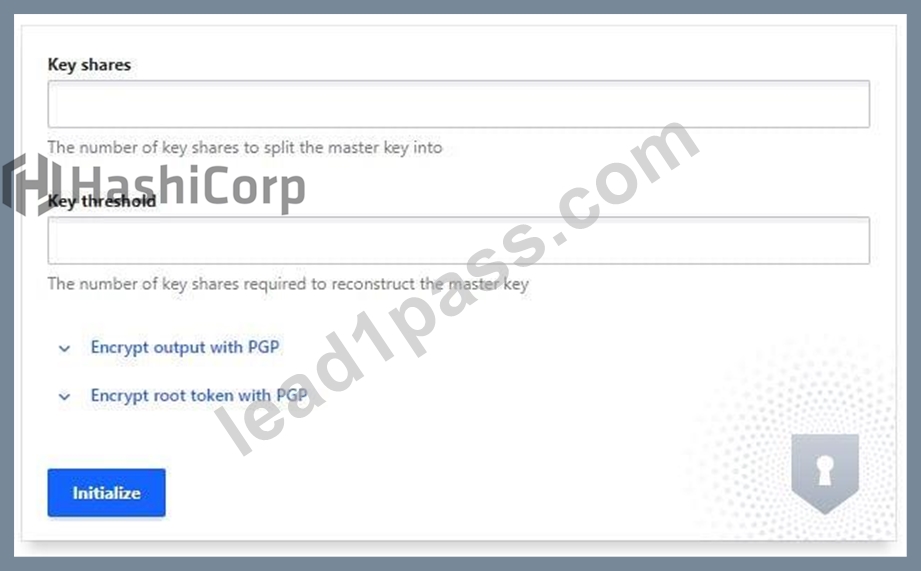
- A. A Vault policy is preventing you from logging in
- B. The Vault configuration file has an incorrect configuration
- C. The Consul storage backend was not configured correctly
- D. Vault needs to be initialized before it can be used
Answer: D
Explanation:
Comprehensive and Detailed in Depth Explanation:
The initialization page means Vault is new or reset. Let's evaluate:
* A:Storage issues don't trigger this screen; they'd cause errors post-init. Incorrect.
* B:Vault requires initialization (vault operator init) to set up keys and enable login. Correct.
* C:Policies apply post-login, not pre-init. Incorrect.
* D:Config errors would prevent Vault from starting, not show this screen. Incorrect.
Overall Explanation from Vault Docs:
"Before Vault can be used, it must be initialized and unsealed... This screen indicates Vault has not been initialized yet." Reference:https://developer.hashicorp.com/vault/docs/commands/operator/init
NEW QUESTION # 167
Which of the following statements are true about HCP Vault Dedicated? (Select three)
- A. Increases reliability and ease of use so you can onboard applications and teams easily
- B. Provides 100% feature parity compared to Vault self-managed clusters
- C. Helps reduce operational overhead for organizations with push-button deployment and fully managed upgrades
- D. Increases security across clouds and machines through a single interface
Answer: A,C,D
Explanation:
Comprehensive and Detailed in Depth Explanation:
HCP Vault Dedicated is a managed cloud service offering specific benefits over self-managed Vault. The HashiCorp Vault documentation outlines its advantages: "Vault Enterprise running on the HashiCorp Cloud Platform (HCP) enables users to secure, store, and tightly control access to tokens, passwords, certificates, and encryption keys within one unified cloud-based platform." It lists the following benefits relevant to the options:
* B (Helps reduce operational overhead for organizations with push-button deployment and fully managed upgrades): The documentation states, "Reduce operational overhead: Push-button deployment, fully managed upgrades, and backups mean organizations canfocus on adoption and integration instead of operational overhead." This reflects HCP Vault Dedicated's managed nature, automating deployment and maintenance tasks.
* C (Increases reliability and ease of use so you can onboard applications and teams easily): It notes,
"Ease of use: HCP Vault Dedicated is built around making cloud security automation simple. Get up and running quickly so that you can onboard applications and teams easily," and "Reliability:
HashiCorp has experience supporting thousands of commercial Vault Enterprise clusters and HCP Vault Dedicated brings that expertise directly to users." This simplifies onboarding and ensures dependable operation.
* D (Increases security across clouds and machines through a single interface): The docs confirm,
"Increase security across clouds and machines: Secure your infrastructure across all your environments through a single interface and globally control and restrict access to sensitive data and systems," highlighting centralized security management.
However,A (Provides 100% feature parity compared to Vault self-managed clusters)is false. The documentation clarifies under "Feature Parity": "HCP Vault Dedicated does not provide 100% feature parity compared to Vault self-managed clusters. While it offers many of the same features and capabilities, there may be some differences or limitations in functionality between the two deployment options." Thus, B, C, and D are true.
Reference:
HashiCorp Vault Documentation - What is HCP Vault: Feature Parity
NEW QUESTION # 168
An authentication method should be selected for a use case based on:
- A. Compatibility with the secret engine which is to be used
- B. The cloud provider for which the client is located on
- C. The auth method that best establishes the identity of the client
- D. The strongest available cryptographic hash for the use case
Answer: C
Explanation:
An authentication method should be selected for a use case based on the auth method that best establishes the identity of the client. The identity of the client is the basis for assigning a set of policies and permissions to the client in Vault. Different auth methods have different ways of verifying the identity of the client, such as using passwords, tokens, certificates, cloud credentials, etc. Depending on the use case, some auth methods may be more suitable or convenient than others. For example, for human users, the userpass or ldap auth methods may be easy to use, while for machines or applications, the approle or aws auth methods may be more secure and scalable. The choice of the auth method should also consider the trade-offs between security, performance, and usability. References: Auth Methods | Vault | HashiCorp Developer, Authentication - Concepts | Vault | HashiCorp Developer
NEW QUESTION # 169
Which of the following capabilities can be used when writing a Vault policy? (Select four)
- A. write
- B. create
- C. list
- D. deny
- E. root
- F. apply
Answer: A,B,C,D
Explanation:
Comprehensive and Detailed In-Depth Explanation:
Vault policies define access control using specific capabilities. The Vault documentation lists the valid capabilities:
"When creating a policy, only the following capabilities are available in Vault:
* create
* read
* update
* delete
* list
* sudo
* deny"-Vault Policies: Capabilities
* A: list is valid:
"The list capability enables the user to view a list of available resources or entities within Vault."
-Vault Policies: Capabilities
* B: deny is valid:
"The deny capability is used to explicitly deny access to specific resources or operations within Vault."
-Vault Policies: Capabilities
* E: create is valid:
"The create capability allows the user to create new policies, roles, tokens, and other entities within Vault."
-Vault Policies: Capabilities
* F: write is a common shorthand for update in Vault's context and is valid:
"The update capability (often referred to as write in CLI contexts) allows the user to modify or update existing resources or entities within Vault."
-Vault Policies: Capabilities
Note: While write isn't explicitly listed, it's synonymous with update in practice, as confirmed by CLI usage and community convention.
* C: apply is not a Vault policy capability.
* D: root is not a capability; it's a policy name for superuser access.
References:
Vault Policies: Capabilities
NEW QUESTION # 170
Short-lived, dynamically generated secrets provide organizations with many benefits. Select the benefits from the options below. (Select four)
- A. Applications only have access to privileged accounts when needed
- B. Credentials only exist when needed
- C. Credentials accidentally checked into a code repo or discovered in a text file are likely to be invalid
- D. Each application instance can generate its own credentials, rather than using a shared credential across all application instances
- E. Dynamic credentials do not change, so legacy applications can easily take advantage of them
Answer: A,B,C,D
Explanation:
Comprehensive and Detailed In-Depth Explanation:
Dynamic secrets in Vault are generated on-demand and have short lifespans, offering significant security and operational benefits:
* A. Unique Credentials per Instance: "Each application instance can generate its own credentials" isolates access, reducing the blast radius of a compromise. The documentation highlights: "This improves security by isolating access."
* B. On-Demand Existence: "Credentials only exist when needed" minimizes exposure time. Vault's design ensures "dynamic secrets do not exist until they are read," reducing theft risk.
* C. Least Privilege Enforcement: "Applications only have access to privileged accounts when needed" aligns with security best practices. "This helps enforce the principle of least privilege," per the docs.
* D. Invalidation of Leaked Credentials: "Credentials accidentally checked into a code repo or discovered in a text file are likely to be invalid" due to their short lifespan and revocation. "Dynamic secrets can be revoked immediately after use."
* Incorrect Option:
* E. Static Nature Misconception: "Dynamic credentials do not change" is false. The documentation counters: "Dynamic secrets change," enhancing security, but this may challenge legacy apps, not ease their use.
These benefits collectively enhance security by limiting credential exposure and scope.
Reference:https://developer.hashicorp.com/vault/tutorials/getting-started/getting-started-dynamic-secrets
NEW QUESTION # 171
Although batch and service tokens share many characteristics, which of the following are true only about batch tokens? (Select three)
- A. They are valid for either the primary or any secondary clusters
- B. Maintain a single fixed TTL
- C. Are renewable up until the max TTL
- D. They are not persisted to disk
- E. Can create child tokens
Answer: A,B,D
Explanation:
Comprehensive and Detailed In-Depth Explanation:
Batch and service tokens differ in key ways, with these unique tobatch tokens:
* C. Maintain a single fixed TTL: "Batch tokens maintain a single fixed TTL," non-renewable, unlike service tokens.
* D. Valid across clusters: "They are valid for either the primary or any secondary clusters," enhancing flexibility in replicated setups.
* E. Not persisted to disk: "Batch tokens are not persisted to disk," reducing exposure risk.
* Incorrect Options:
* A. Can create child tokens: "Batch tokens cannot create child tokens," unlike service tokens.
* B. Renewable: "Batch tokens are not renewable," a key distinction from service tokens.
Batch tokens prioritize lightweight, ephemeral use.
Reference:https://developer.hashicorp.com/vault/docs/concepts/tokens#token-type-comparison
NEW QUESTION # 172
When a lease is created, what actions can be performed by using only the lease ID? (Choose two)
- A. Revoke the lease
- B. Extend the max TTL for the lease
- C. Renew the lease
- D. Authenticate using the lease ID
Answer: A,C
Explanation:
Comprehensive and Detailed In-Depth Explanation:
A lease ID in Vault identifies a lease associated with dynamic secrets, allowing specific management actions:
* A. Renew the lease: "Using the lease ID, the lease can be renewed up until the maximum TTL," extending its duration without altering other properties.
* B. Revoke the lease: "It is possible to revoke the lease, which immediately invalidates the lease and any associated resources." This terminates the lease instantly.
* Incorrect Options:
* C. Extend the max TTL: Requires configuration changes beyond the lease ID. "This operation typically involves modifying the configuration."
* D. Authenticate: Lease IDs are for lease management, not authentication. "The lease ID does not have any direct relationship to authentication processes." Lease IDs enable precise control over dynamic secret lifecycles.
Reference:https://developer.hashicorp.com/vault/docs/commands/lease
NEW QUESTION # 173
A new application is being provisioned in your environment. The application requires the generation of dynamic credentials against the Oracle database in order to read reporting data. Which is the best auth method to use to permit the application to authenticate to Vault?
- A. Userpass
- B. GitHub
- C. OIDC
- D. AppRole
Answer: D
Explanation:
Comprehensive and Detailed In-Depth Explanation:
AppRole is optimal for machine authentication. The Vault documentation states:
"AppRole is an auth method that is better suited for machine-to-machine authentication. The AppRole auth method allows machines or applications to authenticate with Vault using a role-specific secret ID and role ID."
-Vault Auth: AppRole
* D: Correct. Ideal for dynamic Oracle credentials:
"AppRole is the best auth method to use in this scenario because it allows machines or applications to authenticate with Vault."
-Vault Auth: AppRole
* A,B,C: Human-oriented, not machine-suited.
References:
Vault Auth: AppRole
NEW QUESTION # 174
You are using Azure Key Vault for the auto-unseal configuration on your cluster. After the Vault service restarts, what command must you run to unseal Vault?
- A. vault operator init
- B. You don't need to run a command when using auto-unseal
- C. vault operator members
- D. vault operator unseal
Answer: B
Explanation:
Comprehensive and Detailed in Depth Explanation:
When using Azure Key Vault for auto-unseal, no manual command is required to unseal Vault after a service restart. The HashiCorp Vault documentation states: "Vault supports opt-in automatic unsealing via cloud technologies: AliCloud KMS, AWS KMS, Azure Key Vault, Google Cloud KMS, and OCI KMS. This feature enables operators to delegate the unsealing process to trusted cloud providers to ease operations in the event of partial failure and to aid in the creation of new or ephemeral clusters." Specifically, for Azure Key Vault, "the auto-unseal feature automatically handles the unsealing process," eliminating the need for manual intervention.
The documentation further explains: "When configured with auto-unseal, Vault will automatically unseal itself upon startup using the configured key management service, provided the necessary permissions and credentials are in place." Options likevault operator unsealare for manual unsealing,vault operator memberslists cluster members, andvault operator initinitializes Vault-none apply to auto-unseal scenarios.
Thus, A is correct.
Reference:
HashiCorp Vault Documentation - Auto Unseal with Azure Key Vault
HashiCorp Vault Documentation - Seal Concepts: Auto Unseal
NEW QUESTION # 175
An application requires a specific key/value pair to be updated in order to process a batch job. Thevalue should be either "true" or "false." However, when developers have been updating the value, sometimes they mistype the value or capitalize the value, causing the batch job not to run. What feature of a Vault policy can be used to restrict entry to the required values?
- A. Add an allowed_parameters value to the policy
- B. Use a * wildcard at the end of the policy
- C. Change the policy to include the list capability
- D. Add a deny statement for all possible misspellings of the value
Answer: A
Explanation:
Comprehensive and Detailed in Depth Explanation:
To restrict the values of a key/value pair to only "true" or "false" and prevent mistyping or capitalization errors, theallowed_parametersfeature in a Vault policy is the most effective solution. The HashiCorp Vault documentation explains that allowed_parameters can be used to "permit a list of keys and values that are permitted on the given path." By specifying allowed_parameters with the exact values "true" and "false," the policy ensures that only these values are accepted, rejecting any deviations (e.g., "True," "TRUE," or "flase").
This provides fine-grained control and eliminates the risk of human error impacting the batch job.
Adding adeny statement for all possible misspellingsis impractical and error-prone, as it requires anticipating every potential mistake, which is neither scalable nor efficient. Thelist capabilityallows listing and reading values but does not restrict what can be written, failing to address the problem of enforcing specific values. Using awildcard (*)at the end of the policy permits unrestricted values, which directly contradicts the need to limit entries to "true" or "false." Thus, allowed_parameters is the precise tool for this use case.
Reference:
HashiCorp Vault Documentation - Policies: Fine-Grained Control
NEW QUESTION # 176
......
Free HCVA0-003 Test Questions Real Practice Test Questions: https://simplilearn.lead1pass.com/HashiCorp/HCVA0-003-practice-exam-dumps.html