

H12-821_V1.0 Exam Info and Free Practice Test All-in-One Exam Guide Sep-2025
Pass Huawei H12-821_V1.0 Actual Free Exam Q&As Updated Dump Sep 12, 2025
NEW QUESTION # 186
Which of the following statements about OSPF protocol packets is wrong?
- A. OSPF packets are encapsulated in UDP packets, and the port number is 89
- B. The OSPF protocol uses five types of packets to complete the transfer of routing information
- C. All OSPF packet headers carry the Router-ID field
- D. The header format of all OSPF packets is the same
Answer: A
NEW QUESTION # 187
On a broadcast or NBMA network, not all neighbors will establish adjacency relationships.
- A. TRUE
- B. FALSE
Answer: A
NEW QUESTION # 188
On the campus OSPF network shown in the following figure, the interfaces connecting the five routers are GE interfaces, and their costs are not changed. The import-route command is run on R1. After the network converges, the route to the server at 192.168.1.0/24 is queried on R2.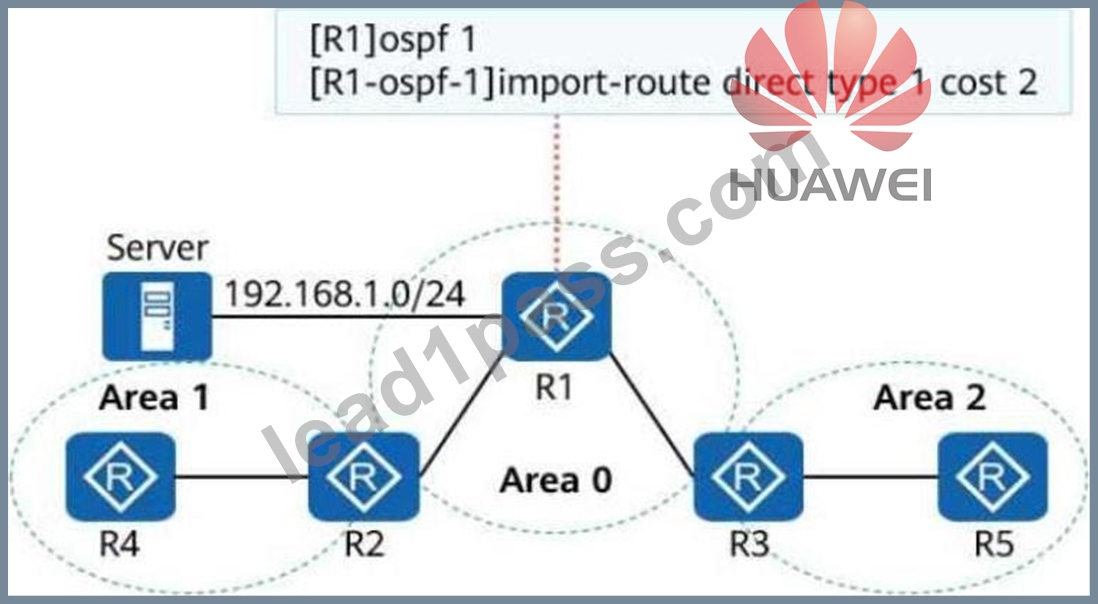
Which of the following is the cost of this route?
- A. 0
- B. 1
- C. 2
- D. 3
Answer: B
NEW QUESTION # 189
The ACL configuration of a router is as shown in the figure.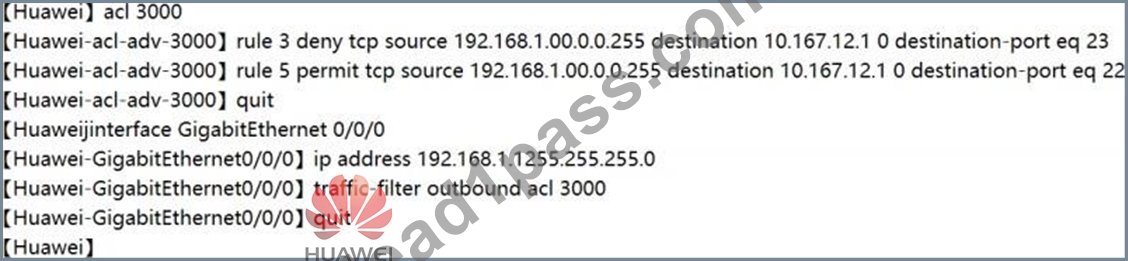
Based on the content analysis in the figure, which of the following descriptions is correct?
- A. Accessing all hosts in the 10.167.12.0/24 network segment through remote desktop from the 192.168.1.0/24 network segment is allowed
- B. Accessing the host at the 10.167.12.1 address through SSH from the 192.168.1.0/24 network segment is denied.
- C. Accessing all hosts in the 10.167.12.0/24 network segment through Telnet from the 192.168.1.0/24 network segment is allowed
- D. Traffic in this device from the 192.168.1.0/24 network segment to the host address other than 10.167.12.1 is not allowed to pass.
Answer: A
NEW QUESTION # 190
On an STP network, parameters used for role election, such as the root bridge ID, root path cost, and bridge ID, are all fields in BPDUs.
- A. TRUE
- B. FALSE
Answer: A
Explanation:
In STP (Spanning Tree Protocol),Bridge Protocol Data Units (BPDUs)contain critical information used in the election and role assignment process, including:
Root Bridge ID- Identifies the current root bridge.
Root Path Cost- Total path cost to reach the root.
Bridge ID- Unique identifier for each switch.These fields are used to determine port roles (root, designated, etc.) and to elect the root bridge.
Reference from Huawei HCIP-Datacom-Core Technology Study Guide:
"BPDUs carry the root bridge ID, root path cost, sender's bridge ID, and port ID. These are used in root bridge election and port role determination." (Chapter: Layer 2 Technologies - Section: STP Operation)
NEW QUESTION # 191
On an STP network, the root bridge, root port, and designated port are elected in sequence. The election rules of these ports are different. List the steps for electing the root port in sequence.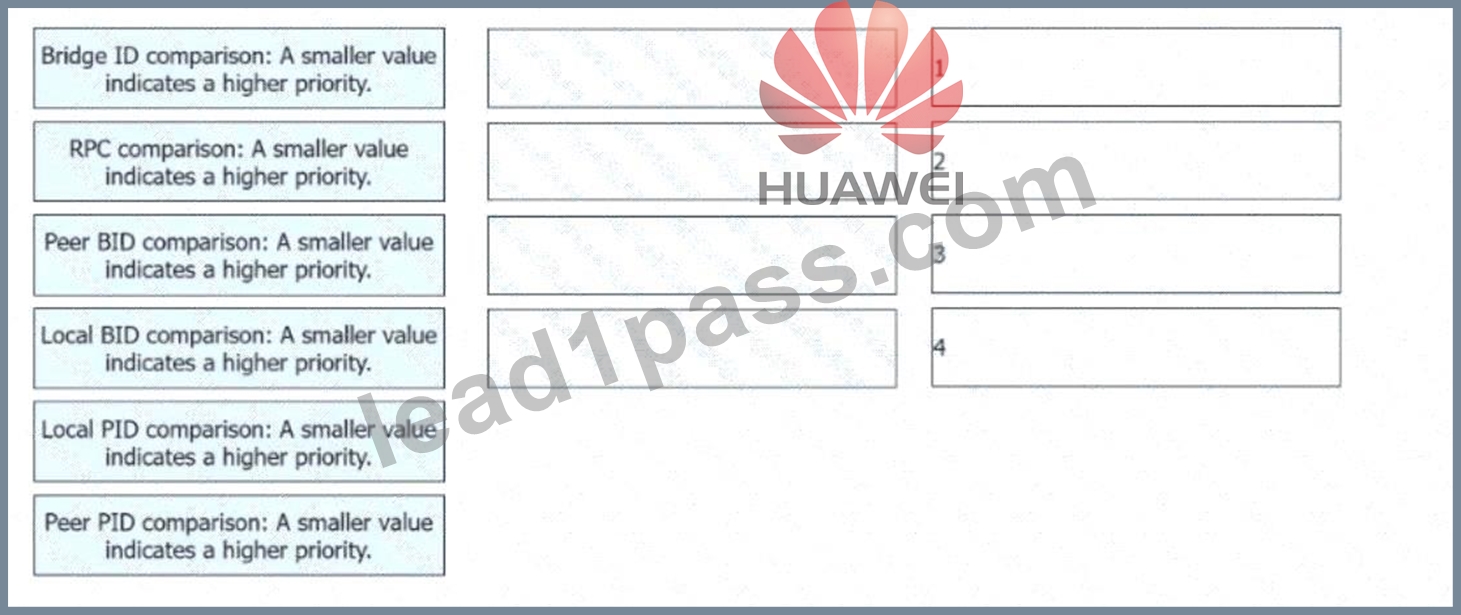
Answer:
Explanation: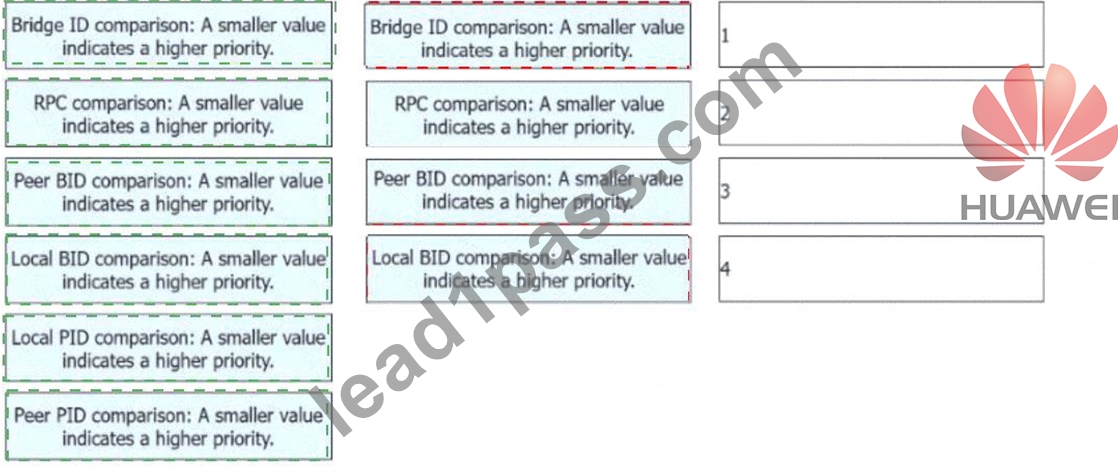
Explanation:
The sequence of steps for electing the root port in an STP (Spanning Tree Protocol) network is as follows:
* Bridge ID Comparison: The Bridge ID (BID) is compared between the bridges in the network. A smaller value indicates a higher priority, meaning the bridge with the lowest Bridge ID is elected as the root bridge.
* RPC (Root Path Cost) Comparison: The path cost to reach the root bridge is calculated. The router with the lowest Root Path Cost (RPC) to the root bridge will have a higher priority for the election of the root port.
* Peer BID Comparison: If there is a tie in the Root Path Cost, the Peer BID is compared. A smaller Peer BID indicates a higher priority. This step ensures that if two routers have the same RPC, the one with the lower Peer Bridge ID wins.
* Local BID Comparison: If there is still a tie, the Local BID is compared. A smaller Local BID indicates a higher priority. This final step ensures that the router with the lowest local identifier is selected.
* Bridge ID Comparison:The first step in electing the root port is comparing the Bridge IDs. The bridge with the lowest Bridge ID becomes the root bridge. The Bridge ID is made up of the bridge priority and MAC address. The root bridge is the center of the network for STP, and all other ports will calculate their paths based on this root.
* HCIP-Datacom-Core Technology Training Material (STP Concepts and Election Process).
RPC (Root Path Cost) Comparison:Once the root bridge is selected, the network needs to determine the best path to the root. Each port on a non-root bridge will calculate the Root Path Cost (RPC), which is the cumulative cost of reaching the root bridge from that port. The root port is the one that has the lowest RPC, meaning it provides the best path to the root bridge.
Reference: HCIP-Datacom-Core Technology Training Material (STP Path Selection).
Peer BID Comparison:If multiple paths have the same Root Path Cost, the next step is to compare the Peer Bridge IDs. The bridge with the lowest Peer BID is chosen as the root port. This ensures a tie-breaking mechanism based on the neighbor's identifier.
Reference: HCIP-Datacom-Core Technology Training Material (STP Election Process).
Local BID Comparison:If there is still a tie after comparing the Peer Bridge IDs, the Local Bridge ID is compared. A smaller Local BID indicates a higher priority, and the port with the lower Local BID will be selected as the root port.
Reference: HCIP-Datacom-Core Technology Training Material (STP Local Port Selection).
NEW QUESTION # 192
Which of the following statements regarding the display bgp routing-table command output is true?
- A. The route to the destination address 192.168.1.0 is injected into the BGP routing table using the network command.
- B. The route to the destination address 192.168.1.0 is learned through AS 200.
- C. The MED value of the route to the destination address 192.168.1.0 is 100.
- D. The route to the destination address 192.168.1.0 is not the optimal route in the BGP routing table.
Answer: A
Explanation:
TheOriginattribute in thedisplay bgp routing-tableoutput is marked asi, indicating that the route was injected into the BGP routing table using thenetworkcommand. The other options are incorrect because the AS path is not displayed, the MED is0, and the route is marked as the best (>), meaning it is the optimal route .
NEW QUESTION # 193
The VRID of the VRRP virtual router is 3 and the virtual IP address is 100.1.1.10. What is the virtual MAC address?
- A. 00-00-5E-00-01-03
- B. 01-00-5E-00-01-03
- C. 00-00-5E-00-01-64
- D. 01-00-5E-00-01-64
Answer: A
Explanation:
The virtual MAC address for a VRRP virtual router is determined by the formula 00-00-5E-00-01-[VRID in hexadecimal]. For VRID 3, the hexadecimal equivalent is 03. Thus, the virtual MAC address is 00-00-5E-00-
01-03 .
NEW QUESTION # 194
Which function does the switch control plane not include?
- A. Traffic Statistics
- B. Routing operation
- C. Business processing
- D. System loading
Answer: D
NEW QUESTION # 195
Which of the following are the advantages of building a campus network using stacking and clustering technologies? (Multiple choice)
- A. Simplify network management and reduce the complexity of network deployment planning
- B. Prompt utilization of network devices and links
- C. Business interruption time is greatly reduced
- D. Can effectively reduce network power consumption
Answer: A,B,C
NEW QUESTION # 196
Which of the following descriptions of routing interactions between BGP peers are correct? (Multiple choice)
- A. When there are multiple valid routes to the same destination address, the BGP device only advertises the optimal route to the peer.
- B. All routes sent by peers will be received by the BGP device
- C. When routing is updated, the BGP device only sends updated BGP routes.
- D. The BGP device will publish the BGP routes obtained from IBGP peers to all its peers.
Answer: A,C
NEW QUESTION # 197
To prevent inter-area routing loops, OSPF does not allow advertising routing information between two non- backbone areas and allows sing routing information only within an area or between the backbone area and a non-backbone area. Therefore, each ABR must be connected to the backbone area.
- A. TRUE
- B. FALSE
Answer: A
Explanation:
OSPF (Open Shortest Path First) mandates that the backbone area (Area 0) serves as the central area for routing information exchange. To avoid inter-area routing loops, routing information is only exchanged between the backbone area and non-backbone areas, not directly between two non-backbone areas.
Consequently, each Area Border Router (ABR) must connect to the backbone area to facilitate this routing exchange .
NEW QUESTION # 198
A session is an entry used to record the connection status of a protocol and is fundamental for the firewall to forward packets. Which of the following protocol packets will the firewall create sessions for?
- A. GRE
- B. ICMP error packet
- C. Subsequent fragment
- D. TCP
Answer: A,D
Explanation:
Comprehensive and Detailed Step-by-Step Explanation:
1. What is a Firewall Session?
* A firewall session is an entry used to maintain the connection state of a protocol.
* When a packet is forwarded, the firewall creates a session for it and tracks subsequent packets for the same connection to ensure efficient forwarding and security enforcement.
2. Analysis of Each Option:
Option A: Subsequent fragment
* Incorrect.
* A session is created for the initial fragment of a packet. Subsequent fragments are matched to the existing session and do not trigger the creation of a new session.
Option B: ICMP error packet
* Incorrect.
* ICMP error packets (e.g., Destination Unreachable) are considered exceptions and do not create new sessions.
Option C: GRE (Generic Routing Encapsulation)
* Correct.
* GRE is a tunneling protocol that encapsulates packets. A firewall creates a session for GRE traffic to track the state of the encapsulated connection.
Option D: TCP (Transmission Control Protocol)
* Correct.
* TCP is a connection-oriented protocol, and firewalls create sessions for TCP connections to track their state (e.g., SYN, SYN-ACK, FIN).
3. Summary:
* The firewall creates sessions for GRE and TCP protocols.
Reference:
Huawei HCIA-Datacom Study Guide, Chapter "Firewall Session Management."
NEW QUESTION # 199
Which of the following statements regarding the BGP error display of a router false?
- A. The error occurred at 12:40:39 on March 22, 2010.
- B. Error Type indicates that the BGP error is caused by the neighbor relationship error.
- C. The neighbor address of this router is 10.1.1.5.
- D. The error may be caused by the incorrect neighbor address.
Answer: D
Explanation:
The error indicates "Incorrect remote AS," which refers to a mismatch in the autonomous system (AS) numbers during BGP peer configuration. This issue is unrelated to the neighbor address. The neighbor address (10.1.1.5) and timestamp (2010-03-22 12:40:39) provided in the output are correct, and the error type confirms a neighbor relationship issue .
NEW QUESTION # 200
Hackers often obtain the login permissions of system administrators through various attacks.
Which of the following measures can be taken to enhance the security of administrator accounts?(Select all that apply)
- A. Encrypt passwords before transferring them. Whenever possible, transfer passwords by email.
- B. To ensure security and make the password easier to remember, you can set the password to be valid for a long time.
- C. Assign exclusive accounts for administrators with different maintenance roles to avoid account sharing.
- D. Periodically check whether unnecessary administrator accounts exist in the system. If such accounts exist, delete them to reduce the attack surface.
Answer: C,D
Explanation:
A is correct- Removing unused accounts helpsminimize the risk surface.
B is false- Email isnot a secure methodfor transferring sensitive information like passwords, even if encrypted.
C is correct-Unique administrator accountshelp with accountability and tracking.
D is false-Long-term password validityreduces security. Passwords should be rotated regularly.
Reference from Huawei HCIP-Datacom-Core Technology Study Guide:
"To secure admin access, avoid account sharing, delete inactive users, and periodically update credentials through secure channels." (Chapter: Device Security - Section: Account Management)
NEW QUESTION # 201
Which of the following attributes may not be included in the Update message of a BGP route? (Multiple choice)
- A. 0rigin
- B. MED
- C. AS_Path
- D. Local_Preference
Answer: B,D
NEW QUESTION # 202
MSTP uses the 802.1D standard and is backward compatible with STP and RSTP. By establishing multiple loop-free trees, it solves broadcast storms and achieves redundant backup.
- A. TRUE
- B. FALSE
Answer: B
NEW QUESTION # 203
Which of the following descriptions about the basic concepts of VRRP are wrong? (Multiple choice)
- A. A VRRP router may belong to one or more virtual routers
- B. The VRP backup group can consist of one Master device and multiple Master devices, and is regarded as the default gateway of hosts in a shared LAN
- C. VRRP uses VRID to identify virtual routers
- D. A virtual router can only have one IP address, which is configured by the user
Answer: B,D
NEW QUESTION # 204
The neighbor information of the router RTA is as shown in the figure.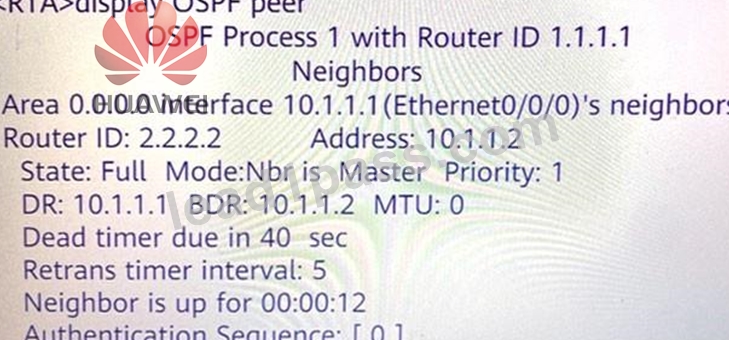
Which of the following descriptions of the OSPF neighbor information is wrong?
- A. The neighbor's Router ID is 2.2.2.2
- B. The Router ID of this router is 1.1.1.1
- C. The address of DR is 10.1.1.1
- D. The router is the Master
Answer: D
NEW QUESTION # 205
In OSPF, the DR and BDR elected in a broadcast network listen to both the 224.0.0.5 address and the 224.0.0.6 address.
- A. TRUE
- B. FALSE
Answer: A
NEW QUESTION # 206
As shown in the figure is the BGP error output information of a router.
<Huawei> display bgp error
Error type: Peer Error
Date/Time: 2010-03-22 12:40:39
Peer Address: 10.1.1.5
VRF Name: Public
Error info: Incorrect remote AS
Which of the following statements about this information is wrong?
- A. The error occurred at 12:40:39 on March 22, 2010.
- B. The neighbor address of the router is 10.1.1.5
- C. Error Type shows hesitating neighbor relationship errors lead to
- D. The cause of the error may be due to the wrong neighbor address
Answer: D
NEW QUESTION # 207
The VRID of the VRRP virtual router is 3 and the virtual IP address is 100.1.1.10. What is the virtual MAC address?
- A. 00-00-5E-00-01-03
- B. 01-00-5E-00-01-03
- C. 00-00-5E-00-01-64
- D. 01-00-5E-00-01-64
Answer: A
Explanation:
The virtual MAC address for a VRRP virtual router is determined by the formula 00-00-5E-00-01-[VRID in hexadecimal]. For VRID 3, the hexadecimal equivalent is 03. Thus, the virtual MAC address is 00-00-5E-00-
01-03 .
NEW QUESTION # 208
......
Online Questions - Valid Practice H12-821_V1.0 Exam Dumps Test Questions: https://simplilearn.lead1pass.com/Huawei/H12-821_V1.0-practice-exam-dumps.html