

C-S4TM-2023 Exam Info and Free Practice Test All-in-One Exam Guide Apr-2026
Pass SAP C-S4TM-2023 Actual Free Exam Q&As Updated Dump Apr 21, 2026
NEW QUESTION # 17
You want to set up charge calculation for freight orders. Valid charges should consist of a based on the distance and gross weight of the freight order, and a supplemental charge per container that is included in the freight order. Multiple containers are allowed for each freight order, and the charge is based on the container type can be small, medium or large. What is the minimum number of charge lines with instruction type "standard" that you must set up?
- A. 0
- B. 1
- C. 2
- D. 3
Answer: C
NEW QUESTION # 18
What SAP TM functionality is available with "Basic Shipping" of SAP S/4HANA Supply Chain for Transportation Management?
There are 3 correct answers to this question.
- A. Transportation planning based on inbound deliveries
- B. Transportation execution without event management
- C. Package building
- D. Transportation planning based on outbound deliveries
- E. Transportation planning based on sales orders
Answer: A,B,D
NEW QUESTION # 19
What is a framework that allows you to create and configure Web Dynpro applications in Web Dynpro ABAP? Please choose the correct answer.
- A. Dispatch and monitor the transportation
- B. Plan the transportation and select carriers
- C. Transfer orders and deliveries from an ERP system
- D. Floorplan Manager (FPM)
Answer: D
NEW QUESTION # 20
Which of the following are features of the transportation cockpit? Note: There are 3 correct answers to this question.
- A. Gantt chart
- B. Cost determination
- C. Multiple screens
- D. Command line
- E. Distance calculation
Answer: A,C,D
Explanation:
The transportation cockpit in SAP S/4HANA Transportation Management is a central interface for planning and monitoring transportation activities. According to the SAP documentation, its key features include:
* Multiple screens (A): The cockpit supports multiple screens to display different views, such as maps, Gantt charts, and worklists, enhancing usability.
* Gantt chart (C): The Gantt chart visualizes the timeline of transportation activities, aiding in scheduling and monitoring.
* Command line (D): The command line allows users to execute quick actions or navigate functions efficiently within the cockpit.
The other options are incorrect:
* Cost determination (B)is performed in charge management, not directly in the transportation cockpit.
* Distance calculation (E)is handled in transportation lanes or by the optimizer, not as a direct feature of the cockpit.
Reference:
SAP S/4HANA Cloud Private Edition, Transportation Management Study Guide: Unit 1 - Transportation Management Overview and Fundamentals, Section on Transportation Cockpit Features.
SAP Help Portal: Transportation Management - Transportation Cockpit ().
NEW QUESTION # 21
You want to ensure that the system interprets rates from a rate table as percentages. Where do you have to set the percentage indicator? Note: There are 2 correct answers to this question.
- A. Scale
- B. Calculation profile
- C. Rate table
- D. Calculation sheet
Answer: C,D
Explanation:
In SAP S/4HANA Transportation Management, to ensure that rates in a rate table are interpreted as percentages (e.g., for surcharges like fuel), the percentage indicator must be set in specific configuration objects. According to the SAP documentation:
* Calculation sheet (A): The percentage indicator can be set in the calculation sheet to specify that certain charge types (e.g., fuel surcharge) are calculated as percentages of the base rate.
* Rate table (D): The percentage indicator is defined in the rate table to indicate that the rates stored within it are percentages, ensuring correct calculation during charge determination.
The other options are incorrect:
* Scale (B)defines the ranges for rates (e.g., weight or distance) but does not include a percentage indicator.
* Calculation profile (C)defines general calculation settings but does not directly control the percentage interpretation of rates.
Reference:
SAP S/4HANA Cloud Private Edition, Transportation Management Study Guide: Unit 5 - Charge Calculation and Freight Settlement, Section on Rate Table and Calculation Sheet Configuration.
SAP Help Portal: Transportation Management - Charge Calculation ().
NEW QUESTION # 22
You add an assessorial charge to a freight order after the freight settlement document (FSD) has been posted and accruals have been booked in materials management. The background report to create FSDs determines change strategy "Reverse and Repost with new FSD" for this freight order. What will you see in transportation management and materials management? Note: There are 2 correct answers to this question.
- A. 1 purchase order in materials management
- B. 3 service entry sheets in materials management
- C. 2 FSDs and 1 credit memo in transportation management
- D. 3 FSDs in transportation management
Answer: C,D
Explanation:
When an assessorial charge is added to a freight order after the initial freight settlement document (FSD) is posted, and the change strategy is set to "Reverse and Repost with new FSD," the system handles the update as follows, according to SAP documentation:
* 2 FSDs and 1 credit memo in transportation management (B): The original FSD is reversed with a credit memo, and a new FSD is created to include the assessorial charge, resulting in two FSDs (the original and the new) and one credit memo.
* 3 FSDs in transportation management (C): This includes the original FSD, the credit memo (counted as a separate document in some configurations), and the new FSD with the updated charges.
The other options are incorrect:
* 1 purchase order in materials management (A)is not guaranteed, as the number of purchase orders depends on the original setup and may not change with the FSD update.
* 3 service entry sheets in materials management (D)is unlikely, as typically one service entry sheet is updated or replaced, not multiplied, during the reversal and reposting process.
Reference:
SAP S/4HANA Cloud Private Edition, Transportation Management Study Guide: Unit 5 - Charge Calculation and Freight Settlement, Section on FSD Change Strategies.
SAP Help Portal: Transportation Management - Freight Settlement Updates
NEW QUESTION # 23
What business documents (objects) can be used as a base for track and trace functionality in transportation management? Note: There are 2 correct answers to this question.
- A. Resource
- B. Freight order
- C. Service order
- D. Forwarding order
Answer: B,D
Explanation:
In SAP S/4HANA Transportation Management, track and trace functionality is supported by documents that represent the transportation process and contain relevant tracking information. According to the SAP documentation:
* Freight order (A)is a key document used for road or rail transport, containing details about the transportation process, including stages, carriers, and tracking events, making it suitable for track and trace.
* Forwarding order (D)is used in logistics service provider scenarios and represents the customer's transportation requirements, including tracking information across multiple stages.
The other options are incorrect:
* Resource (B)refers to vehicles, drivers, or other assets used in transportation, not a document for tracking goods.
* Service order (C)is used for internal service-related activities and does not support track and trace functionality for goods transportation.
Reference:
SAP S/4HANA Cloud Private Edition, Transportation Management Study Guide: Unit 4 - Freight Order Management, Section on Track and Trace.
SAP Help Portal: Transportation Management - Track and Trace ().
NEW QUESTION # 24
You are using SAP S/4HANA without geographical services. How can you determine the geographical coordinates for a location? Note: There are 2 correct answers to this question.
- A. The location coordinates are determined based on manual entry.
- B. The location coordinates are determined at street level.
- C. The location coordinates are determined at region or country level.
- D. The location coordinates cannot be determined.
Answer: A,C
Explanation:
In SAP S/4HANA Transportation Management without geographical services (e.g., GIS integration), geographical coordinates for locations cannot be automatically determined with high precision. According to the SAP documentation:
* The location coordinates are determined at region or country level (A): The system can assign approximate coordinates based on predefined region or country data in the location master data, providing a basic level of geographical information.
* The location coordinates are determined based on manual entry (D): Users can manually enter coordinates in the location master data to specify the exact position of a location.
The other options are incorrect:
* The location coordinates cannot be determined (B)is incorrect because coordinates can be assigned manually or at a region/country level.
* The location coordinates are determined at street level (C)requires geographical services for precise geocoding, which is not available in this scenario.
Reference:
SAP S/4HANA Cloud Private Edition, Transportation Management Study Guide: Unit 1 - Transportation Management Overview and Fundamentals, Section on Location Master Data.
SAP Help Portal: Transportation Management - Location Coordinates without GIS ().
NEW QUESTION # 25
A carrier has an agreement with a shipper that starts on January 1 for fuel price as 5% of the base freight. The fuel surcharge is pegged to the current price of 3 USD a gallon. The fuel surcharge can change proportionally based on the fuel price on the calculation date. How will you define fuel surcharge calculation in transportation management? Note: There are 2 correct answers to this question.
- A. Use the rating amount or a standard rate table for the fuel surcharge.
- B. Use a rate table for the fuel surcharge with calculation date as a scale.
- C. Use an index table for the fuel surcharge charge item.
- D. Use a determination rule for the index rate table.
Answer: C,D
Explanation:
In SAP S/4HANA Transportation Management, fuel surcharges that vary based on fuel price changes are managed using dynamic calculation methods. According to the SAP documentation:
* Use an index table for the fuel surcharge charge item (A): An index table is used to store fuel price indices (e.g., pegged to 3 USD per gallon) and calculate the surcharge as a percentage (5%) of the base freight, adjusted based on the current fuel price.
* Use a determination rule for the index rate table (D): A determination rule is required to select the appropriate index table based on conditions, such as the calculation date or agreement validity, ensuring the correct fuel price is applied.
The other options are incorrect:
* Use the rating amount or a standard rate table for the fuel surcharge (B)is not suitable, as standard rate tables do not dynamically adjust based on fuel price indices.
* Use a rate table for the fuel surcharge with calculation date as a scale (C)is not typically used, as index tables are preferred for dynamic fuel surcharge calculations.
Reference:
SAP S/4HANA Cloud Private Edition, Transportation Management Study Guide: Unit 5 - Charge Calculation and Freight Settlement, Section on Fuel Surcharge Calculations.
SAP Help Portal: Transportation Management - Index Tables for Charge Calculation ().
NEW QUESTION # 26
In which object can you track and trace the whole journey of your goods?
- A. Forwarding order
- B. Freight unit
- C. Freight booking
- D. Freight order
Answer: B
NEW QUESTION # 27
You want to differentiate transportation requirement types in a newly installed SAP TM system based on SAP ERP document types. What do you need to create in SAP TM?
There are 2 correct answers to this question.
- A. A condition based on /SCMTMS/DTR_TYPE
- B. A condition based on /SCMTMS/TOR_TYPE
- C. A condition based on /SCMTMS/OTR_TYPE
- D. A condition based on /SCMTMS/FUBR
Answer: B,C
NEW QUESTION # 28
Which of the following can you use to determine a stage sequence in a forwarding order? Note: There are 2 correct answers to this question.
- A. Stage profile
- B. Stage type
- C. Shipping type
- D. Movement type
Answer: A,D
Explanation:
Transportation Management for Logistics Service Provider (LSP)
NEW QUESTION # 29
Which of the following characteristics describe transportation zones? Note: There are 2 correct answers to this question.
- A. Transportation zones transfer their properties to their locations.
- B. Transportation zones are used to group locations.
- C. Transportation zones increase the effort needed to model the network.
- D. Transportation zones are physical locations.
Answer: A,B
Explanation:
In SAP S/4HANA Transportation Management, transportation zones are used to organize the transportation network. According to the SAP documentation:
* Transportation zones transfer their properties to their locations (A): Zones define attributes (e.g., geographical or organizational properties) that are inherited by the locations within them, simplifying configuration.
* Transportation zones are used to group locations (D): Zones group multiple locations (e.g., warehouses, plants) to streamline planning and routing in the transportation network.
The other options are incorrect:
* Transportation zones are physical locations (B)is incorrect; zones are logical groupings, not physical sites.
* Transportation zones increase the effort needed to model the network (C)is incorrect; zones reduce modeling effort by grouping locations.
Reference:
SAP S/4HANA Cloud Private Edition, Transportation Management Study Guide: Unit 7 - Master Data, Section on Transportation Zones.
SAP Help Portal: Transportation Management - Transportation Zone Management ().
NEW QUESTION # 30
In an ERP system that is processing sales orders, situations arise when an order is created for a new customer that is a one time transaction. Transportation will have to be planned and this could cause a large amount of master data that will quickly become obsolete.
One-time-ship-to locations can be created in two ways, as follows:
There are 2 correct answers to this question.
- A. Automatically (by the system), based on the address of an incoming transportation request to SAP TM
- B. Division
- C. Manually, by the user in the forwarding order user interface
Answer: A,C
NEW QUESTION # 31
You are planning to use Package Builder to estimate freight volume more accurately for better capacity planning. On what criteria can you base the definition of the package type assignment? Note: There are
2 correct answers to this question.
- A. Business partner
- B. Shipping location
- C. Shipping type
- D. Handling unit type
Answer: A,B
Explanation:
Transportation Planning
NEW QUESTION # 32
In which of the following areas can you use incompatibilities? Note: There are 3 correct answers to this question.
- A. Freight unit building
- B. Tendering
- C. Charge calculation
- D. Carrier selection
- E. Delivery proposal
Answer: A,D,E
Explanation:
In SAP S/4HANA Transportation Management, incompatibilities are used to enforce restrictions in various processes to prevent incompatible combinations. According to the SAP documentation, incompatibilities can be applied in:
* Delivery proposal (A): Incompatibilities ensure that certain products or freight units are not combined in delivery proposals (e.g., due to hazardous material restrictions).
* Freight unit building (D): Incompatibilities prevent specific products or requirements from being combined into the same freight unit (e.g., incompatible goods).
* Carrier selection (E): Incompatibilities restrict certain carriers from being assigned to specific freight orders based on criteria like equipment or service capabilities.
The other options are incorrect:
* Tendering (B)uses tendering profiles and rules but does not typically involve incompatibilities.
* Charge calculation (C)relies on freight agreements and rate tables, not incompatibilities.
Reference:
SAP S/4HANA Cloud Private Edition, Transportation Management Study Guide: Unit 3 - Transportation Planning, Section on Incompatibilities.
SAP Help Portal: Transportation Management - Incompatibility Areas ().
NEW QUESTION # 33
In which object can you track and trace the whole journey of your goods, if the whole journey has multiple transportation stages?
- A. Consignment order
- B. Freight unit
- C. Freight booking
- D. Freight order
Answer: B
Explanation:
In SAP S/4HANA Transportation Management, thefreight unitis the central object used to track and trace the entire journey of goods across multiple transportation stages. A freight unit represents a logistical unit of goods that are transported together, and it is used to manage and monitor the transportation process from start to finish, including all stages such as loading, transport, and unloading. According to the SAP S/4HANA Transportation Management documentation, freight units are created based on requirements (e.g., sales orders, deliveries) and serve as the basis for planning and execution. They contain all relevant information about the goods, such as weight, volume, and transportation requirements, and they remain consistent across multiple stages, enabling end-to-end tracking.
Freight bookings, freight orders, and consignment orders have different roles:
* Freight bookingis used for ocean or air transport and typically represents a contract with a carrier for a specific shipment.
* Freight orderis used for road or rail transport and represents the execution document assigned to a carrier.
* Consignment orderis a logical grouping for communication between shippers and consignees, not primarily for tracking goods across stages.
The freight unit, however, is the only object that consistently tracks the goods across all stages of transportation, making it the correct choice.
Reference:
SAP S/4HANA Cloud Private Edition, Transportation Management Study Guide: Unit 4 - Freight Order Management, Section on Freight Units and Tracking.
SAP Help Portal: Transportation Management - Freight Units ().
NEW QUESTION # 34
How can you limit the number of columns that are displayed in a forwarding order worklist?
- A. Define a new query
- B. Apply a filter
- C. Define a new page layout
- D. Define a new view
Answer: C
Explanation:
Transportation Management Overview and Fundamentals
NEW QUESTION # 35
SAP ERP logistics integration introduces the concept of order-based (OTR) and delivery-based (DTR) transportation requirements. The customer downstream TM processing options are as follows:
(3 correct answers)
- A. from OTRs only
- B. from DTRs only
- C. outbound delivery to SAP TM
- D. consuming OTRs with DTRs
Answer: A,B,D
NEW QUESTION # 36
You create a freight settlement document after you plan an inbound delivery with the following items: The total freight costs are USD 3000.
Which posting can be automatically performed for Product 2 if you transfer the freight settlement document with the distributed costs to SAP ERP?
Please choose the correct answer.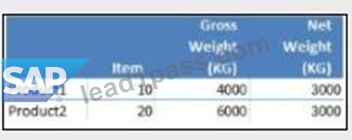
- A. USD 1500 on CO-PA
- B. USD 3000 on Material Account
- C. USD 1800 on Material Account
- D. USD 1200 on CO-PA
Answer: C
NEW QUESTION # 37
You have defined several means of transport MT combinations.
If food is loaded on the truck, you cannot transport hazardous goods in a coupled trailer, furthermore, these hazardous goods cannot be transported on certain means of transport.
Which of the following incmpatibility types do you use to model this scenario? (2 correct answer)
- A. FU - FU (MT combination level)
- B. FU - vehicle resource
- C. FU - FU ( compartment level)
- D. FU - FU (vehicle level)
Answer: C,D
NEW QUESTION # 38
You want to increase the rates of a rate table by 3 percent for a specific source country using the Mass Update function. What must you specify in the Update Rates function?
- A. Scale range
- B. Currency
- C. Rounding profile
- D. Scale item
Answer: A
Explanation:
In SAP S/4HANA Transportation Management, the Mass Update function is used to adjust rates in a rate table. To increase rates by 3% for a specific source country, you must specify thescale range (A)in the Update Rates function. According to the SAP documentation, the scale range defines the criteria (e.g., source country) for which the rate adjustment applies, allowing the system to filter and update the relevant rates. For example, the scale range can be configured to target rates associated with a specific country, and the percentage increase (3%) is applied to those rates.
The other options are incorrect:
* Scale item (B)refers to individual entries within a scale, not the range used for filtering.
* Currency (C)specifies the currency of the rates but is not sufficient to target a source country.
* Rounding profile (D)defines how rates are rounded, not the criteria for updating rates.
Reference:
SAP S/4HANA Cloud Private Edition, Transportation Management Study Guide: Unit 5 - Charge Calculation and Freight Settlement, Section on Rate Table Management.
SAP Help Portal: Transportation Management - Mass Update Function ().
NEW QUESTION # 39
To which of the following can you assign a dimensional weight profile?
- A. Charge profile
- B. Charge type
- C. Calculation profile
- D. Calculation base
Answer: C
NEW QUESTION # 40
Which object do you have to create in SAP ERP if you want to use handover locations? Please choose the correct answer.
- A. Warehouse
- B. Customer
- C. Vendor
- D. Route
Answer: C
NEW QUESTION # 41
......
Online Questions - Valid Practice C-S4TM-2023 Exam Dumps Test Questions: https://simplilearn.lead1pass.com/SAP/C-S4TM-2023-practice-exam-dumps.html