

[Apr 11, 2026] 100% Real & Accurate NCP-CI-Azure Questions with Free and Fast Updates
Self-Study Guide for Becoming an Nutanix Certified Professional - Cloud Integration - Azure (NCP-CI-Azure v6.7) Expert
NEW QUESTION # 34
A company wants to start using Nutanix Cloud Clusters (NC2) in Azure. The company has large spend commitments as part of a Microsoft Azure Consumption Commitment (MACC) totaling $15 million.
What approach should the administrator take to ensure the Nutanix licensing costs apply to the MACC?
- A. Request a trial directly from Nutanix.
- B. Purchase Nutanix licenses directly from Nutanix and contact Microsoft support.
- C. Purchase Nutanix licenses through the Azure Marketplace.
- D. Leverage existing Nutanix licenses
Answer: C
Explanation:
Microsoft Azure Consumption Commitment (MACC): To ensure that the Nutanix licensing costs apply to the MACC, the company needs to make purchases that are recognized by Azure's billing system.
Azure Marketplace Purchases: By purchasing Nutanix licenses through the Azure Marketplace, the costs will be included in the Azure billing and count towards the MACC, thereby leveraging the committed spend.
Reference:
Azure Marketplace Documentation
Nutanix Licensing Guide
NEW QUESTION # 35 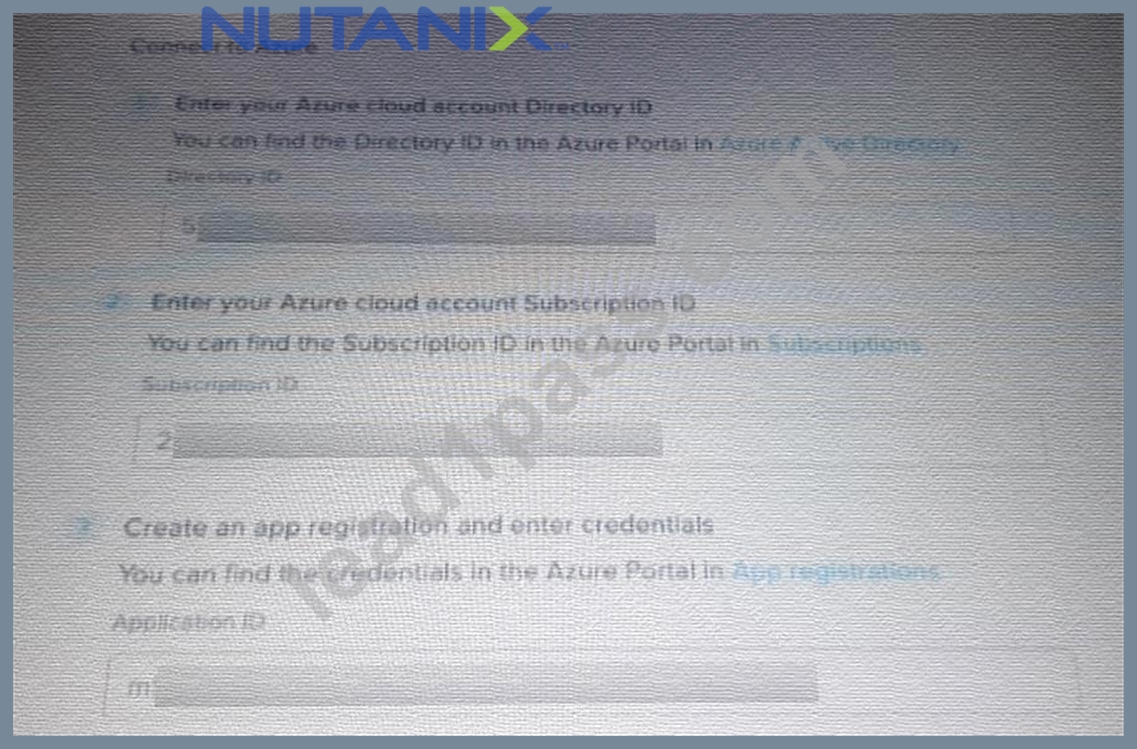
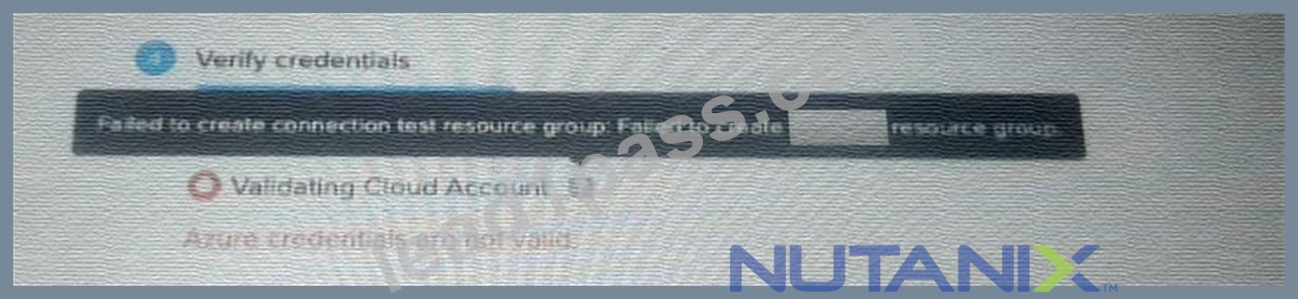
Which action shouldthe administrator take to troubleshoot the error shown in the exhibit?
- A. Check the Azure subnet delegation status.
- B. Check the Azure AD App registration Client Secret.
- C. Check the PC VNet is peered correctly.
- D. Check the NC2 organization permissions.
Answer: B
Explanation:
To troubleshoot the error shown in the exhibit where Azure credentials are not valid and the creation of the resource group failed, the administrator should:
* Verify that the Azure AD App registration has been correctly configured, especially the Client Secret.
* Ensure that the Client Secret is valid, has not expired, and matches what has been entered in the configuration.
This step is crucial because an invalid or expired Client Secret would prevent the validation of Azure credentials and the creation of necessary resources.
References
* Azure AD App Registration and Secrets Management
* Nutanix Cluster Configuration Documentation
NEW QUESTION # 36
Which wen interface should be used to most efficiently terminate a Nutanix cloud cluster?
- A. NC2 Console
- B. Prism Central Console
- C. AWS Console
- D. Prism Element Console
Answer: A
Explanation:
To efficiently terminate a Nutanix cloud cluster, the NC2 (Nutanix Cloud Clusters) Console should be used.
The NC2 Console provides the necessary tools and interface specifically designed for managing and terminating Nutanix clusters within cloud environments, ensuring a seamless and efficient process.References
* Nutanix Cloud Clusters Documentation
NEW QUESTION # 37
Exhibit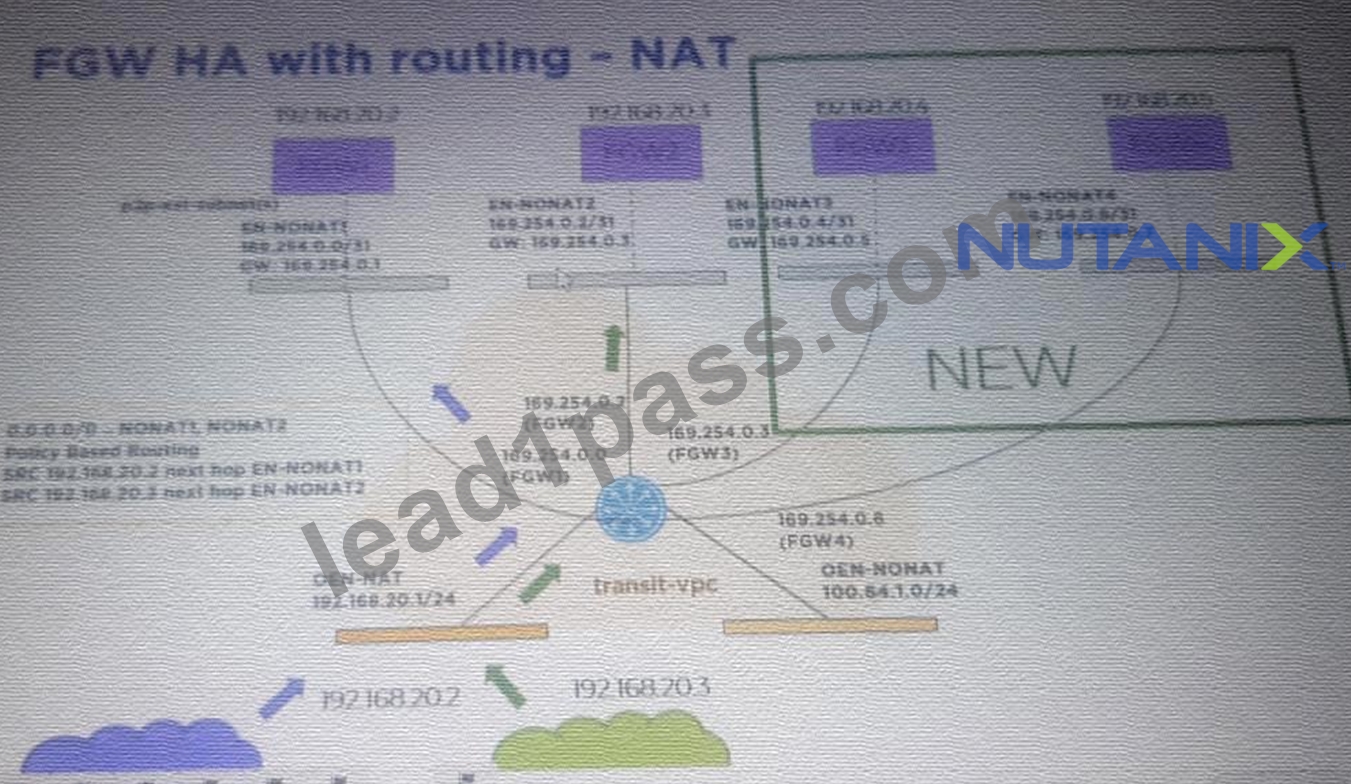
An NC2 on Azure cluster was deployed with two Flow Gateway in HA (FHW1 and FGW2). After a week of use, four bare-metal nodes were added to the NC2 cluster and additional workloads were added. The existing workloads were using floating IPs to allow inbound traffic to communicate with the running workloads on the NC2 cluster.
It was determined that additional bandwidth for north/south traffic would be needed. Two additional Flow Gateways were added (FGW3 and FGW4) from the NC2 portal configuration menu.
The existing workloads prior to expansion on the NC2 cluster will be able to use which Flow Gateways using the NAT traffic path after the expansion?
- A. All four Flow Gateways.
- B. They will be able to use FGW3 and FGW4 once the NC2 workloads reboots.
- C. All four Flow Gateways using a MAC/Hash algorithm.
- D. Only the Flow Gateway each workload was using prior to expansion.
Answer: D
Explanation:
In the NC2 on Azure cluster scenario, the existing workloads were using floating IPs for inbound traffic before the addition of new Flow Gateways (FGW3 and FGW4). The NAT traffic path established initially will continue to direct traffic through the originally assigned Flow Gateways (FGW1 and FGW2). The existing workloads will not automatically utilize the new Flow Gateways (FGW3 and FGW4) without a reconfiguration or reboot, which reassigns the NAT paths.
References
* Nutanix Flow Networking and Configuration Guide
NEW QUESTION # 38
Native Azure VMs exist in a subnet (10.20.80.0/20) in the Prism Central VNet that need access to the workload running on the Nutanix User.
What needs to be modified to allow access from the native Azure VMs to the workloads running in the Nutanix User VPC?
- A. Adjust the Inbound Network Security Group on the Flow Gateway VM Internal NIC to allow traffic
102030,0/20. - B. Change the ERP value to the the subnet range of the native Azure VMs (10.20.80.0/20) on the Transit VPC and the Nutanix User VPC.
- C. Adjust the Inbound Network Security Group on the Flow Gateway VM External NIC to allow traffic
102030.0/20. - D. Remove the ERP value on the transit VPC and Nutanix User VPC.
Answer: A
Explanation:
To allow access from the native Azure VMs to the workloads running in the Nutanix User VPC, the administrator needs to:
* Adjust the Inbound Network Security Group (NSG) on the Flow Gateway VM's Internal NIC.
* Specifically, allow traffic from the subnet range of the native Azure VMs (10.20.80.0/20) in the Inbound rules of the NSG associated with the Internal NIC of the Flow Gateway VM.
This configuration change permits the desired network traffic, ensuring that the native Azure VMs can communicate with the workloads in the Nutanix User VPC.References
* Azure Network Security Groups Overview
* Nutanix Networking and Security Best Practices
NEW QUESTION # 39
An administrator has been tasked with deploying a new production NC2 cluster on Azure and is studying the deployment requirements.
How many Azure Ready Nodes, at a minimum, must the administrator ensure are deployed withinthe cluster?
- A. 0
- B. 1
- C. 2
- D. 3
Answer: A
Explanation:
Minimum Node Requirement: For production deployments, Nutanix typically requires a minimum of three nodes to ensure high availability and fault tolerance within the cluster.
Azure Ready Nodes: Deploying at least three Azure Ready Nodes allows the cluster to provide redundancy, ensuring that the failure of a single node does not affect the overall availability and performance of the cluster.
Reference:
Nutanix NC2 on Azure Deployment Guide
High Availability and Redundancy Best Practices
NEW QUESTION # 40
NC2 Azure API calls are failing and MCM no longer shows telemetry or health of the cluster.
Where should the administrator look first?
- A. SSH into the NC2 Azure CVMs
- B. Check VPN/ExpressRoute
- C. Log into Prism and check alerts and notifications
- D. Check whitelisting of Outbound Communication
Answer: D
Explanation:
* Outbound Communication Whitelisting:For NC2 Azure API calls and telemetry data to function correctly, certain outbound communications must be allowed. If these communications are not whitelisted, API calls can fail, and telemetry or health data might not be reported correctly.
* First Check:Given the symptoms (failing API calls and missing telemetry), the first step should be to ensure that all necessary outbound communications are correctly whitelisted. This includes ensuring that endpoints and services required for NC2 operation are accessible.
References:
* Nutanix NC2 Networking Requirements
* Azure Networking and Security Configuration Guide
NEW QUESTION # 41
The cluster has the following configuration:
A Transit VPC exists as Default, but is additionally configured with a overlay-external-subnet-nonat overlay subnet The ERP for the Transit VPC is 10.1.1.0/25 A User VPC exists named User_VPC_Prod The ERP for the User VPC is 10.1.1.0/24 Outbound and inbound routes have been configured A User VM NO-NAT subnet has been configured in the User VPC The administrator has successfully created a VM and added the NIC associated with the NO-NAT subnet, but is not able to communication with other resources.
Which option will resolve this issue?
- A. The ERP in the User VPC must be from a different CIDR range than the ERP in the transit VPC.
- B. Check that the network ACLs for the NO-NAT subnet are not blocking the necessary traffic.
- C. Verify that the route table associated with the User VPC has appropriate routes to the Transit VPC.
- D. Ensure that the security groups associated with the VM allow traffic to and from the desired resources.
Answer: A
Explanation:
In this scenario, the issue arises from overlapping IP address ranges between the Transit VPC and the User VPC. Here's a detailed breakdown:
* Understanding ERPs (Elastic Routing Prefixes):
* The ERP for the Transit VPC is 10.1.1.0/25, which covers IP addresses from 10.1.1.0 to
10.1.1.127.
* The ERP for the User VPC is 10.1.1.0/24, which covers IP addresses from 10.1.1.0 to 10.1.1.255.
* IP Address Overlap:
* Since 10.1.1.0/25 is a subset of 10.1.1.0/24, there is a significant overlap in the IP address ranges of these two ERPs.
* This overlap can cause routing issues because the same IP address range is being used in both VPCs, leading to ambiguity in routing and communication.
* Communication Issue:
* When a VM in the User VPC tries to communicate with other resources, the network cannot accurately determine the correct route due to the overlapping IP address ranges.
* This overlap prevents proper routing and results in the VM being unable to communicate with other resources as intended.
* Resolution:
* To resolve this issue, the ERPs must be in different CIDR ranges. This means the IP address ranges for the Transit VPC and the User VPC should not overlap.
* For example, if the Transit VPC uses 10.1.1.0/25, the User VPC could use a different range such as 10.1.2.0/24 or any other range that does not overlap with 10.1.1.0/25.
By ensuring that the ERPs are in different CIDR ranges, the network can properly route traffic between the VPCs without any conflicts or ambiguities, thereby enabling the VM in the User VPC to communicate with other resources effectively.
NEW QUESTION # 42
An administrator is tasked with preparing the company's Azure subscription for use with NCZ.
Which two Azure Resource Providers need to be registered? (Choose two.)
- A. Microsoft.Nutanix
- B. Microsoft.Network
- C. Microsoft.HybridNetwork
- D. Microsoft.HybridCompute
Answer: A,B
Explanation:
Azure Resource Providers: To prepare an Azure subscription for NC2, specific resource providers must be registered to enable necessary services and resources.
Required Providers:
Microsoft.Network: This provider is essential for networking functionalities, including virtual networks, subnets, and other network resources necessary for NC2 deployment.
Microsoft.Nutanix: This provider is specifically required for integrating and managing Nutanix resources within the Azure environment.
Other Providers:
Microsoft.HybridNetwork and Microsoft.HybridCompute: These are not specifically required for NC2 but might be relevant for other hybrid or extended network configurations.
Conclusion: Registering both "Microsoft.Network" and "Microsoft.Nutanix" ensures that all necessary network and Nutanix-specific resources are available for NC2 deployment.
Reference:
Azure Resource Providers Documentation
Nutanix on Azure Setup Guide
NEW QUESTION # 43
An administrator needs to extend an on-premises subnet to an NC2 cluster on Azure.
Which set of options should the administrator configure to complete this task?
- A. Subnet Type: On-premises VLAN subnets and VPC subnets Traffic Type: IPv4 unicast traffic IPv6 unicast traffic and ARP On-premises Hypervisor: ESXi and AHV
- B. Subnet Type: On-premises VLAN subnets and VPC subnets Traffic Type: IPv6 umcasi traffic and ARP On-premises Hypervisor: Hyper-V
- C. Subnet Type: On-premises VLAN subnets and VPC subnets Traffic Type: IPv4 unicast traffic and ARP On-premises Hypervisor: AHV
- D. Subnet Type: VPC subnets
Traffic Type: IPv4 unicast traffic and ARP
On-premises Hypervisor: ESXi, AHV, Hyper-V
Answer: A
Explanation:
To extend an on-premises subnet to an NC2 cluster on Azure, the administrator should configure:
Subnet Type: Both on-premises VLAN subnets and VPC subnets. This ensures that the subnet can span both the on-premises environment and the Azure environment.
Traffic Type: Support for IPv4 unicast traffic, IPv6 unicast traffic, and ARP is necessary to ensure proper communication and address resolution across the extended subnet.
On-premises Hypervisor: ESXi and AHV are supported hypervisors for this type of configuration, allowing for a seamless extension of the subnet between these environments.
Reference
Nutanix Hybrid Cloud Networking
NEW QUESTION # 44
After creating a new Nutanix User VPC, what is needed to allow traffic to flow out of the Flow gateway VM when using the NATed Path?
- A. Add a default route on the Nutanix User VPC of 0.0.0.0/0 to the External Overlay network.
- B. Add a default route on the Transit VPC of 0.0.0.0/0 to the Flow Gateway.
- C. Add a default route on the Transit VPC of 0.0.0.0/0 to the Flow Gateway.
- D. Edit the External Flow Gateway Security Group on the External NIC to allow outbound traffic.
Answer: A
Explanation:
Edit the Internal Flow Gateway Security Group on the internal NIC to allow outbound taffic Explanation:
NATed Path Configuration: When using the NATed Path, it is essential to ensure that traffic can flow out of the Flow gateway VM to external networks.
Default Route: Adding a default route on the Nutanix User VPC ensures that all outbound traffic is directed to the appropriate network gateway.
Configuration Steps:
Navigate to the routing settings of the Nutanix User VPC.
Add a default route with the destination of 0.0.0.0/0, pointing to the External Overlay network.
Security Group Settings:
Ensure that the External Flow Gateway Security Group on the External NIC allows outbound traffic.
Ensure that the Internal Flow Gateway Security Group on the internal NIC allows outbound traffic (if needed for internal network flows).
Conclusion: Properly configuring the default route on the Nutanix User VPC enables outbound traffic flow via the NATed Path through the External Overlay network.
Reference:
Nutanix Flow Gateway Configuration Guide
Azure VPC Routing Documentation
NEW QUESTION # 45
An administrator needs to open the following ports in the firewall between an on-premises cluster and azure for disaster recovery:
* 22
* 2009
* 2020
* 2049
* 3260
* 9440
Which rile-type should be created on the firewall for communication to be appropriately established?
- A. Outbound (TCP)
- B. Outbound (ICMP)
- C. Bi-directional (TCP)
- D. Bi-directional (ICMP)
Answer: C
Explanation:
* Port Requirements: The specified ports (22, 2009, 2020, 2049, 3260, 9440) are commonly used for various services and require TCP communication.
* Port 22: SSH
* Port 2009: Used for Nutanix internal communication
* Port 2020: Nutanix services
* Port 2049: NFS
* Port 3260: iSCSI
* Port 9440: Nutanix Prism management
* Communication Type: To ensure proper disaster recovery setup, bi-directional communication is needed to allow traffic to flow both from on-premises to Azure and vice versa.
* TCP Protocol: These ports use the TCP protocol, which provides reliable communication between devices.
* Conclusion: Creating a bi-directional (TCP) rule on the firewall allows the necessary communication for disaster recovery processes.
References:
* Nutanix Networking and Security Documentation
* Azure Networking Documentation
NEW QUESTION # 46
An on-premises network has been extended to azure with a VPN/ExpressRoute. The routing and peering of VNets is setup and has been confirmed to be correct.
Which statement best describes the state of the traffic flow between the on-prem CVMs and the NC2 CVMs in Azure?
- A. The Network Security Group of the Flow Gateway VM on the Externa! NICs will need to be edited to enable the traffic flow.
- B. A ticket will need to be put in with Microsoft support to open the subnet ranges from on-premises.
- C. The Network Security Group of the Flow Gateway VM on the Internal NICs will need to be edited to enable the traffic flow.
- D. Traffic will flow directly to the NC2 CVMs. Nothing will block the path by default.
Answer: C
Explanation:
Network Security Groups (NSGs): NSGs control the inbound and outbound traffic to and from Azure resources. For traffic between on-premises CVMs and NC2 CVMs in Azure, the NSGs associated with the Flow Gateway VM's Internal NICs must be configured to allow the required traffic.
Editing NSGs: To enable traffic flow, specific rules must be added to the NSGs to permit traffic from the on-premises network to the NC2 environment. This includes specifying the appropriate source and destination IP ranges and the necessary ports and protocols.
Reference:
Azure Network Security Groups Documentation
Nutanix NC2 Networking Configuration Guide
NEW QUESTION # 47
What is the minimum number of nodes needed to deploy an RF3 NC2 cluster?
- A. 0
- B. 1
- C. 2
- D. 3
Answer: C
Explanation:
Replication Factor (RF3): RF3 requires that data is replicated across three different nodes to ensure data durability and fault tolerance. This replication scheme allows the system to tolerate the failure of two nodes simultaneously.
Minimum Node Requirement for RF3: To meet the RF3 requirements while maintaining operational capability, a minimum of five nodes is necessary. This configuration ensures that there are enough nodes to distribute the data and provide the necessary redundancy.
Reference:
Nutanix Replication Factor Documentation
Nutanix NC2 on Azure Deployment Guide
NEW QUESTION # 48
An administrator is deploying an NC2 cluster in Azure and observes on NC2 console that nodes will not progress and continue in a Booting state.
What is the most likely cause for the node not continuing to deploy?
- A. The Azure account does not have an active subscription.
- B. An Azure Support case must first be submitted for allowlisting the Azure subscription.
- C. The subscription has not been validated to be allowlisted by Microsoft.
- D. A private DNS server is being used that is not reachable.
Answer: C
Explanation:
Azure Subscription Validation: When deploying an NC2 cluster, the Azure subscription must be validated and allowlisted by Microsoft. This is a crucial step to ensure that the necessary permissions and configurations are set up for the deployment.
Booting State Issue: If the nodes are stuck in the Booting state, it often indicates that the subscription has not been properly validated and allowlisted. This prevents the deployment from progressing as required resources and permissions are not fully accessible.
Checking Allowlisting Status: Administrators should verify that their subscription has been allowlisted by contacting Azure support or checking the status through the Azure portal.
Resolution: Once the subscription is validated and allowlisted by Microsoft, the deployment should proceed without the nodes getting stuck in the Booting state.
Reference:
Nutanix NC2 on Azure Documentation
Azure Subscription Management
NEW QUESTION # 49
......
NCP-CI-Azure Study Guide Realistic Verified NCP-CI-Azure Dumps: https://simplilearn.lead1pass.com/Nutanix/NCP-CI-Azure-practice-exam-dumps.html