

Ace ISTQB CTAL-TTA Certification with Actual Questions Aug 09, 2025 Updated
2025 The Most Effective CTAL-TTA with 175 Questions Answers
NEW QUESTION # 26
A unit test should be isolated Which option correctly describes the meaning of 'isolated' as a characteristic of a unit test?
SELECT ONE OPTION
Whenever it is run under the same conditions, it should produce the same results.
- A. it should provide immediate feedback.
- B. It should test only the code for which it was originally written
- C. It should only test the functionality related to it.
Answer: B
Explanation:
The term 'isolated' as a characteristic of a unit test means that it should test only the code for which it was originally written. This ensures that the unit test is focused, minimizes dependencies on other parts of the codebase, and errors can be traced back to specific units without ambiguity .
NEW QUESTION # 27
Which of the following statements BEST describes how tools support model-based testing?
- A. Finite state machines are used to describe the intended execution-time behavior of a software-controlled system.
- B. Large sets of test cases are generated to provide full code coverage.
- C. Random sets of threads of execution are generated as test cases.
- D. An engine is provided that allows the user to execute the model.
Answer: A
Explanation:
Model-based testing tools support the creation and execution of tests based on models of the system under test.
Finite state machines (FSMs) are often used in model-based testing to describe the expected behavior of a system during execution. FSMs help in defining the states of the system and the transitions between these states based on events, which can then be used to generate test cases that validate the system's behavior against the model.
NEW QUESTION # 28
Considering the following statements:
A) The data used for a test is held external to the automated script
B) The scope of an automated test suite is driven by the range of test data available C) It uses a high-level language to separate the action to be performed on the test data from the test script D) A spreadsheet is used to record the actions to be performed instead of the input data Which of the following options is the correct selection of these statements to describe data-driven and keyword-driven automation?
- A. Data Driven = d; Keyword-driven = d
- B. Data Driven = b; Keyword-driven = c
- C. Data Driven = a; Keyword-driven = c
- D. Data Driven = a; Keyword-driven = d
Answer: C
Explanation:
Analysis:
Understanding the characteristics of data-driven and keyword-driven automation is crucial for identifying the correct statements.
Correct Pairing:
C: Data Driven = a; Keyword-driven = c:
* Data Driven = a: "The data used for a test is held external to the automated script" is a key characteristic of data-driven testing, where test data is stored separately from the test scripts, allowing the same script to run with different data sets.
* Keyword-driven = c: "It uses a high-level language to separate the action to be performed on the test data from the test script" is characteristic of keyword-driven testing, where keywords representing actions are used to describe test steps, separating the business logic from the test scripts.
Explanation of Incorrect Options:
* A. Data Driven = a; Keyword-driven = d: Statement d does not accurately describe keyword-driven testing.
* B. Data Driven = b; Keyword-driven = c: Statement b does not accurately describe data-driven
* testing.
* D. Data Driven = d; Keyword-driven = d: Statement d is not accurate for either data-driven or keyword-driven testing.
References:
The ISTQB CTAL-TTA syllabus and standard practices in test automation clearly differentiate between data-driven and keyword-driven testing methodologies.
Sources:
* ISTQB-CTAL-TTA Syllabus
* General knowledge on test automation methodologies.
NEW QUESTION # 29
A unit test should be deterministic. Which option correctly describes the meaning of 'deterministic' as a characteristic of a unit test9 SELECT ONE OPTION
- A. It should be small so that many tests can be run in a short period of time
- B. Whenever it is run under the same conditions, it should produce the same results.
- C. it should not depend on any other test.
- D. It should only test the functionality related to it.
Answer: B
Explanation:
A unit test being 'deterministic' means that whenever it is run under the same conditions, it should produce the same results. This characteristic is crucial for reliable, repeatable testing outcomes that are not influenced by external factors or previous test states .
NEW QUESTION # 30
Consider the following code segments.
Segment 1:
If a > b then setc = 12
elseif c >7 set c = 5
endif
Segment 2: setc= 12 for n = 1 to c
display c
endfor
Segment 3:
If (a > b) or (c < d) then
set c = 12
else
set c = 5
endlf
Segment 4:
set y = 4
call (segments)
segments:
start
for I = 1 to y
print y
endfor
end
Which segment would receive the highest cyclomatic complexity value?
- A. Segment 4
- B. Segment 1
- C. Segment 2
- D. Segment 3
Answer: D
Explanation:
Cyclomatic complexity is a measure of the number of linearly independent paths through a program's source code. Segment 3 has two conditions: if (a > b) or (c < d) and the associated else. This structure introduces multiple decision points, thereby increasing the number of potential execution paths. Comparatively, the other segments have fewer conditions and straightforward loops, which contribute to a lower cyclomatic complexity.
Segment 3, with its compound condition and branching logic, likely has the highest cyclomatic complexity.
NEW QUESTION # 31
When conducting a data flow analysis of following section of pseudo code:
Declare C, F, Z Decimal
Set Z = 32
Read F
SetC = (F-Z) * 5/9
Free C, F. Z
Print F
Which of the variables utilized above has a potential anomalie?
- A. C and Z
- B. AI1 of the variables
- C. F
- D. None of the variables
Answer: C
Explanation:
Analyzing the given pseudocode for potential anomalies in data flow:
Declare C, F, Z Decimal Set Z = 32 Read F Set C = (F-Z) * 5/9 Free C, F, Z Print F The potential anomaly is with variable F. It is used after being freed, which typically indicates an error in managing the variable's lifecycle within the code.
* Explanation: Freeing a variable typically indicates that it is no longer available for use, but F is used after this operation, which could result in undefined behavior or errors.
NEW QUESTION # 32
You are working on a complex systems integration project that will soon be deployed to the production environment. This system is replacing a system that was popular with the users and had no outstanding non-functional issues. There are multiple components that interact and these have been developed by various development and testing groups including some outsourced groups. You will be leading the performance testing effort. Although you would prefer to have a dedicated test system for this effort, you will have to use the production system. You can do this testing at a low usage time, but there will be some users on the system and you will be using real data for the tests. You are now planning your performance testing. Unfortunately, there are no requirements for the performance requirements of the system. How do you determine the acceptable performance levels for the various operational profiles?
- A. You should go back to the business analysts and require them to update the requirements to include the performance expectations
- B. You should use industry standard performance benchmarks
- C. You should check the performance of the legacy system and use that as a benchmark for the new system
- D. You should ask the users what they expect to see for the performance
Answer: C
Explanation:
Given the absence of defined performance requirements for the new system, a practical approach is to use the performance metrics of the legacy system as a benchmark. This method is beneficial as it provides a clear, historical baseline of what users are accustomed to and accept as satisfactory performance. Benchmarking against the legacy system ensures the new system meets or exceeds the performance levels that users already find acceptable, which can facilitate smoother acceptance and transition to the new system.
NEW QUESTION # 33
Which statement is correct with respect to fault injection tools?
- A. They inject defects into the SUT in order to test the error handling capabilities of test automation software
- B. They modify the code under test in order to check the coverage achieved by specified tests
- C. They can detect memory leaks and wild pointers when a component is executing
- D. They deliberately introduce incorrect inputs to a system to ensure it can withstand and recover from error conditions
Answer: D
Explanation:
Analysis:
Fault injection tools are used to introduce faults into a system to test its robustness and error-handling capabilities.
B: They deliberately introduce incorrect inputs to a system to ensure it can withstand and recover from error conditions:
* This statement correctly describes the purpose of fault injection tools, which is to introduce faults or errors to evaluate how well the system can handle and recover from these conditions.
Explanation of Incorrect Options:
* A: They modify the code under test in order to check the coverage achieved by specified tests:
* This describes code coverage tools, not fault injection tools.
* C: They inject defects into the SUT to test the error handling capabilities of test automation software:
* Fault injection tools test the system under test (SUT) itself, not the test automation software.
* D: They can detect memory leaks and wild pointers when a component is executing:
* This describes dynamic analysis tools, not fault injection tools.
References:
The ISTQB CTAL-TTA syllabus covers the use of fault injection tools and their role in testing the robustness of systems.
Sources:
* ISTQB-CTAL-TTA Syllabus
* General knowledge on fault injection tools.
NEW QUESTION # 34
Consider the code fragment provided below: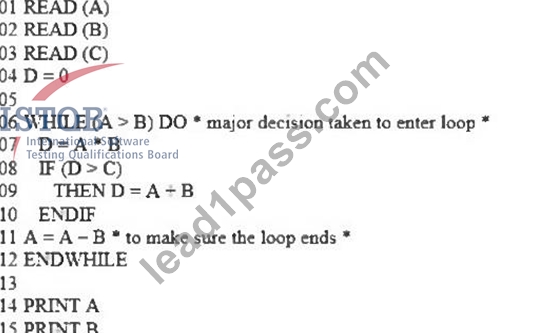
The comment frequency of the code fragment is 13%.
To which non-functional quality characteristic does a good level of comment frequency especially contribute?
- A. Usability
- B. Performance Efficiency
- C. Maintainability
- D. Portability
Answer: C
Explanation:
The comment frequency in a code fragment relates to the number of comments in relation to the code size. A good level of comment frequency can significantly contribute to the maintainability of the software. Maintainability is a non-functional quality characteristic that refers to the ease with which a software system can be modified to correct defects, update features, improve performance or other attributes, or adapt to a changed environment. Comments in the code help developers understand the logic, purpose, and functionality of the code, which is crucial when modifications are required. This does not directly contribute to portability, usability, or performance efficiency, which are concerned with different aspects of the software's operation and user interaction.
NEW QUESTION # 35
Which statement correctly describes continuous testing'
SELECT ONE OPTION
- A. Each new build of the system triggers a pre-defined set of tests to be executed automatically.
- B. Each modification made to the system is automatically tested and then automatically made implemented in live
- C. Each modification made to the system triggers the tests that cover that change to be executed automatically.
- D. Each new build of the system triggers deployment into a testing environment.
Answer: A
Explanation:
The correct description of continuous testing is that each new build of the system triggers a pre-defined set of tests to be executed automatically. This approach ensures that any changes or additions to the system are immediately validated, helping to catch issues early and streamline the development process .
NEW QUESTION # 36
Which of the following defect types is NOT an example of a defect type typically found with API testing?
- A. High architectural structural complexity
- B. Loss of transactions
- C. Timing problems
- D. Data handling issues
Answer: A
Explanation:
In the context of API testing, the defect types generally found are related to the specific interactions with the API, such as issues with data formatting, handling, validation, and the sequencing or timing of API calls.
Architectural structural complexity is not typically a defect that would be identified at the API testing level.
API tests are concerned with the interface and immediate integration points, not the overarching system architecture, which would be more relevant to design or system-level testing.
NEW QUESTION # 37
Your team is now accountable for the support and enhancement of a payroll system that has been in production for many years and modified by many different developers. It has been noticed by management that small functional enhancements take much longer than equivalent changes on more recently developed systems. You have been tasked with implementing improved testing approaches that will help to identify the root cause of this problem.
Which of the following is the best technique to apply in this scenario?
- A. Orthogonal arrays
- B. Static analysis
- C. Data flow analysis
- D. Exploratory analysis
Answer: B
Explanation:
Static analysis is the best technique for identifying the root causes of issues in a legacy system where small functional enhancements take disproportionately long to implement. This technique involves examining the code without executing it to detect potential vulnerabilities, coding errors, and complexities. Static analysis can highlight problematic code segments and inefficient coding practices that may contribute to the increased time required for implementing changes, thereby assisting in addressing these systemic issues efficiently.
NEW QUESTION # 38
Which of the following is true regarding maintainability?
- A. This factor becomes more Important the longer the system remains in the production environment
- B. This factor affects resource utilization
- C. This factor Is critical for the initial success of the product launch
- D. This factor will influence the performance of the system
Answer: A
Explanation:
Maintainability refers to how easily software can be maintained over time to correct faults, improve performance, or adapt to a changed environment. This quality factor becomes increasingly important the longer the system remains in the production environment because as systems age, they often require updates and modifications to continue meeting user needs effectively. This factor is critical for ensuring the system can be efficiently updated without causing downtime or significant expense.
NEW QUESTION # 39
Given the following pseudocode:
Program tax check
Integer: tax_rate
real: tax%
BEGIN
tax% := 0
GET (tax_rate)
WHILE tax_rate > 0 loop
IF tax_rate > 3 THEN
tax_rate := 3
ENDIF
tax% := tax% + (tax_rate / 10)
tax_rate := tax_rate - 1
ENDLOOP
IF tax% > 0.6 THEN
print ("tax rate is high")
ELSEIF tax% < 0.1 THEN
print ("tax rate is zero")
ELSE
print ("tax rate is low")
ENDIF
END tax check
If control flow analysis is performed on the pseudocode, which of the following results is MOST likely?
- A. No unreachable code
- B. Unreachable code at line 15
- C. Unreachable code at line 17
- D. Infinite loop from line 7 to line 13
Answer: C
Explanation:
Program tax check
Integer: tax_rate
real: tax%
BEGIN
tax% := 0
GET (tax_rate)
WHILE tax_rate > 0 loop
IF tax_rate > 3 THEN
tax_rate := 3
ENDIF
tax% := tax% + (tax_rate / 10)
tax_rate := tax_rate - 1
ENDLOOP
IF tax% > 0.6 THEN
print ("tax rate is high")
ELSEIF tax% < 0.1 THEN
print ("tax rate is zero")
ELSE
print ("tax rate is low")
ENDIF
END tax check
Explanation of Control Flow:
* Initialization:
* tax% := 0
* Get Tax Rate:
* GET (tax_rate)
* While Loop:
* Loop runs while tax_rate > 0.
* Inside the loop:
* If tax_rate > 3, set tax_rate to 3.
* Update tax% by adding tax_rate / 10.
* Decrement tax_rate by 1.
* Post-Loop Condition Checks:
* After the loop, check the value of tax%:
* If tax% > 0.6, print "tax rate is high".
* Else if tax% < 0.1, print "tax rate is zero".
* Otherwise, print "tax rate is low".
Unreachable Code Analysis:
* The ELSEIF tax% < 0.1 THEN condition (line 17) is unreachable.
* In the loop, tax% is incremented by a minimum of 0.1 each time tax_rate is greater than 0.
* Therefore, tax% cannot be less than 0.1 after the loop.
Conclusion:
* Line 17 (ELSEIF tax% < 0.1 THEN) will never be true given the logic of the loop.
NEW QUESTION # 40
What is the common name for a type of automated testing technique that separates test input data and expected test results from the control script used to execute all of the tests?
- A. Behavior-based testing
- B. Model-driven testing
- C. Data-based testing
- D. Keyword-driven testing
Answer: D
Explanation:
The common name for the automated testing technique that separates test input data and expected results from the control script is Keyword-driven testing. In this approach, test scripts are written using keywords related to the application under test, which are easy to read and can be interpreted by a script engine to perform testing actions.
* Explanation: This methodology allows for the reusability of scripts and easier maintenance because the test data and the scripts that use the data are maintained separately.
NEW QUESTION # 41
You have identified existing test cases that require re-factoring, Which is the NEXT task you should perform?
SELECT ONE OPTION
- A. Adjust the observable behavior of the tests to meet the user stories
- B. Make changes to the internal structure of the tests to improve maintainability
- C. Analyze the Impact of the functionality of the current iteration on the existing regression tests
- D. Re run the tests to ensure that the test results remain the same
Answer: B
Explanation:
Once existing test cases have been identified for refactoring, the next step is typically to make changes to the internal structure of these tests to improve their maintainability. This involves revising the code or scripts to make them cleaner, more efficient, and easier to understand, which helps in maintaining them over time as the software evolves. This process may also involve updating test data or dependencies to ensure that the tests remain robust and reliable .
NEW QUESTION # 42
Which of the following are activities that the Technical Test Analyst performs when setting up a test automation project?
1.Schedule the manual testing
2.Define interface requirements between tools
3.Perform a code review on the functional specifications
4.Determine whether to use a rule-dnven approach
5.Tram the test analysts to use and supply the data
- A. 1.4
- B. 2,5
- C. 3. 5
- D. 1.2
Answer: B
Explanation:
In setting up a test automation project, the Technical Test Analyst performs activities such as defining interface requirements between tools and training the test analysts to use and supply the data. These activities are crucial for ensuring that the automation tools are effectively integrated and that the team is capable of utilizing these tools efficiently.
NEW QUESTION # 43
You are working on a project to develop an application that allows users to collaborate via bespoke, online whiteboards. The first release, delivering core functionality, highlighted misunderstandings of the user stories between testers, developers and the product owner during sprint development Since that release, the developers have agreed to implement a TDD approach for future software development.
Creation of the product backlog for the second release is underway and you have recommended to the project stakeholders that an atdd approach be adopted for the backlog's user stories. What would be a GOOD REASON for making this recommendation?
SELECT ONE OPTION
- A. The test strategy states that automation shall be used to minimize effort for execution of acceptance tests
- B. The team wants to start using BDD and therefore atdd must also be used
- C. TDD can only work effectively when an ATDD approach is used for the user stories use of attd examples will help address the misunderstandings encountered in release 1
Answer: C
Explanation:
Adopting an Acceptance Test-Driven Development (ATDD) approach can be particularly beneficial in scenarios where previous releases have suffered from misunderstandings among the development team and stakeholders regarding user story requirements. ATDD involves creating executable specifications before coding begins, which clarifies expectations and ensures alignment across the team. This method helps prevent issues seen in earlier stages by providing a clear, agreed-upon criteria for acceptance, thereby reducing the chances of future misunderstandings .
NEW QUESTION # 44
Which of the following test categories would best characterize a test designed to confirm that the data backup tapes stored offsite by a bank can be retrieved and loaded within the business process service level agreement?
- A. Reliability testing
- B. Continuity testing
- C. Hazard testing
- D. Security testing
Answer: B
Explanation:
Testing that focuses on confirming that data backup tapes can be retrieved and loaded within specified service levels is classified as Continuity Testing. This type of testing ensures that business processes can continue after a disruption, such as data loss or system failure.
* Explanation: Continuity testing specifically addresses scenarios where operational capacity must be restored and verified within business continuity planning frameworks, such as disaster recovery processes.
NEW QUESTION # 45
You are reviewing the following Java function that determines whether a number input by the user is even or odd:
import java.util.Scanner;
public class OddOrEven {
public static void main(String[] args) {
Scanner reader = new Scanner(System.in);
System.out.print("Please enter a number: ");
int number = reader.nextInt();
if (number % 2 == 0) {
System.out.println("Your input number '" + number + "' is even.");
} else {
System.out.println("Your input number '" + number + "' is odd.");
}
}
}
You are guided by the following checklist:
*All variables must start with a Capital letter
*All output messages must start with a Capita letter
*There must be a clear comment when explaining the purpose of the dress
How many checklist items Mve been fuelled7
SELECT ONE OPTION
- A. 0
- B. 1
- C. None
- D. 2
Answer: D
Explanation:
Only one of the checklist items has been fulfilled in the Java function provided. Option C is correct.
* Checklist Review:
* Capitalization of Variables: The variable 'Number' does start with a capital letter, fulfilling this checklist item.
* Capitalization of Output Messages: The output messages do not start with a capital letter following the prompt text (e.g., 'your input number...'), failing this checklist item.
* Comment Line: There is no comment line explaining the purpose of the class or method, failing this checklist item.
Thus, only the requirement regarding the capitalization of the variable is met, indicating a partial adherence to the specified coding standards .
NEW QUESTION # 46
You are working for a video game manufacturer You have a new title being released Market interest in the product is at an all time high and everyone in the company has been promised huge bonuses if the launch is successful You are responsible for portability testing Which area, m particular should you emphasize in your testing?
- A. Replaceability
- B. Installability
- C. Learnability
- D. Analyzability
Answer: B
Explanation:
In portability testing for a video game that is anticipated to be highly popular, the key area to emphasize is installability. This involves ensuring that the game can be successfully installed across different platforms and configurations that potential players might use. Focusing on installability helps minimize technical barriers to entry, crucial for a successful launch and widespread adoption of the game .
NEW QUESTION # 47
The following user story has been written for a new application being developed to pre-book a space at a National Car Park.
As a vehicle driver
i want to be able to pre-book a car parking space online, selecting a disabled driver's space if needed So that l can pay in advance and receive confirmation of my parking space number.
The following acceptance criteria have also been written:
*Payment can be made via PayPal, Debit or Credit Card
*Confirmation of payment and car parking details should be sent after the booking process is completed
*Driver information is stored in the reservation database
The database has been built and tested in a previous sprint, but the interface to the different payment methods have yet to be developed As a tester in an agile team, you have been asked to review the user story You have detected some issues with this story:
1.it needs to cater for different user groups: a driver or disabled driver
2.it needs to cater for different vehicle types: a car. 4x4. van or motorbike
3.There are no acceptance criteria relating to how quick the booking process should be
4.How confirmation is to be sent for payment and space number, and other important details, have not been specified
5.A stub will be needed to test the payment method
Which pair of requirements engineering techniques are you MOST LIKELY to have used to uncover these issues' SELECT ONE OPTION
- A. Story Mapping and use Cases
- B. Personas and Diagrams
- C. Diagrams and Story Mapping
- D. Storyboards and Personas
Answer: D
Explanation:
The most likely pair of requirements engineering techniques used to uncover the issues mentioned with the user story would be "Storyboards and Personas." This approach allows for a visual and persona-based exploration of how different users (such as drivers of different vehicle types and disabled drivers) would interact with the system. This technique helps in uncovering varied user needs and ensuring that all critical user interactions are considered during the development process.
NEW QUESTION # 48
......
Try Free and Start Using Realistic Verified CTAL-TTA Dumps Instantly.: https://simplilearn.lead1pass.com/ISTQB/CTAL-TTA-practice-exam-dumps.html